Credit Score & Reports Financial Education Personal Finance

Separating Fact from Fiction: 7 Common Credit Score Myths in Canada

In the world of personal finance, your credit score is often treated like a secret “grade” that determines your worthiness for a home, a car, or a loan. Because it’s so important, it’s also surrounded by myths and old wives’ tales that can actually end up hurting your financial progress.

At LendingMoney.ca, our goal is Credit Rehabilitation. We want to pull back the curtain on how credit really works so you can stop worrying and start building. Here are seven of the most common credit score myths debunked.

Myth #1: Checking my own credit score will lower it.

The Fact: Checking your own credit score is considered a Soft Inquiry (or a soft hit), and it has zero impact on your score.

In fact, we encourage you to check it regularly! Monitoring your score through services like Equifax, TransUnion, or third-party apps helps you spot errors or signs of identity theft early. The only checks that lower your score are “Hard Inquiries,” which happen when a lender pulls your report to approve you for a new credit card or loan.

Myth #2: Carrying a balance on my credit card helps my score.

The Fact: This is one of the most expensive myths out there. You do not need to pay interest to have a good credit score.

Lenders want to see that you use your credit and pay it off. Carrying a balance month-to-month doesn’t help your score; it just costs you money in high interest. The best strategy for your score is to pay your balance in full every month. This keeps your Credit Utilization Ratio low, which accounts for about 30% of your total score.

Myth #3: If I have a high income, I’ll have a high credit score.

The Fact: Your salary is not part of your credit score calculation.

You could earn $200,000 a year and have a poor credit score if you miss payments or max out your cards. Conversely, someone with a modest income can have a perfect 850 score by managing their debts responsibly. While your income is very important to lenders when they calculate your “Debt-to-Income” ratio for a mortgage, it doesn’t move the needle on your three-digit credit score.

Myth #4: I should close old credit cards I don’t use anymore.

The Fact: Closing an old account can actually lower your score.

There are two reasons for this:

  1. Length of History: 15% of your score is based on the age of your accounts. Closing your oldest card makes your credit history look shorter (and “younger”) than it actually is.
  2. Available Credit: Closing a card reduces your total available credit limit. If you have a balance on other cards, your utilization percentage will suddenly spike, which looks risky to lenders.

Myth #5: Paying off a debt removes it from my credit report.

The Fact: Negative information (like a late payment or a collection) usually stays on your report for 6 to 7 years.

Paying off a collection account is great – it changes the status to “Paid,” which looks much better to a human lender – but it doesn’t make the history of that collection disappear instantly. The key to “Credit Rehabilitation” is to start making on-time payments now so that the positive recent history outweighs the old mistakes.

Myth #6: Debit cards help build my credit score.

The Fact: Using a debit card has no impact on your credit.

When you use a debit card, you are spending your own money from a chequing account. Credit scores only track how you manage borrowed money. If you are trying to build credit from scratch or rebuild after a tough period, you need a “tradeline” like a secured credit card or a small installment loan that reports to the bureaus.

Myth #7: A divorce automatically separates our credit scores.

The Fact: Credit scores are always individual, but joint accounts stay joint until they are closed.

A divorce decree might say your ex-spouse is responsible for the joint car loan, but the bank doesn’t care. If your name is still on that loan and your ex-spouse misses a payment, your credit score will take the hit. When separating finances, it is crucial to pay off, close, or refinance joint accounts into single names.

Why Understanding the Truth Matters

At LendingMoney.ca, we see these myths every day. Clients often wait to apply for help because they are afraid of a “hit” to their score, not realizing that the high-interest debt they are carrying is doing far more damage every single month.

Our Credit Rehabilitation approach is about more than just money – it’s about education. When you understand the rules of the game, you can win.

Ready to stop guessing and start growing? [Apply with Ease] and let our Financial Heroes help you build a plan based on facts, not myths.

Read Blog – The Truth Behind the Curtain: Myths vs. Realities of Private Lending
Debt Management Debt Relief Personal Finance

The R7 Survival Guide: Navigating Travel Hotels and Rentals Without a Traditional Credit Card

When you file a Consumer Proposal, the immediate relief from debt is life-changing. But shortly after, the “R7 reality” sets in. In Canada, an R7 rating usually means you’ve surrendered your traditional credit cards.

Suddenly, the world feels a lot less “convenient.” You go to book a weekend getaway or rent a car for a business trip, and you hit a wall. “We require a major credit card for security,” the clerk says.

Does an R7 mean you’re grounded for the next few years? Not at all. At LendingMoney.ca, we help our clients navigate these exact “speed bumps.” Here is the reality of living with an R7 and the workarounds you need to stay mobile.

1. The Hotel Hard Line: Why Debit No Longer Cuts It

In years past, you might have found a hotel willing to take a cash or debit deposit. In 2026, those days are virtually over. Most major Canadian hotel brands (Marriott, Hilton, Delta, etc.) have moved to “Credit Only” policies for check-in.

The R7 Reality: Even if you have $5,000 in your bank account, the front desk computer is programmed to require a pre-authorization on a credit card.

  • The “No-Go” Scenario: You arrive after a long flight, show your ID and your Visa Debit card, and the clerk tells you they cannot “open the room” without a credit card on file. Without a card, you are literally locked out of your reservation, often with no refund.
  • Why they do it: A debit card is “real money,” but a credit card is a “guarantee.” Hotels need the ability to charge for damages discovered after you’ve checked out. Their systems are built to verify a credit line, not a bank balance.
  • The Survival Tip: This is where the Secured Credit Card becomes your most essential piece of luggage. Because it is a genuine Mastercard or Visa (not a “Prepaid” or “Debit” card), the hotel system recognizes it as a valid credit instrument. Without this tool, your R7 rating can turn a business trip into a travel nightmare.

2. Car Rentals: The Credit Card Gatekeeper

If you think hotels are strict, car rental agencies are the ultimate gatekeepers. To a rental company, you aren’t just a guest; you are a person driving away with a $40,000 piece of machinery.

The R7 Reality: While some local “off-brand” agencies might entertain a massive cash deposit, every major airport rental counter in Canada now mandates a major credit card in the driver’s name.

  • The “Denied” Rental: You can book and pay for a car online using a debit card, but when you stand at the counter to get the keys, they will ask for a credit card for the security hold. No credit card? No car. They will cancel your booking on the spot.
  • The Survival Tip: Don’t rely on “Visa Debit.” In 2026, rental systems are more sophisticated and can instantly detect that a card is linked to a bank account rather than a credit line. You must have a Secured Credit Card with an embossed name that matches your driver’s license.

3. The Prepaid Trap: Why It’s Not a Solution

Many people in a Consumer Proposal try to use “Prepaid” cards (like those you buy at a grocery store or a gas station).

The R7 Reality: These are almost universally rejected by hotels and car rentals.

  • The Reason: These cards lack a “Name” field and aren’t tied to a person’s identity. Since the hotel can’t “verify” the person holding the card, they won’t accept it for security.
  • The Hero Solution: At LendingMoney.ca, we emphasize getting a Named Secured Card. It looks, feels, and “swipes” exactly like a high-limit bank card. It bridges the gap between your R7 reality and the requirements of the modern world.

4. Why the Hold Still Matters (Even on Credit)

Even when you have a secured card, you have to be strategic.

  • The Math: If your secured card has a $500 limit and you use it to check into a hotel, they might put a $400 hold on it for the stay plus incidentals.
  • The Result: You now only have $100 left of “spendable” credit until you check out and that hold is released (which can take 3–5 days).
  • The Survival Tip: Always “over-fund” your secured card before a trip. If you know you’re traveling, increase your security deposit to $1,000 or $1,500 so you don’t find your card “Maxed Out” by a simple hotel hold.

5. The Hero Tool: The Branded Secured Credit Card

This is why we advocate for Credit Rehabilitation starting immediately after you file your proposal.

The R7 Reality: A “Prepaid” card (like a vanilla Visa gift card) will not work for hotels or car rentals because it doesn’t have your name embossed on it.

  • The Solution: You need a Secured Credit Card (like Neo or Capital One). Because these are technically “Real” Mastercards or Visas, they are accepted by 99% of hotels and car rental agencies.
  • The Benefit: Since you provide the deposit upfront, the bank isn’t taking a risk, but the merchant sees a “Major Credit Card.” It solves the “no-card” problem while simultaneously rebuilding your score.

6. Online Shopping and “Hidden” Fees

Living with an R7 in 2026 means becoming a master of the Visa Debit.

  • The Reality: Most online retailers (Amazon, Uber, SkipTheDishes) treat Visa/Mastercard Debit exactly like a credit card.
  • The Risk: Subscriptions. If you have an R7, you don’t have a “credit cushion.” If an automated subscription (like Netflix or a gym membership) hits your account when you’re low on funds, you’ll be hit with an NSF (Non-Sufficient Funds) fee from your bank—often $45 or more.
  • The Survival Tip: Use a separate “Bills” account. Keep your “Spending” money on your debit card and keep your “Bill” money in a secondary account that isn’t attached to your tap-to-pay.

7. Travel Insurance: The Missing Safety Net

Most people don’t realize that their old “Gold” or “Infinite” credit cards provided free travel and rental car insurance.

The R7 Reality: When you lose those cards, you lose the insurance. If you decline the “Loss Damage Waiver” at the car rental counter because you think your card covers it, you are uninsured.

  • The Survival Tip: You must buy the insurance at the counter or through a third-party provider like CAA. It adds $20–$30 a day to your trip, but with an R7, you cannot afford a $20,000 bill for a fender bender.

Why Survival is Only Temporary

Living with an R7 requires more planning, more cash-on-hand, and a bit more patience at the checkout counter. But remember: this is a phase of Credit Rehabilitation.

At LendingMoney.ca, we don’t just want you to “survive” your R7 years; we want you to use them to build a foundation. By using a secured card correctly and managing your debit account perfectly, you are proving to the world that you are ready for an R1 rating again.

Tired of the “No Credit Card” struggle? [Talk to a Financial Hero] at LendingMoney.ca. We’ll help you find the right secured tools to make your day-to-day life feel “normal” again.

Debt Management Personal Finance

Homeownership and Insolvency: How a Consumer Proposal Affects Your Mortgage

One of the biggest fears homeowners face when considering debt relief is: “Will I lose my house? The short answer is no. In fact, a Consumer Proposal is often the very tool that saves a home by freeing up the cash flow needed to keep the mortgage current. However, while you keep the house, the “R7” rating on your credit report changes the rules of the game when it comes time to renew or refinance. Here is how a Consumer Proposal affects your mortgage in 2026.

1. Existing Mortgages: Business as Usual

A Consumer Proposal only deals with unsecured debt (credit cards, lines of credit, tax debt). Your mortgage is a secured debt. As long as you continue to make your mortgage payments on time, your lender generally cannot cancel your mortgage just because you filed a proposal.

2. The Renewal Reality

When your mortgage term ends, you have to renew. Here is where the impact of a Consumer Proposal is felt:

  • Renewing with Your Current Lender: If your mortgage is in good standing (no missed payments), most major banks will offer you an “automatic renewal” without a new credit check. However, you likely won’t be able to negotiate for their best “promotional” rates.
  • Switching Lenders: This is the challenge. If you try to move your mortgage to a new bank to find a better rate, they will pull your credit. If they see an active Consumer Proposal, they will likely decline the application unless you have significant equity or move to an Alternative (B) Lender.

3. Refinancing to Pay Off the Proposal

Many homeowners use their house as a “hero tool.” If your home has increased in value, you can often refinance your mortgage to pull out equity and pay off your Consumer Proposal in one lump sum.

  • The Benefit: This gets you a “Certificate of Full Performance” immediately, which starts the 3-year clock to clear your credit report much sooner.
  • The 2026 Rule: Most lenders will require you to have at least 20% equity remaining in the home after the refinance.

4. Buying a New Home After a Proposal

Can you buy a house after filing a proposal? Yes.

  • While in the Proposal: You will likely need a 20% down payment and an alternative lender with higher interest rates.
  • After Completion: Most “A” Lenders (Big Banks) want to see that your proposal has been completed for at least 2 years, and that you have rebuilt your credit with at least two new “tradelines” (like a secured card and a small installment loan).

5. The Equity Trap

If you have a massive amount of equity in your home (e.g., you owe $200k on a $800k home), your creditors might notice. They may demand a higher monthly payment in your proposal because they know you have assets. A Licensed Insolvency Trustee will help you structure the proposal so it is fair to creditors while still being affordable for you.

Final Thoughts: Protecting Your Largest Asset

A Consumer Proposal is not a threat to your home; it is a shield. By legally settling your credit card debt for cents on the dollar, you ensure that your mortgage – and your family’s roof – remains the top priority.

Worried about an upcoming mortgage renewal? [Talk to LendingMoney.ca]. We specialize in the “B-Lending” market and can help you navigate your mortgage options while in a Consumer Proposal.

Debt Management Personal Finance

Trapped in a High-Interest Private Mortgage? Here’s Your 2026 Exit Strategy

Power of Sale, pay off a large CRA debt, or bridge a gap while self-employed. But a private mortgage is like a spare tire: it’s designed to get you to the repair shop, not to drive on for years.

In 2026, many Ontario homeowners are finding that their “temporary” private loans have become permanent weights. If you’re paying 12% or higher interest plus monthly fees, you’re likely not making a dent in your principal. At LendingMoney.ca, we specialize in the “Private-to-Bank Pivot.” Here is how to renegotiate your position and lower your rates.

1. Why You Need an Exit Strategy Now

In 2026, the Bank of Canada has stabilized rates around 2.25%, meaning “B-Lenders” (Trust Companies) are offering rates in the 5% to 6% range.

  • The Cost of Waiting: If you have a $500,000 private mortgage at 12%, you are paying $5,000 per month in interest alone.
  • The B-Lender Alternative: Moving that same loan to a B-Lender at 5.9% would drop your interest cost to roughly $2,450 per month.
  • The Result: That’s $2,550 per month back in your pocket—money that could be used to actually pay off your home.

2. Step 1: The Mid-Term Credit Audit

Most private mortgages have 12-month terms. The biggest mistake homeowners make is waiting until month 11 to think about an exit.

  • The LendingMoney.ca Approach: We start your Credit Rehabilitation on Day 1. If you took a private loan because of a low credit score, we use the first 6 months of that term to ensure your “tradelines” (credit cards and small loans) are being paid perfectly.
  • The Goal: To move to a B-Lender, you generally need a credit score of 550–600. To move back to an A-Lender (Bank), you need 680+. We track your progress to ensure you hit these benchmarks before your private loan expires.

3. Step 2: Income Storytelling

Many people are in private mortgages because they are self-employed and the bank didn’t “understand” their income.

  • The Renegotiation: At LendingMoney.ca, we don’t just send your tax returns to a lender. We package your bank statements, contracts, and business growth plans.
  • The 2026 Shift: In today’s market, alternative lenders are much more willing to look at “Gross Revenue” rather than “Net Income.” We use this to prove you can handle a lower-interest institutional loan.

4. Step 3: The Equity Appraisal Update

In 2026, home values in Ontario have stabilized. If your home has increased in value since you took your private mortgage, your Loan-to-Value (LTV) ratio has improved.

  • Why LTV Matters: Private lenders take the highest risk, so they charge the highest rates. As your equity grows, your risk profile drops.
  • The Move: We order a new appraisal to show that you now have 25% or 30% equity. This “unlocks” the door to B-Lenders who require a 20% equity stake but offer rates that are half of what you’re currently paying.

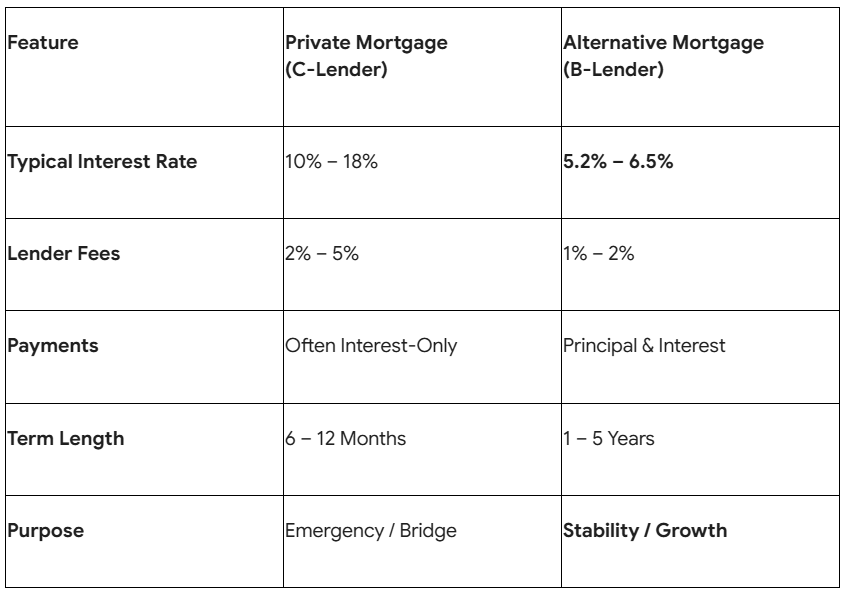
Private vs. B-Lender Comparison (2026)

5. How LendingMoney.ca Renegotiates for You

When you work with a Financial Hero at LendingMoney.ca, we act as your advocate. We don’t just wait for your private lender to send a renewal notice (which often comes with a massive “Renewal Fee”).

  1. We Negotiate the Add-Backs: We argue for your business expenses and one-time costs to be added back to your income, qualifying you for better rates.

We Manage the Paperwork: Moving from a private individual to a regulated institution requires a lot of documentation. We handle the heavy lifting so you don’t have to.

Don’t Renew Your Stress-Refinance Your Future

A private mortgage renewal notice is a wake-up call. Don’t just sign it and accept another year of high interest. Use the equity you’ve built to “graduate” to a better class of lender.

Is your private mortgage term coming to an end? [Request a Private-to-Bank Analysis] from LendingMoney.ca today. Let’s see how much we can drop your rate and start your journey back to the bank.

Debt Management Personal Finance

Consumer Proposal vs. Debt Consolidation Loan: Which is Your Hero Move?

When you’re buried under high-interest debt, the goal is always the same: find a way out. In the Canadian financial landscape of 2026, two primary paths emerge: the Debt Consolidation Loan and the Consumer Proposal.

While they might sound similar – both result in one monthly payment – they are fundamentally different tools. Choosing the wrong one could cost you thousands of dollars or years of unnecessary stress. At LendingMoney.ca, we’re here to help you weigh the pros and cons so you can make an informed decision for your financial future.

The Debt Consolidation Loan: The Refinance Strategy

A debt consolidation loan is a new personal loan used to pay off all your smaller, high-interest debts (like credit cards). You are essentially moving your debt from several “expensive” places to one “cheaper” place.

The Pros:

  • Protects Your Credit Score: As long as you make your payments on time, your credit score usually stays stable or even improves as your credit utilization drops.
  • Total Control: You aren’t entering a legal process. You maintain your relationship with your bank and keep your current credit limits (though we recommend closing them to avoid re-spending!).
  • Simplified Life: One due date, one interest rate, and a clear “end date” for your debt.

The Cons:

  • Harder to Qualify: In 2026, lenders have tightened their belts. To get a rate low enough to make consolidation worth it, you typically need a credit score of 680 or higher.
  • No Debt Reduction: You still owe 100% of the principal. If you owe $40,000, you are still paying back $40,000 plus interest.
  • The “Debt Trap” Risk: If you don’t change your spending habits, you might end up with a consolidation loan plus new credit card balances.

The Consumer Proposal: The Settlement Strategy

A Consumer Proposal is a legal agreement where you offer to pay your creditors a percentage of what you owe, interest-free, over a period of up to five years.

The Pros:

  • Principal Reduction: You can often reduce your total debt by 50% to 80%. If you owe $40,000, you might only pay back $12,000.
  • Legal Protection: The moment you file, all interest stops, and creditors are legally forbidden from calling you or garnishing your wages.
  • No Interest: Every dollar you pay goes directly toward the principal.

The Cons:

  • Credit Impact: It carries an R7 rating on your credit report. This will make it difficult to get traditional low-interest loans for a few years.
  • Public Record: It is a formal insolvency proceeding.
  • The “R7” Footprint: It stays on your credit report for 3 years after you finish the payments (or 6 years after you start, whichever is sooner).

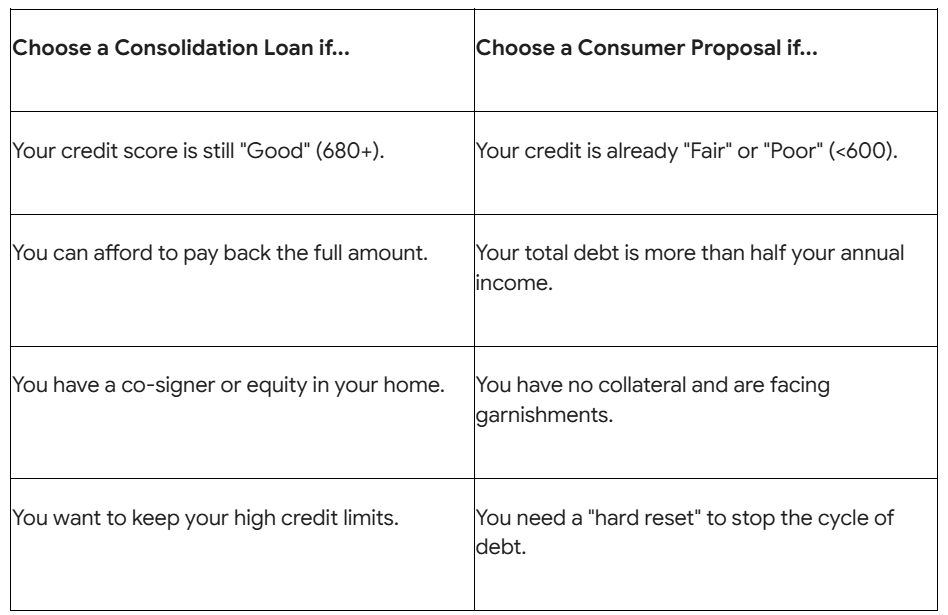
Which One is Right for You?

The LendingMoney.ca Verdict

At LendingMoney.ca, we don’t believe in a one-size-fits-all approach. If you have the credit to qualify, a Consolidation Loan is a fantastic way to save on interest while keeping your credit score pristine. However, if the math simply doesn’t add up and you’ll be in debt for the next 20 years, a Consumer Proposal is the more heroic choice for your long-term health.

Confused about which path to take? [Speak with a Financial Hero] today. We’ll run the numbers with you and find the strategy that fits your 2026 goals.