Blogs Mortgage Renewal Mortgages Private Lending

Fixing Your Credit While in a Private Mortgage

A private mortgage is often described as a “bridge.” But a bridge is only useful if it leads somewhere. If you are in a private mortgage in 2026, your primary goal is to use this 12-month window to rehabilitate your credit so you can “graduate” to a lower-interest bank or B-lender.

At LendingMoney.ca, we don’t want you to stay in a private loan forever. We want to help you fix the issues that put you there in the first place. Here is your month-by-month guide to Credit Rehabilitation while using a private mortgage.

1. The Private Mortgage Reporting Reality

In 2026, most individual private lenders do not report to Equifax or TransUnion.

  • The Problem: Even if you make every payment on time for a year, your credit score might not go up because the bureaus don’t see the “good behavior.”
  • The Hero Move: You must focus on your other tradelines. Since the mortgage isn’t helping your score, your credit cards, car loans, and phone bills have to do the heavy lifting.
  • The Catch: While private lenders don’t report the “good,” they will certainly report the “bad” if they have to take legal action (Power of Sale). On-time payments are mandatory to protect your equity.

2. Eliminate “R9” and “R7” Ghost Debts

If you took a private mortgage to consolidate debt, you likely have old collections (R9) or settled accounts (R7) on your report.

  • The Strategy: Use a small portion of your mortgage “holdback” or savings to pay off any remaining small collections.
  • The 2026 Rule: A “Paid Collection” is significantly better than an “Active Collection” when applying for a B-Lender. It shows the underwriter that you have cleared the wreckage of the past.

3. The 10% Utilization Rule

The fastest way to jump your score while in a private mortgage is to change how you use your credit cards.

  • The Math: If you have a $5,000 limit, never let the balance exceed $500 (10%) on the day the statement is produced.
  • The Hero Move: In 2026, many apps allow “Real-Time Reporting.” Pay your credit card balance every time you get paid (bi-weekly) rather than once a month. This keeps your “average utilization” extremely low, which is the #1 “Point Booster” in the Equifax algorithm.

4. Add Two “Fresh” Tradelines

To get back to a traditional bank, you usually need a “2-2-2” profile: 2 years of history on 2 lines of credit with at least $2,000 limits.

  • The Strategy: If your old cards were closed during a Consumer Proposal or bankruptcy, open two new Secured Credit Cards immediately.
  • The Timeline: By the time your 12-month private mortgage is up, these cards will have 12 months of perfect history, making you an ideal candidate for a B-Lender (Trust Company).

5. Diversify with a “Credit Builder” Loan

In 2026, lenders like seeing a mix of credit types. If you only have credit cards, your score will plateau.

  • The Move: Open a small Installment Credit-Builder Loan (like those offered by Nyble or KOHO).
  • How it works: You pay a small amount monthly ($20–$50), and they report it as a “Personal Loan” payment. This adds “Credit Mix” to your profile, which accounts for 10% of your total score.

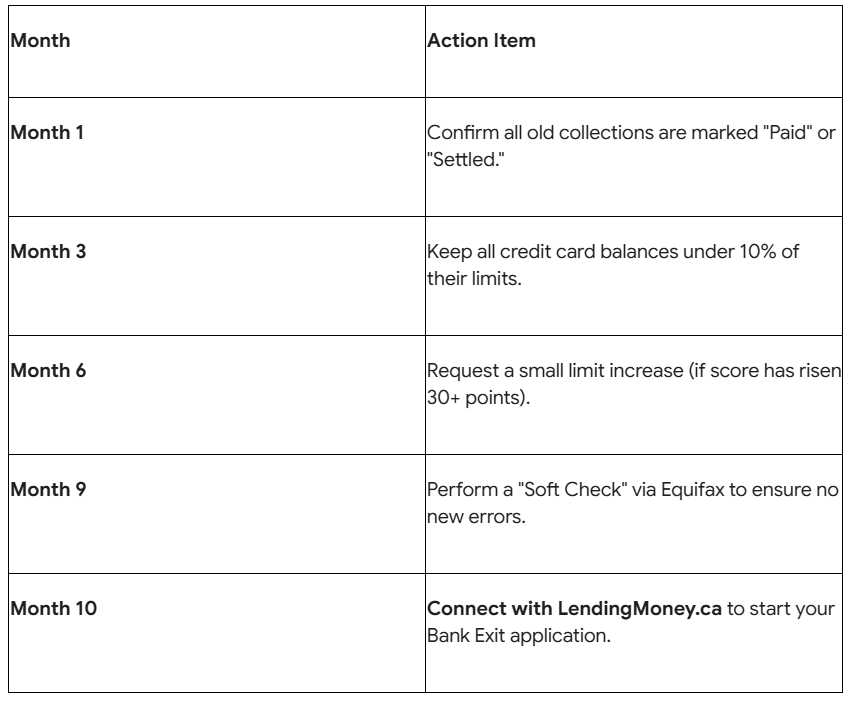
Your 12-Month Credit Rehab Calendar
The Goal: Graduation Day

Fixing your credit while in a private mortgage requires discipline. You are paying a higher interest rate now so that you never have to pay it again. At LendingMoney.ca, we provide the tools and the coaching to ensure that when your private term ends, you are ready for a prime-rate mortgage.

Currently in a private mortgage and want to see your “Graduation Date”? [Get a Free Credit Rehabilitation Roadmap] from LendingMoney.ca today and let’s start moving you back to the bank.

Read blog – Breaking the Cycle: A Guide to Loans for Debt Consolidation with Poor Credit
Alternative Lending Blogs Mortgage Renewal Private Mortgages

The Silent Equity Killer: How to Avoid Private Mortgage Renewal Fees

If you have a private mortgage, you probably remember the “Lender Fee and Broker Fee you paid to get it. What many homeowners don’t realize is that most private lenders charge those fees every single year you stay with them.

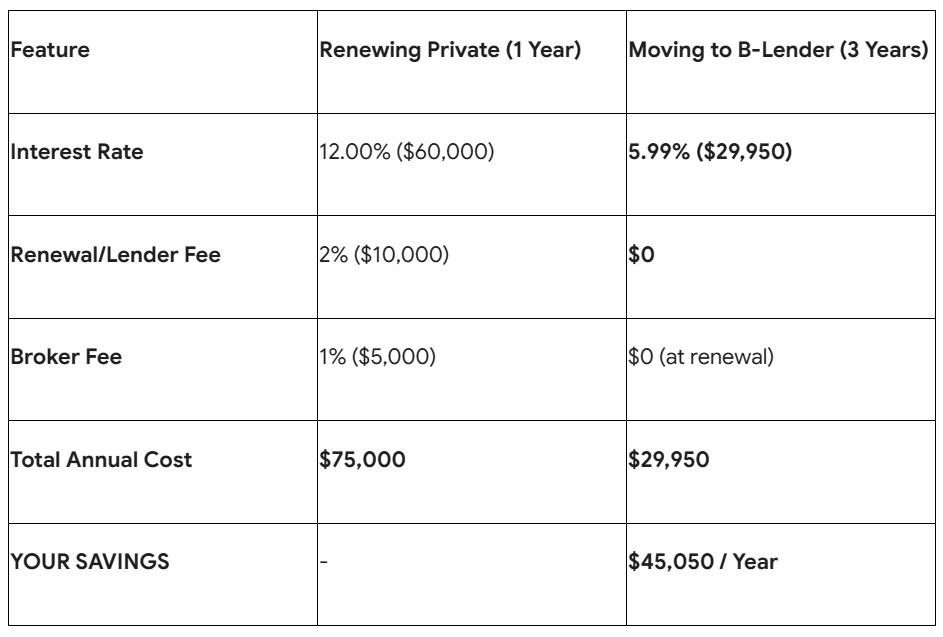
In 2026, with private interest rates already sitting between 10% and 15%, adding a 2% renewal fee means you are effectively paying an APR of nearly 17%. If you have a $500,000 mortgage, that’s $10,000 vanished in a single signature. Here is how to stop the bleed.

1. The 120-Day Rule (Start Before They Do)

Private lenders count on you being “trapped.” They often send your renewal notice just 21 to 30 days before the term ends, leaving you with no time to find an alternative.

  • The Hero Move: Start your search 4 months (120 days) before your maturity date.
  • The LendingMoney.ca Advantage: We track your maturity date from day one. At the 4-month mark, we perform a “Financial Health Check” to see if your Credit Rehabilitation is far enough along to move you to a B-Lender or a Credit Union where there are zero renewal fees.

2. Leverage Your Improved Story

A private lender charges a renewal fee because they claim the “risk” is still high. You need to prove them wrong.

  • Show the Progress: Since you took the private loan, have you paid off a collection? Has your income increased? Have you made every private mortgage payment on time?
  • The Negotiation: At LendingMoney.ca, we use these “wins” to negotiate. We tell the lender: “Our client’s credit score has jumped 60 points. They are now eligible for a B-Lender. If you want to keep this loan, you must waive the renewal fee.”

3. The B-Lender Pivot (The Fee-Free Zone)

The best way to avoid private renewal fees is to stop being a private borrower. In 2026, the jump from “Private” (C-Lender) to “Alternative” (B-Lender) is the most important step in your journey.

  • B-Lenders (Trust Companies): Unlike private individuals, B-Lenders are regulated institutions. They generally do not charge renewal fees. Once you are in, you simply renew at the current market rate.
  • The Savings: Moving to a B-Lender doesn’t just lower your interest rate; it saves you that 1%–2% annual fee forever.

4. Don’t Auto-Renew by Silence

Many private mortgage contracts have a clause that says if you don’t respond, the mortgage “auto-renews” for another year, including the fees.

  • The Action Step: Read your original commitment letter. Look for the “Renewal” section.
  • The 2026 Reality: Some lenders are now charging “Exit Fees” if you leave. We review your contract to ensure the cost of leaving is smaller than the cost of staying. Usually, paying a small discharge fee is much cheaper than paying a massive renewal fee.

5. Use a Bridge-to-Bank Strategy

If your credit isn’t quite ready for a bank yet, we can sometimes find a “Semi-Private” institution. These are lenders that sit between a private individual and a bank.

  • The Benefit: They offer 2-year or 3-year terms.
  • Why this works: By taking a 3-year term, you only pay a fee once instead of paying a renewal fee every 12 months. This gives you three years of stable payments to finish your Credit Rehabilitation.

Comparison: The Cost of Staying vs. The Cost of Moving (2026)

Based on a $500,000 Mortgage

Your Equity Belongs to You, Not the Lender

At LendingMoney.ca, we believe private mortgages should be short, sharp, and successful. If you are entering your second or third year in a private loan, you are no longer using a “bridge”, you are living on it.

Is your private mortgage renewal coming up in the next 120 days? [Upload Your Current Statement] for a free Exit Analysis. Let’s stop the fees and start your graduation back to the bank.