
Blogs Mortgage Tips Mortgages

The 2026 Mortgage Renewal Guide: How to Beat “Payment Shock”

If you bought or refinanced your home in 2021, you likely enjoyed some of the lowest interest rates in Canadian history—some as low as 1.5% to 2%. As you approach your 2026 renewal, the landscape has changed. With the Bank of Canada holding its policy rate at 2.25% and fixed rates averaging between 4% and 5%, most homeowners are facing a monthly payment increase of 15% to 25%.

At LendingMoney.ca, we don’t want you to just “sign and send” your renewal papers. We want you to use this moment to optimize your entire financial life. Here is the 2026 guide to winning your renewal.

1. The Reality of the “2026 Payment Jump”

For a typical $500,000 mortgage, jumping from a 1.99% rate to a 4.79% rate means your monthly payment will climb by roughly $700 per month.

  • The “Auto-Renewal” Trap: Your bank will send you a letter about 21 days before your term ends. It will likely offer you their “posted rate,” which is often 0.5% higher than what you could get by shopping around. Never sign the first offer.
  • The “Stress Test” Myth: If you stay with your current lender, you do not have to re-qualify or pass the stress test. However, if you want to switch lenders to find a better rate, you may need to pass the 7.25% stress test.

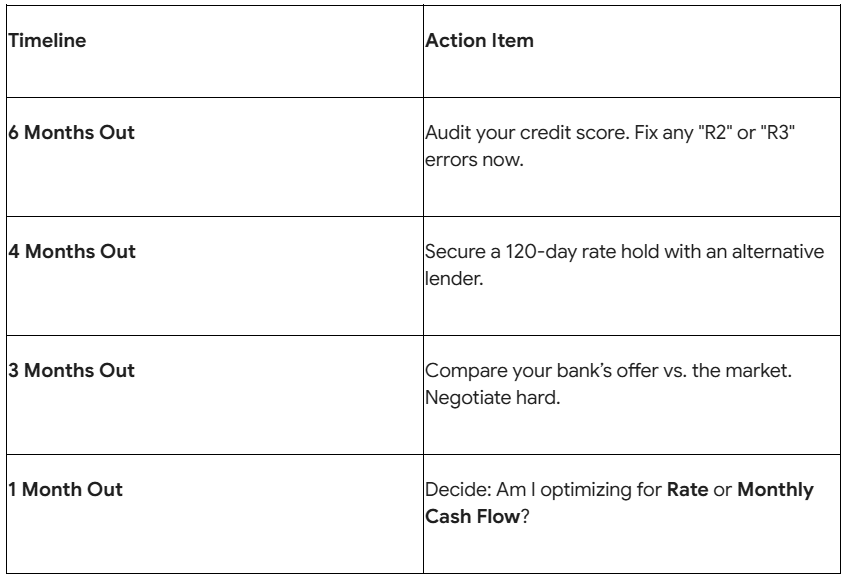
2. Strategy: The 120-Day “Rate Hold”

In 2026, volatility is the only constant.

  • The Move: Start shopping four months before your renewal date. Most lenders (and all Financial Heroes at LendingMoney.ca) can lock in a rate for you for 120 days.
  • The Win: If rates go up before your renewal, you are protected at the lower locked-in rate. If rates go down, you can simply take the new, lower market rate. It’s a “no-lose” strategy.

3. Extending Amortization: The Cash-Flow Lifesaver

If the new 2026 payments are going to break your household budget, you have a powerful lever: Amortization.

  • The Pivot: If you originally had a 25-year mortgage and you are 5 years in, your remaining amortization is 20 years. At renewal, you can often “stretch” that back out to 25 or even 30 years.
  • The Result: While this increases the total interest you pay over the life of the loan, it can drop your monthly payment by $300 to $500, giving your family the breathing room you need to stay stable.

4. The “Consolidation Renewal” (Credit Rehab Move)

This is the most popular strategy at LendingMoney.ca in 2026. If you are renewing your mortgage but also carrying $30,000 in credit card debt at 22%, you are fighting a losing battle.

  • The Move: Instead of a “Straight Renewal,” do a Refinance Renewal. Roll that high-interest debt into your new mortgage.
  • The Result: Even if your mortgage rate goes up to 5%, you are still “killing” 22% debt. Your total monthly outflow for all debts will likely decrease, and your credit score will skyrocket as your utilization drops to zero.

5. New 2026 Rules for Investors (OSFI Changes)

If you are renewing a mortgage on a rental property, be prepared for new scrutiny.

  • The “Independent Qualification” Rule: As of January 2026, OSFI requires that rental properties “stand on their own” for qualification if you switch lenders.

The Catch: If your rental isn’t generating enough cash flow to cover the new, higher interest rates, you may be “trapped” with your current lender. This makes it even more important to have a clean credit profile before your renewal date.

Your 2026 Renewal Checklist

Why Renew with LendingMoney.ca?

The big banks see renewal as an automated process. We see it as a financial reset. Whether you need to extend your amortization to save your budget or consolidate debt to save your credit, we are the alternative lending partnership to make it happen.

Is your renewal notice arriving soon? [Upload Your Renewal Offer] to LendingMoney.ca and let our Financial Heroes find you a better deal.

Blogs Home Buying Mortgages Personal Finance

Strength in Numbers: How to Qualify for a Mortgage as a Single Parent in Canada (2026 Guide)

The dream of homeownership shouldn’t disappear just because you are a single parent. Whether you are starting over after a divorce or raising a family on your own, the path to a mortgage is often clearer than you think. While the “single income” challenge is real, Canada’s 2026 mortgage rules include several “boosters” specifically designed to help families succeed.

At LendingMoney.ca, we believe every family deserves a stable place to call home. Our “Hero” approach means we help you find the hidden income and special programs that traditional banks might overlook. Here is how to qualify for a mortgage as a single parent in 2026.

1. Unlock "Hidden" Qualifying Income

When a bank looks at your mortgage application, they calculate your Debt-to-Income (DTI) ratio. For a single parent, your salary is only one part of the equation. In 2026, lenders are more flexible than ever about what counts as “qualifying income.”

  • Canada Child Benefit (CCB): Most lenders now accept 100% of your CCB payments as qualifying income for children under the age of 15. This monthly “lifeline” can add thousands of dollars to your annual qualifying total.
  • Child Support & Spousal Support: If you have a written separation agreement or a court order, this support is considered stable income. Most lenders allow support payments to make up to 30–50% of your total qualifying income, provided you can show a history of consistent payments.
  • Boarder or Rental Income: If you are buying a home with a “mortgage helper” (a legal basement suite), you can often use 50–100% of the projected rental income to help you qualify for a larger mortgage.

2. Leverage New 2026 Government Incentives

The Canadian government has introduced several landmark measures in the Making Life More Affordable for Canadians Act (Bill C-4) that directly benefit single-parent households.

  • The First-Time Home Buyer GST Rebate: As of 2026, the GST is fully eliminated on new homes priced up to $1 million for first-time buyers. This can save you up to $50,000 on the purchase price of a new build—money that stays in your pocket for furniture or emergency savings.30-
  • Year Amortization: Single parents buying newly constructed homes can now qualify for 30-year mortgages (up from the traditional 25). This lower monthly payment makes it much easier to pass the “Stress Test” on a single income.
  • The “Second Chance” First-Time Buyer Rule: Even if you owned a home with your ex-spouse, you can qualify as a “first-time buyer” again if you have been living separate and apart for at least 90 days due to a relationship breakdown. This unlocks the Home Buyers’ Plan (HBP), allowing you to withdraw up to $60,000 tax-free from your RRSP.

3. The Power of "Home Start" and Low Down Payments

You don’t need a 20% down payment to buy a home. Through CMHC-insured mortgages, you can enter the market with as little as 5% down.

  • CMHC Home Start: This program is specifically designed to help families with a minimum credit score of 600. If your score took a dip during a separation, this program provides a realistic pathway back into homeownership without requiring a “perfect” 700+ score.
  • Flex Down Options: Some lenders allow you to use “non-traditional” sources for your down payment, such as a gift from a family member or even a personal loan, provided your credit and income are stable.

4. Tackle the "Stress Test" with Credit Rehabilitation

The biggest hurdle for single parents is the “Mortgage Stress Test,” which requires you to prove you could handle payments if interest rates were higher.

  • Consolidate Before You Apply: If you are carrying high-interest car loans or credit card debt, it eats into your “Total Debt Service” ratio. Using a LendingMoney.ca consolidation loan to pay off these small debts before applying for a mortgage can drastically increase the amount a mortgage lender will give you.
  • The “Hero” Strategy: By clearing $400/month in credit card payments through consolidation, you could potentially qualify for an additional $50,000 to $70,000 in mortgage principal.

5. Build Your "Professional Team"

Qualifying as a single parent requires a more nuanced approach than a standard application. You need experts who understand family law and alternative lending.

  • Mortgage Brokers: They have access to “B-Lenders” who are more flexible with child support and CCB income than the major banks.
  • Financial Heroes: At LendingMoney.ca, we help you bridge the gap by cleaning up your credit and consolidating debt so your mortgage application is “bank-ready.”

Final Thoughts: Your Family's New Chapter

Being a single parent takes incredible strength, and that same strength can build a financial foundation for your children. By combining government rebates, child-related tax benefits, and a smart credit rehabilitation strategy, the keys to your own front door are within reach.

Ready to see how much home you can actually afford? [Connect with a Financial Hero] at LendingMoney.ca and let’s build your path to homeownership today.