Alternative Lending Blogs Mortgage Tips

The Underwriter’s Ear: How to Explain a Credit Hit and Win Your Mortgage

In the 2026 Canadian mortgage market, underwriters are no longer just looking at your 3-digit score; they are looking at your story. Thanks to new OSFI (Office of the Superintendent of Financial Institutions) guidelines, lenders are required to perform “enhanced due diligence” on any application with historical credit “bruising.”

If a lender asks you for a Letter of Explanation (LOX) regarding a late payment, a collection, or a past insolvency, don’t panic. This is actually a massive opportunity. It’s your chance to move beyond the cold math of the credit bureau and prove your “Hero” status.At LendingMoney.ca, we help our clients draft these letters every day. Here is the 2026 playbook for explaining a credit hit to a mortgage underwriter.

1. The Three Golden Rules of the LOX

Before you start typing, keep these three principles in mind:

  • Be Honest: Underwriters have access to more data than ever before. If you try to hide a detail, they will find it, and your application will be declined for “misrepresentation.”
  • Be Concise: An underwriter reviews dozens of files a day. They don’t want a 10-page novel; they want three paragraphs that explain the What, the Why, and the Resolution.
  • Be Factual: Avoid emotional language. Don’t say, “It was a really hard time.” Instead, say, “Due to a medical leave between June and August 2024, my household income was reduced by 40%.”

2. The Structure of a Winning Explanation

A professional Letter of Explanation should follow this exact 3-part flow:

Part A: The Incident (What Happened?)

Identify the specific item on your credit report.

  • Regarding the 30-day late payment on my RBC Credit Card in October 2024…

Part B: The Extenuating Circumstance (The Why)

Explain the specific, one-time event that caused the issue. Underwriters look for “isolated incidents” rather than “chronic habits.”

  • “This occurred during a transition between employers where my final paycheck was delayed by three weeks.”

Part C: The Resolution (Why it Won’t Happen Again)

This is the most important part. You must prove that the situation has been fixed and your finances are now stable.

  • The account was brought current immediately upon receipt of funds. Since then, I have established a 3-month emergency fund and set up automated minimum payments to ensure no future oversights.

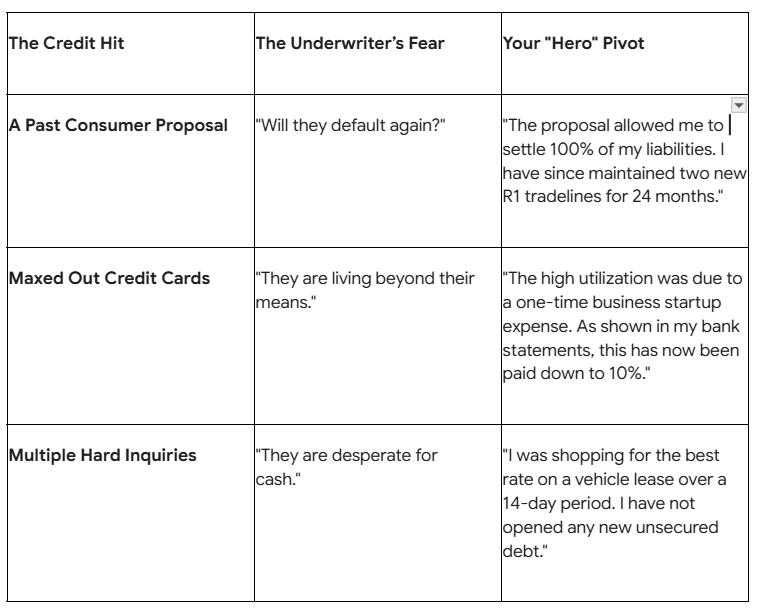
3. Common 2026 “Credit Hits” and How to Pivot Them

4. The Paper Trail (Supporting Documents)

In 2026, a letter isn’t enough – you need receipts. An underwriter is much more likely to accept your explanation if you attach:

  • Medical Notes: If a health issue caused the credit hit.
  • Termination/Hiring Letters: If it was due to a job gap.
  • Release of Lien/Discharge Papers: If it was a legal or tax issue.
  • Bank Statements: Showing the specific payment that cleared the debt.

5. Sample Template: The Late Payment Explanation

RE: Mortgage Application #12345 – Letter of Explanation for Credit Inquiry/Late Payment

To the Underwriting Department,

I am writing to provide context regarding the 60-day delinquency on my [Creditor Name] account in early 2025.

During this period, my family experienced a temporary financial strain due to [Reason: e.g., a localized flood not fully covered by insurance]. This was a one-time, unforeseen event.

Since that time, the account has been paid in full and maintained in good standing. My current employment at [Company] is stable, and I have maintained a 700+ score on all other tradelines. I have also implemented a [e.g., automated savings plan] to ensure total financial resilience moving forward.

Thank you for your consideration of my application.

Sincerely, [Your Name]

Why Your Story Matters at LendingMoney.ca

At LendingMoney.ca, we specialize in “Story-Based Underwriting.” We know that life happens—divorce, illness, and business pivots can all leave a mark on your credit report. But a mark isn’t a dead end.

We work with alternative lenders who prioritize the current person over the past score. We help you draft the explanations that turn a Maybe into an Approved.

Need help explaining your credit history to get a mortgage? [Connect with a Financial Hero] today and let’s tell your story the right way.

Read blog – How to Fix Your Credit After a CRA Debt Settlement

Alternative Lending Bad Credit Mortgage Personal Finance

Breaking the Cycle: A Guide to Loans for Debt Consolidation with Poor Credit

For many Canadians, the debt spiral feels like a trap with no exit. High-interest credit cards, unexpected medical bills, or a sudden change in employment can lead to missed payments, which in turn causes credit scores to plummet. Once your credit score hits a certain threshold, traditional banks often stop listening.

At LendingMoney.ca, we believe your past doesn’t have to define your future. If you are searching for a loan to consolidate debt with poor credit, you aren’t just looking for money – you’re looking for a strategy. This guide breaks down how debt consolidation works, why your credit score isn’t the only factor that matters, and how you can reclaim your financial freedom.

What is Debt Consolidation?

At its core, debt consolidation is the process of taking out one new loan to pay off several smaller, high-interest debts. Instead of managing five different due dates and five different interest rates, you have one predictable monthly payment.

For those with poor credit, the primary goal of consolidation is twofold:

  1. Lowering the Cost of Borrowing: Swapping 29.99% credit card interest for a lower installment loan rate.
  2. Credit Rehabilitation: Streamlining payments so you never miss a due date again, which is the fastest way to boost your score.

Can You Really Get a Consolidation Loan with Poor Credit?

The short answer is yes. While traditional “Big Five” banks rely almost exclusively on automated credit scores, alternative lenders and private firms look at a broader financial picture.

Why Banks Say No

Traditional lenders use rigid “risk models.” If your score is below a certain number (typically 600–650), their system automatically flags you as high-risk, regardless of your current income or your commitment to change.

Why LendingMoney.ca Says Yes

We focus on Credit Rehabilitation. We look at your current cash flow, your employment stability, and your specific financial goals. We understand that life happens. Our “Hero” approach means we look for reasons to fund you, not reasons to turn you away.

The Benefits of Consolidating Debt

When you secure a loan to consolidate debt with poor credit, the immediate relief is often emotional, but the long-term benefits are purely mathematical.

1. Immediate Interest Savings

If you are carrying a balance on three credit cards at 19% -29% interest, a significant portion of your monthly payment is simply feeding the beast- it never touches the principal balance. By consolidating into a single loan with a fixed term, more of your money goes toward actually erasing the debt.

2. A Boost to Your Credit Score

Credit utilization (how much of your available credit you are using) makes up about 30% of your credit score. When you use a consolidation loan to pay off “maxed-out cards, your utilization drops to zero. This often results in a significant “point jump” in your credit score within 30 to 60 days.

3. Direct Creditor Payment

One of the most effective ways to consolidate is through Direct Creditor Payment. At LendingMoney.ca, we can handle the logistics for you, paying your high-interest creditors directly so the debt is cleared immediately. This removes the temptation to spend the loan money elsewhere and ensures the “slate is wiped clean” on day one.

Types of Loans for Poor Credit Consolidation

Depending on your situation, there are several paths you can take:

Unsecured Personal Loans

These are the most common. They don’t require collateral (like a house or car). They are granted based on your income and your ability to manage the new payment. These are ideal for debts ranging from $500 to $15,000.

Secured Loans or Home Equity

If you are a homeowner, you may have access to much larger sums at lower rates by using the equity in your home. This is a powerful tool for major debt overhauls, allowing for much lower monthly payments over a longer term.

Private Lending

Private lenders often have the most flexibility. They are “real people” looking at real situations, making them a top choice for Canadians who have been through bankruptcy or consumer proposals.

Step-by-Step: How to Consolidate Your Debt

If you’re ready to take the first step in your financial journey, here is how the process works at LendingMoney.ca:

  1. The Quick Application: Spend five minutes on our secure portal. We ask about your income and the debts you want to crush.
  2. The Strategy Session: We don’t just send an automated email. We look at your path to rehabilitation. We determine which debts are hurting your score the most and build a plan to pay them off.
  3. Fast Funding: Once approved, we move quickly. In many cases, your creditors can be paid, or your funds can be deposited, within 24 to 48 hours.
  4. One Simple Payment: You stop worrying about five different apps and passwords. You make one affordable payment that fits your budget.

Common Myths About Poor Credit Loans

Myth #1: Applying will ruin my credit score.

While a “hard pull” can take a few points off, the long-term gain of paying off maxed-out cards far outweighs the temporary dip of an inquiry.

Myth #2: The interest rates are too high.

“High” is relative. If a consolidation loan is 15% but it’s replacing a 29% credit card, you are saving 14% every single month. That is a massive win for your wallet.

Myth #3: I should just file for bankruptcy.

Bankruptcy should be a last resort. It stays on your record for years and makes it nearly impossible to get a mortgage. Consolidation is a proactive move that shows future lenders you took responsibility and managed your way out of debt.

Why Choose LendingMoney.ca?

We aren’t just a website; we are your partners in this journey. We are affiliated with the Centum LM Group, meaning we have the backing of a major financial network but the heart of a local boutique.

We speak your language. No confusing jargon, no judgment – just a structured path to help you pay off high-interest debt and watch your credit score grow.

Final Thoughts: Your Future Starts Today

Debt is a heavy burden, but it doesn’t have to be permanent. By choosing a loan to consolidate debt with poor credit, you are taking the heroic step of protecting your family’s financial future.

Stop letting high interest dictate your life. Let us help you navigate the road back to a 700+ credit score.

Ready to start your journey? [Apply with Ease Today] and let’s get you back on track.

Read Blog – How to get a Second Mortgage With Bruised Credit

Alternative Lending Bad Credit Mortgage Second Mortgages

How to get a Second Mortgage With Bruised Credit

One of the most common myths in the 2026 mortgage market is that a low credit score is a “permanent no” for home financing. At LendingMoney.ca, we know that bad credit is often just a snapshot of a difficult moment-not a definition of your future.

While a traditional Big Six bank will almost always decline a second mortgage application if your score is below 650, the alternative and private lending markets work differently. They focus on the asset (your home) rather than just the score.

Here is your 2026 guide on how to qualify for a second mortgage, even if your credit has seen better days.

1. The Golden Rule: Equity is King

In the world of bad credit second mortgages, your home equity is your strongest advocate. Lenders in 2026 categorize risk by LTV (Loan-to-Value).

  • The Threshold: To qualify with bruised credit, most alternative lenders want to see a combined LTV (your first mortgage + the new second mortgage) of 75% to 80% or less.
  • The Math: If your home is worth $600,000 and you owe $350,000 on your first mortgage, you have $250,000 in equity. A lender will likely let you borrow up to a total of $480,000 (80% of value). This leaves you with $130,000 available for a second mortgage, regardless of your credit score.

Choosing the Right Path: B Lenders vs. Alternative Solutions (2026)

Depending on your specific Financial Hero journey, we will steer you toward one of these two paths. Both are effective, but they serve different needs:

  • B Lenders (Trust Companies): These are federally or provincially regulated institutions like Community Trust, Home Trust or Equitable Bank. They are a step above a traditional bank but more flexible. They can work with scores as low as 550–600. They still require standard income verification (though they are more lenient with self-employed “stated” income) and typically offer 1-to-3-year terms.
  • Alternative Lenders  (LendingMoney.ca): This is where we excel. As an alternative lender, we often look at Equity-First solutions. We can approve second mortgages that B Lenders might find too complex, such as those involving active CRA debt, recent consumer proposals, or properties with unique valuations. We focus on the asset and the exit strategy, providing the “Bridge” you need when the Trust Companies aren’t an option.

3. The Marketability Factor (Revised)

Because an Alternative Lender is relying on your house as their primary security, the condition and location of your property are the most important factors.

  • Urban Hubs: It is much easier to secure an alternative second mortgage in high-liquidity markets like Mississauga, Toronto, or Ottawa.
  • The “Hero” Appraisal: We use professional appraisals to prove to our lending partners that your home is a solid investment. A clean, well-maintained home allows us to stretch the LTV (Loan-to-Value) higher, giving you more cash to fix your credit.

4. Prove Your Affordability (The Alternative Way)

Even without a high credit score, we need to show that this loan is a solution, not a burden.

  • Bank Statement Underwriting: Unlike the big banks that demand a T4, LendingMoney.ca often uses 6-12 months of bank statements to verify your true cash flow. This is perfect for entrepreneurs who have high revenue but many tax write-offs.
  • The Exit Strategy: This is the most important part of our process. We don’t just give you a second mortgage; we build a plan to move you back to a B Lender or an A Lender within 12 to 24 months.

You are More Than a Number

A low credit score shouldn’t lock you out of your own home’s wealth. Whether you’re dealing with the aftermath of a business failure or just a rough year, your equity is your ticket to a fresh start.

Don’t let a “No” from the bank or a Trust Company stop you. [Get an Alternative Equity Review] from LendingMoney.ca today. Let our Financial Heroes show you how your home can fund your comeback.

What to Expect: Bad Credit Second Mortgage Terms (2026)

5. The Credit Rehab Exit Strategy

At LendingMoney.ca, we never want you to stay in a high-interest second mortgage forever. When we help you qualify with bad credit, we build in an Exit Strategy.

  • Step 1: Use the funds to pay off the high-interest collections and maxed-out cards that are tanking your score.
  • Step 2: Make perfect payments on the new second mortgage for 12 months.
  • Step 3: Once your score bounces back to 680+, you can refinance both mortgages back into a single, low-rate bank mortgage.

You are More Than a Number

A low credit score shouldn’t lock you out of your own home’s wealth. Whether you’re dealing with the aftermath of a business failure or just a rough year, your equity is your ticket to a fresh start.

Don’t let a “No” from the bank stop you. [Get a Confidential Equity Review] from LendingMoney.ca today. Let our Financial Heroes show you how your home can fund your comeback.

Read Blog – How a CRA Lien Affects Your Mortgage Renewal

Alternative Lending Blogs

The Lending Spectrum: B Lenders (Trust Companies) vs. Alternative Lenders

When a “Big Six” bank says no, most Canadians assume their only remaining option is a high-interest private loan. However, there is a massive middle ground occupied by B Lenders and Alternative Lenders.

While both are “alternatives” to traditional banks, they serve very different purposes. At LendingMoney.ca, we want you to understand exactly where you fit on this spectrum so you can choose the right tool for your financial recovery.

1. What is a B Lender ? (The Trust Company)

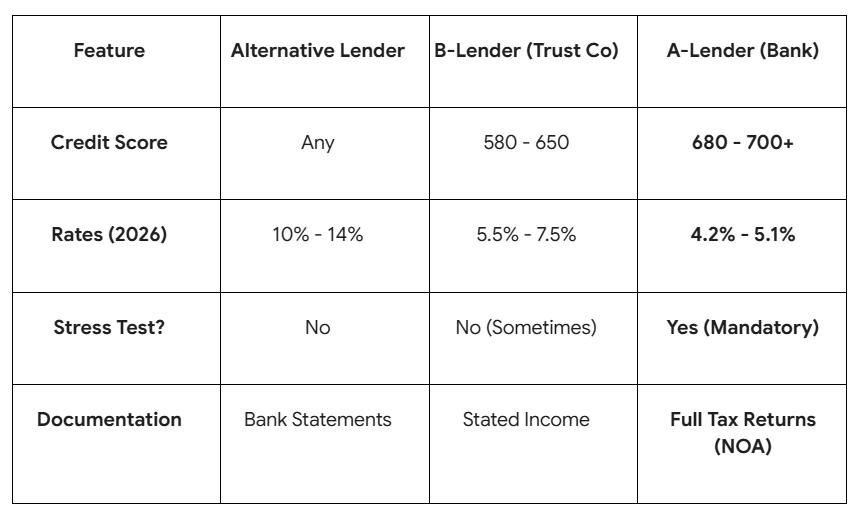
B Lenders are essentially “Bank-Lite.” They are federally or provincially regulated financial institutions, often including Trust Companies (like Home Trust or Community Trust) and specialized banks (like Equitable Bank).

  • Who they are for: The Near-Prime borrower. You have a decent job and a decent house, but maybe your credit score is 600 instead of 700, or you are self-employed and can’t prove every dollar of income.
  • The 2026 Rules: B Lenders are still heavily regulated. While they are more flexible than the Big Six, they still have strict boxes you must fit into regarding your debt-to-income ratios.
  • The Rates: They offer a “middle-ground” rate—usually 1% to 2% higher than a standard bank rate.

The Catch: They almost always require a 20% down payment because they do not offer CMHC-insured mortgages.

2. What is an Alternative Lender ? (LendingMoney.ca)

An Alternative Lender is a non-institutional provider of capital. We aren’t bound by the same rigid “stress tests” or federal “Capital Adequacy” rules that govern banks and trust companies.

  • Who we are for: The “Big Picture” borrower. You might be in a Consumer Proposal, recovering from a bankruptcy, or dealing with an “unconventional” property that an institution won’t touch.
  • The Flexibility: We don’t just look at a credit score. We look at equity, cash flow, and your plan for the future. If you have a solid Exit Strategy (a plan to get back to a bank in 1–2 years), we can provide the funding that institutions won’t
  • The Speed: Because we don’t have layers of institutional committees, we can move at lightning speed—often funding a deal in 24 to 48 hours.

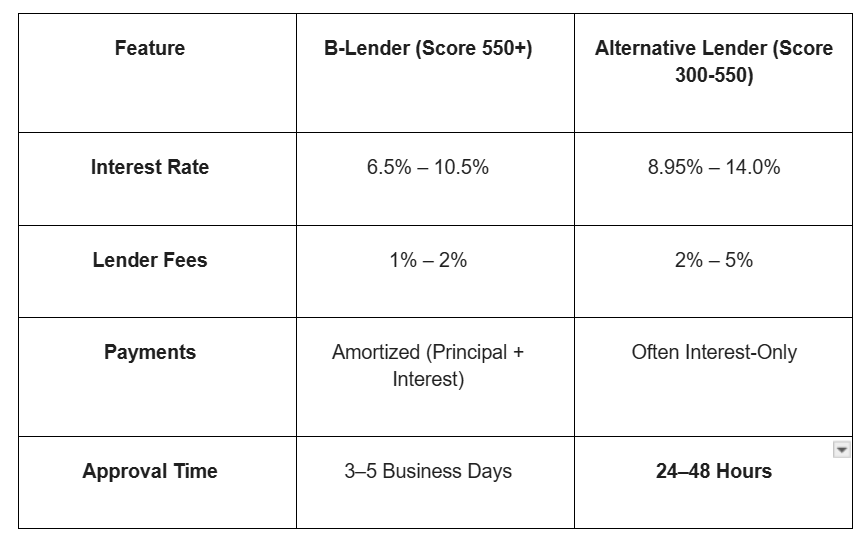
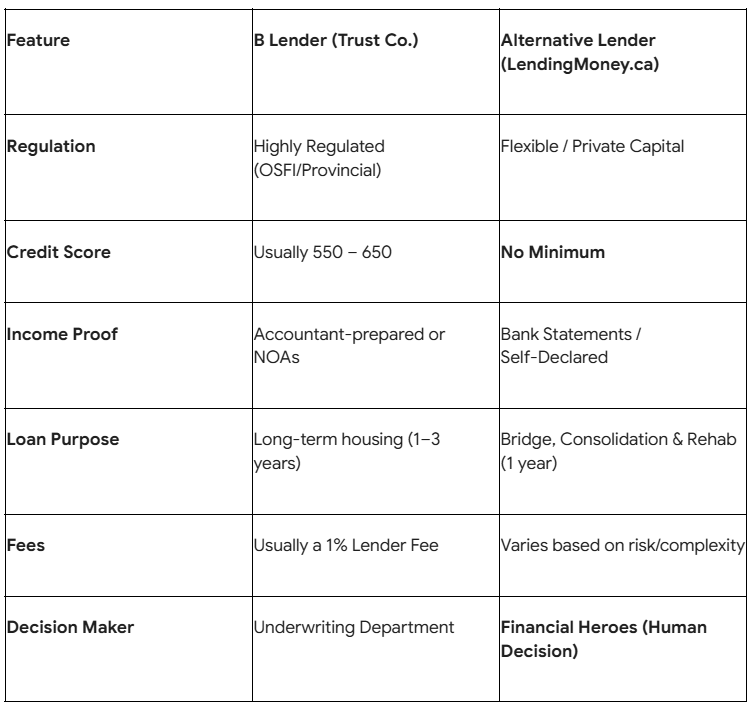
Key Differences at a Glance (2026)

3. Why the B Lender Might Still Say No

In 2026, even B Lenders have become more cautious. Because they are “Deposit-Taking” institutions, they have to answer to regulators about the “quality” of their mortgage book.

If you have active collections, an un-discharged bankruptcy, or significant CRA debt, a B Lender Trust Company will likely still decline your application. They want “bruised” credit, not “broken” credit.

4. The LendingMoney.ca Bridge Strategy

This is where we come in. We don’t compete with B Lenders; we prepare you for them.

Most of our clients use our Alternative Lending solutions as a 12-month bridge.

  1. We provide the funds to pay off the collections, settle the CRA debt, or buy out the Consumer Proposal.
  2. While you are with us, we implement your Credit Rehabilitation plan.
  3. After 12 months, your “broken” credit has become “bruised” (or better), and we “graduate” you to a B Lender or even back to an A Lender bank.

Which One Do You Need?

  • Choose a B Lender if your credit is “okay” and you just need a bit more flexibility on your income proof than the Big Six allows.
  • Choose an Alternative Lender (LendingMoney.ca) if you need speed, have a complex situation, or need a financial “reset” to clear old debts before you can qualify anywhere else.

Still not sure which “box” you fit into? [Talk to a Financial Hero] at LendingMoney.ca. We’ll analyze your situation and tell you exactly which lender is the right stepping stone for your journey.

Alternative Lending Blogs Credit Score Personal Finance

The Final Leap: Moving from Alternative Lending back to the Bank

Alternative mortgages and B-Lenders are fantastic “stabilization” tools. They gave you the cash to pay the CRA, consolidate debt, or bridge a gap in your self-employment income. But now that the dust has settled, you likely want the lowest possible interest rate and the prestige of a traditional bank mortgage.

Moving back to an A-Lender requires more than just a good score; it requires a “clean” financial story. Here are the five benchmarks you must hit to graduate in 2026.

1. The 700 Club: Your New Credit Target

While you can get a B-Lender mortgage with a 600 score, the “Big Banks” in 2026 generally look for a minimum of 680, with 700+ being the “Golden Ticket” for the best advertised rates.

  • The Requirement: You need a “clean” credit bureau for the last 24 months. This means zero late payments on any credit card, car loan, or phone bill since you started your alternative mortgage.
  • The “Tradeline” Rule: Banks want to see at least two active credit cards with limits over $2,000, both with a history of at least two years.

2. The NOA Standard: Tax Transparence

This is often the biggest hurdle for entrepreneurs and those who previously owed the CRA.

  • The Rule: An A-Lender will require your two most recent Notices of Assessment (NOAs). They must show that you owe $0.00 to the government.
  • The 2026 Shift: Banks are now using digital verification. They may ask for a “Proof of Income” statement directly from the CRA portal. If there is any hint of a payment plan or outstanding balance, the bank will decline the application immediately.

3. The Federal Stress Test (Guideline B-20)

When you are with an alternative lender or a private lender, you often don’t have to pass the federal stress test. To move back to a bank, you must pass it.

  • The Math: In 2026, with the Bank of Canada policy rate near 2.25%, the “Benchmark” stress test is typically around 7.25%.
  • The Goal: Your total housing costs (mortgage + taxes + heat) must not exceed 39% of your gross income, and your total debt (including car loans) must not exceed 44%.

4. Stability of Income

Banks love “T4” employees (salaried workers). If you are self-employed, graduating back to a bank is harder but not impossible.

  • The 2-Year Average: The bank will take your “Line 15000” income from your last two years of tax returns and average them.
  • The Hero Move: If your business has grown significantly, we at LendingMoney.ca advise you to package your corporate financial statements to show “add-backs”-proving your true earning power is higher than what you show the taxman.

5. Property Appraisal & Marketability

A-Lenders are the most conservative when it comes to the “collateral” (your house).

  • The Inspection: If you used your alternative mortgage to fund renovations, the bank will want to see that those renovations are 100% complete. They will not take over a mortgage on a “construction zone.”
  • Location: Banks prioritize properties in major urban centers. If your home is in a very remote area, graduating back to a Big Six bank may require a higher credit score or a lower Loan-to-Value (LTV) ratio.

The Graduation Roadmap (Alternative → B → A)

Why Use LendingMoney.ca for Your Final Leap?

Most people think they can just walk into their local bank branch once their credit is fixed. However, if that bank sees a history of a private mortgage on your title, they may still be hesitant.

At LendingMoney.ca, we know which A-Lender underwriters are the most flexible with “recovered” borrowers. We tell your story in a way that highlights your successful rehabilitation, ensuring the bank sees you as a low-risk, high-value client.

Are you ready to stop paying “alternative” rates and start paying “bank” rates? [Request a Bank-Ready Audit] from LendingMoney.ca today. We’ll verify your score, your ratios, and your NOAs to see if today is your Graduation Day.

Read blog- How to Pay CRA Debt With Home Equity

Alternative Lending Blogs Education Personal Finance Tax Debt Solutions

Breaking the Cycle: Why Payday Loans are a Financial Trap in 2026

We’ve all been there: an unexpected car repair, a dental emergency, or a utility bill that’s higher than usual. When you need cash today and the bank has already said no, a neon sign for a payday loan can look like a beacon of hope.

In Ontario, names like Money Mart are everywhere, promising “instant cash” with “no credit check.” But in 2026, the price of that speed has reached a breaking point for many Canadian families. At LendingMoney.ca, we believe that true Credit Rehabilitation starts with understanding why payday loans are designed to keep you in debt-and how alternative lending can set you free.

1. The 365% Reality Check

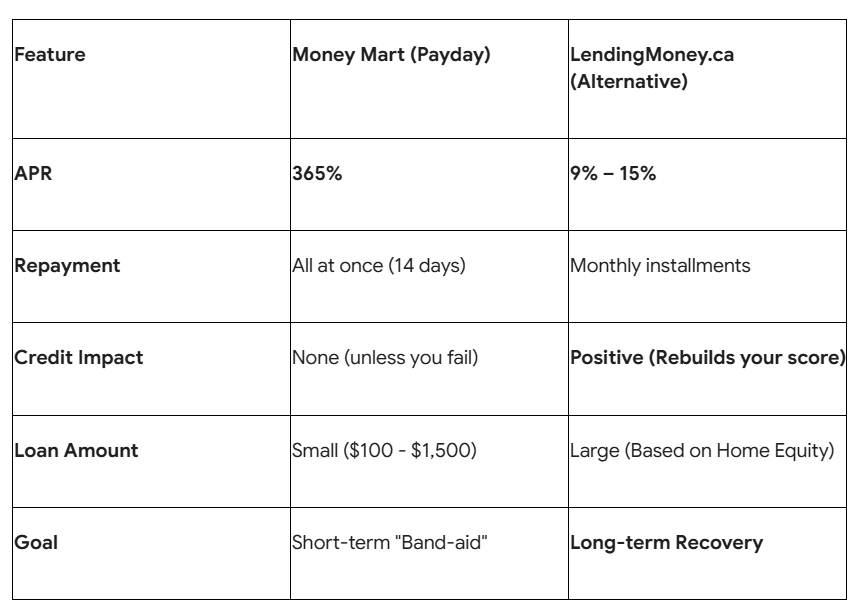
In Ontario, the law limits payday lenders to charging $14 per $100 borrowed. On the surface, $14 doesn’t sound like much. But payday loans are designed to be paid back in just 14 days.

  • The Math: If you borrow $500 for two weeks, you pay $70 in fees. If you were to carry that same debt for a full year, the Annual Percentage Rate (APR) is a staggering 365%.
  • The Comparison: At LendingMoney.ca, an alternative equity loan or second mortgage typically carries an APR between 9% and 15%. That is a difference of over 350%.

2. The Vicious Cycle of Re-Borrowing

The biggest pitfall of a payday loan isn’t the first one—it’s the second one.

  • The Trap: When your next paycheck arrives, the payday lender takes their $570 (principal + fees) directly from your account. This leaves you with $570 less to pay your rent and buy groceries for the next two weeks.
  • The Result: Most borrowers find themselves short again within days, forcing them to take out a new payday loan to cover the gap left by the first one.
  • The 2026 Data: Statistics Canada reports that the average payday loan user in 2026 takes out 8 to 10 loans per year. This isn’t a “bridge”-it’s a treadmill.

3. The No Credit Check Illusion

Payday lenders often advertise “No Credit Check” as a benefit. While this makes it easy to get the money, it has a hidden sting: Payday loans almost never help your credit score.

  • The Logic: Because they don’t report your on-time payments to Equifax or TransUnion, you get zero “points” for paying them back.
  • The Sting: However, if you miss a payment, they will send the debt to a collection agency immediately, which will tank your score. It is a “no-win” scenario for your Credit Rehabilitation.

4. The Balloon Payment vs. Installments

A payday loan is a “balloon” payment—the whole amount is due at once. This is the hardest way to pay back debt.

  • The LendingMoney.ca Difference: We offer Installment-Based alternative loans. Instead of losing $500 of your next paycheck, you might pay $50 a month over a longer term. This protects your daily cash flow and allows you to breathe.

5. Aggressive Collection Tactics in 2026

With the 2026 digital banking updates, payday lenders use “Pre-Authorized Debit” agreements that are notoriously difficult to stop. If you try to block the payment to buy food, they may charge you NSF fees of $20–$50 on top of the 30% default interest they are legally allowed to charge.

Payday Loan vs. LendingMoney.ca Alternative Loan

Stop Digging. Start Building.

If you are currently using payday loans to stay afloat, you aren’t alone-but there is a better way. If you own your home, your equity is a “Financial Hero” waiting to be used.

At LendingMoney.ca, we use your home equity to provide a low-interest alternative to the payday trap. We pay off the high-interest lenders, lower your monthly payments, and start the process of moving you back to a traditional bank.

Ready to break the cycle? [Get a Payday Loan Exit Quote] from LendingMoney.ca today. Let’s trade your 365% debt for a plan that actually works.

Read blog – Breaking the Cycle: A Guide to Loans for Debt Consolidation with Poor Credit

Alternative Lending Blogs Financial Education Financial Recovery Personal Finance

The Big Six vs. The Alternatives: Which Lender is Your Best Financial Partner?

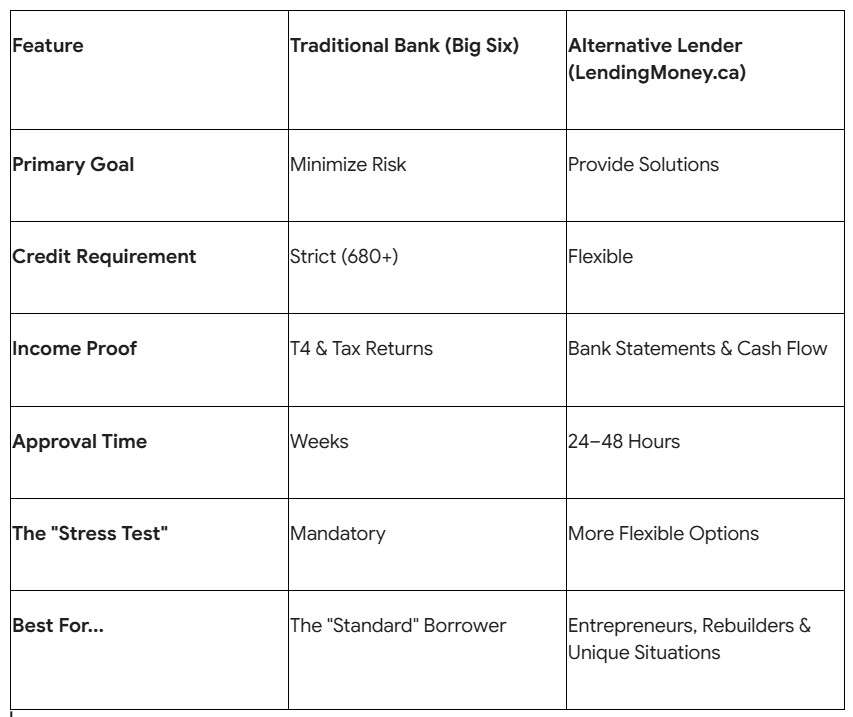
If you’ve ever walked into a major Canadian bank to apply for a loan or a mortgage only to be told you don’t “fit the box,” you aren’t alone. In 2026, Canada’s “Big Six” banks have some of the strictest lending criteria in the world. But a “no” from a bank isn’t the end of your financial journey – it’s often just a sign that you need an alternative lender.

At LendingMoney.ca, we operate in the “Alternative” space. But what does that actually mean for your wallet? Let’s break down the fundamental differences between traditional banks and alternative lenders so you can choose the partner that actually fits your life.

1. The Box vs. The Big Picture

The most significant difference lies in how a lender views you.

  • The Bank (Traditional): Banks are “Algorithm-First.” They use standardized underwriting templates. If your credit score is below a certain number (usually 680+) or if your income is fluctuating, the computer automatically triggers a decline. They rely on “T4 income” and stable 2-year employment histories.
  • The Alternative Lender: We are “Holistic-First.” While we still look at credit, we focus more on current cash flow, home equity, and future potential. We understand that a self-employed entrepreneur or someone recovering from a divorce is more than just a three-digit score.

2. 2026 Regulations and the Stress Test

In 2026, federal regulators (OSFI) have introduced even tighter rules for big banks, particularly regarding rental properties and debt-service ratios.

  • The Bank: Must apply the Mortgage Stress Test to every federally regulated product. They often “double-count” your debts but “single-count” your income, making it incredibly hard to qualify if you have existing loans.
  • The Alternative Lender: Many alternative lenders are provincially regulated, meaning they have more flexibility. We can often look at “global income” or “stated income” for business owners, providing a pathway to homeownership that simply doesn’t exist at a big bank in 2026.

3. Speed of Adjudication

If you are in a “bridge” situation – like needing to close on a house before your old one sells—time is your biggest enemy.

  • The Bank: Because of their massive size and layers of bureaucracy, a bank approval can take 3 to 8 weeks.
  • The Alternative Lender: We are built for speed. At LendingMoney.ca, we can often provide an approval in 24 to 48 hours. We don’t have layers of committees; we have Financial Heroes ready to make decisions.

4. Why the Rate Isn’t the Only Number That Matters

The most common argument for banks is that they offer the lowest interest rates. While this is often true, it comes with a hidden cost.

  • The Bank: Offers a “Prime” rate but requires “Prime” circumstances. If you don’t qualify, the rate is irrelevant.
  • The Alternative Lender: Our rates are slightly higher to reflect the customized risk we take. 
  • The Strategy: Think of an alternative lender as a bridge. You use us to secure your home or consolidate your debt now, and while you’re with us, we work on your Credit Rehabilitation. Once your score is back in the 700s, we help you “graduate” back to a traditional bank rate.

5. Flexibility for the Self-Employed and Gig Workers

In 2026, the Canadian workforce is changing. More people are freelancers, contractors, or small business owners.

  • The Bank: Prefers “stable” paychecks. If you write off expenses to save on taxes (as every smart business owner does), the bank sees a lower income and denies your loan.

The Alternative Lender: We look at your gross revenue and your bank statements. We understand how businesses actually work and don’t punish you for being your own boss.

Comparison at a Glance (2026)

Why Choice is Your Greatest Asset

Relying solely on a bank relationship can limit your growth. In 2026, the most successful Canadians treat financing as a strategy. They use alternative lenders when they need speed and flexibility, and they use traditional banks when they fit the “standard” mold.

At LendingMoney.ca, we are your partners in that strategy. We provide the capital when the bank says “no,” and we provide the roadmap to ensure they eventually say “yes.”

Tired of the bank’s “No”? [Connect with a Financial Hero] at LendingMoney.ca and let’s look at the big picture of your finances today.

Alternative Lending Blogs Debt Consolidation Private Mortgages

If you have received a Notice of Sale Under Mortgage, the most important thing to know is that you still own your home. In Ontario, the “Power of Sale” is a legal process, and like any process, it can be stopped, but the clock is ticking.

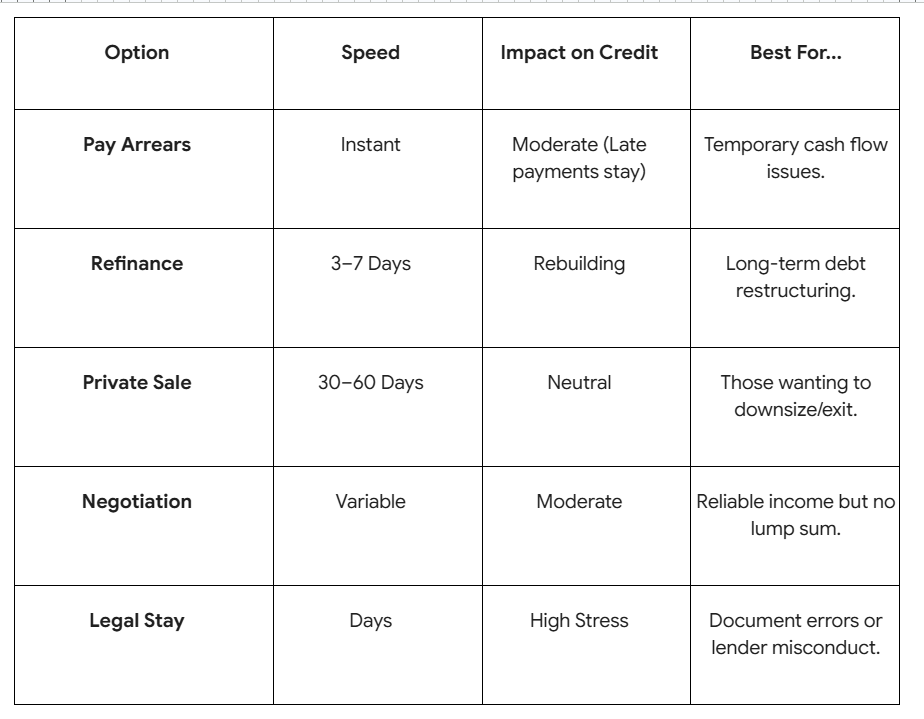
In 2026, lenders are moving faster to protect their capital, often initiating the process after just two missed payments. Here are the top five ways to pull the emergency brake and stop a Power of Sale today.

1. Pay the Arrears and Reinstate (The Cleanest Break)

The most direct way to stop a Power of Sale is to “cure” the default. Under Section 22 of the Mortgages Act, you have the right to bring the mortgage back into good standing by paying exactly what is owed.

  • What you pay: You must pay the total of all missed payments, any late penalties, and the lender’s actual legal costs incurred to date.
  • The Result: Once paid, the Power of Sale is legally voided, and your mortgage continues as if the default never happened.
  • Hero Tip: If you’ve recently returned to work or received an inheritance, this is your best move. Always get a written “Statement of Arrears” from the lender’s lawyer to ensure you are paying the correct amount.

2. Refinance with an Alternative or Private Lender

If you cannot come up with the cash to pay the arrears, you can replace the entire mortgage. Traditional banks will not touch a file in Power of Sale, but Alternative Lenders (like LendingMoney.ca) specialize in this.

  • How it works: A new lender pays off your old bank in full (including all legal fees and penalties). The Power of Sale is cancelled because the debt no longer exists.
  • The 2026 Strategy: This is a “Bridge” strategy. You take a 1-year term with an alternative lender to save your home today, then use that year for Credit Rehabilitation so you can switch back to a lower-rate bank later.

3. Sell the Property Privately (Protect Your Equity)

If you know you cannot afford the mortgage long-term, you should sell the home yourself before the lender does.

  • The Math: When a lender sells your house under Power of Sale, they often sell it “as-is” and may not push for the highest price, they just want their money back. By listing it yourself, you control the marketing and the price.
  • The Legal Window: You can list and sell your home even after a Notice of Sale is issued, provided the sale closes before the lender completes their own transaction. This ensures that the surplus equity (the profit) stays in your pocket, not the bank’s legal fees.

4. Negotiate a Forbearance or Repayment Plan

Believe it or not, most lenders do not actually want your house; they want their money. In 2026, many institutions have “loss mitigation” departments.

  • The Ask: Request a formal Forbearance Agreement. This is a legal document where the lender agrees to “pause” the Power of Sale if you agree to a strict schedule to pay back the arrears over 3–6 months.
  • The Hero Move: You are more likely to get a “Yes” if you can pay a small “good faith” lump sum immediately.

5. Challenge the Process (The Legal Defense)

If the lender has made a mistake in the paperwork, a judge can stay (stop) the Power of Sale.

  • Common Errors: Failing to wait the mandatory 15-day default period before sending the notice, or failing to serve the notice to all registered owners (including ex-spouses).

The Catch: This requires a specialized real estate lawyer and can be expensive. It is usually a “delay tactic” to buy you more time to execute Option 2 or Option 3.

Comparison of Your “Rescue” Options

The 35-Day Redemption Clock

In Ontario, once you receive the Notice of Sale Under Mortgage, you have a 35-day redemption period (40 days if it’s a matrimonial home). During this window, the lender cannot sell the property. This is your “Golden Window” to act. Once this period expires, the lender can list the property on the MLS, and your options become much more expensive.

Warning: Do not wait until Day 34. Appraisals and alternative mortgage funding take time.

Is the clock ticking on your Notice of Sale? [Connect with a Financial Hero] at LendingMoney.ca immediately. We can often secure an equity-based approval in 24 hours to stop the sale and save your home.

Read blog – What is a Power of Sale in Ontario? Your 2026 Emergency Guide

Alternative Lending Blogs Business Finance Credit Rehabilitation Financial Recovery

Starting Over: How to Rebuild Your Credit After a Business Failure

In the entrepreneurial world, failure is often just a prerequisite for future success. However, while your spirit might be ready for the next venture, your credit report usually tells a different story. Between personally guaranteed business loans, maxed-out credit cards used to keep the doors open, and potential CRA arrears, a business closure can leave your credit score in the 400s or 500s.

At LendingMoney.ca, we don’t define you by your last business – we help you fund your next one. Here is your 2026 roadmap for financial recovery and credit rehabilitation after a business failure.

1. Inventory the Personal Guarantee Damage

The first step in recovery is separating what you owe personally from what the business owed.

  • The “PG” Audit: Go through your business contracts. Which loans did you personally guarantee (PG)? These will follow you even after the corporation is dissolved.
  • The “Silent” Hit: If you had a business credit card that you were a Co-Applicant on, that balance is now 100% your personal responsibility.
  • The Action Step: Get your Equifax and TransUnion reports immediately. Ensure no business debts are being “double-counted” as personal debts unless there was a legal guarantee in place.

2. Address the CRA Director Liability

This is the biggest “Hero” move you can make. If your business owed GST/HST or Payroll Deductions, the CRA can hold you personally liable as a Director.

  • The 2026 Risk: The CRA has become more aggressive this year in pursuing directors for unpaid corporate taxes.
  • The Solution: If you have home equity, use an Alternative Equity Loan from LendingMoney.ca to settle these government debts first. The CRA is the only creditor that can “leapfrog” other lenders to freeze your personal assets.

3. The Strategic Settlement Phase

If you have five different credit cards with balances from the failed business, don’t try to pay them all at once.

  • The “Lump Sum” Strategy: It is often better to save a lump sum and offer a settlement to one creditor at a time (e.g., offering $0.40 on the dollar).
  • The Credit Code: A settled debt will be marked as an R7. While not perfect, an R7 is infinitely better than an “R9” (Collection/Charge-off) because it shows the account is closed and settled.

4. Re-Establish Your Personal Tradelines

After a business failure, your Credit Mix is usually a mess of high-interest loans. You need to re-introduce “Normal” credit.

  • The Two-Card Rule: Secure two small Secured Credit Cards. Do not use them for business. Use them for your personal groceries and pay them off every single Friday.

The “Activity” Signal: You need to show the bureaus that you are back to a “stable personal lifestyle.” Consistent, small, weekly payments are the fastest way to signal a turnaround in 2026.

5. Wait, Don’t Rush the New Business Credit

It’s tempting to start a new corporation and apply for credit immediately.

  • The Warning: In 2026, lenders are using AI-driven “Identity Linking.” If you start a new business but your personal score is still 520, you will be declined for everything.
  • The Goal: Focus 100% on your personal Credit Rehabilitation for 6–12 months. Once your personal score crosses the 650 mark, your “Director” status becomes an asset again rather than a liability.

6. Use an Alternative Bridge Loan

If the business failure left you with high-interest personal debt that is “choking” your cash flow, an installment loan from LendingMoney.ca can act as your bridge.

  • Consolidate the “Failure”: Move the high-interest cards into one manageable payment.
  • The Result: Your credit utilization drops, your score rises, and you stop the emotional stress of multiple collections calls.

You Are Not Your Business Failure

A business failure is a masterclass in experience, but it shouldn’t be a life sentence of bad credit. By taking a structured approach to your Credit Rehabilitation, you can be back in a “Mortgage-Ready” position sooner than you think.

Ready to leave the stress of your past business behind? [Talk to a Financial Hero] at LendingMoney.ca today. We’ll help you clean up the debris and build a foundation for your next success.

Read blog –The Head Start: How to Rebuild Your Credit During a Consumer Proposal

Alternative Lending Blogs Mortgage Renewal Private Mortgages

The Silent Equity Killer: How to Avoid Private Mortgage Renewal Fees

If you have a private mortgage, you probably remember the “Lender Fee and Broker Fee you paid to get it. What many homeowners don’t realize is that most private lenders charge those fees every single year you stay with them.

In 2026, with private interest rates already sitting between 10% and 15%, adding a 2% renewal fee means you are effectively paying an APR of nearly 17%. If you have a $500,000 mortgage, that’s $10,000 vanished in a single signature. Here is how to stop the bleed.

1. The 120-Day Rule (Start Before They Do)

Private lenders count on you being “trapped.” They often send your renewal notice just 21 to 30 days before the term ends, leaving you with no time to find an alternative.

  • The Hero Move: Start your search 4 months (120 days) before your maturity date.
  • The LendingMoney.ca Advantage: We track your maturity date from day one. At the 4-month mark, we perform a “Financial Health Check” to see if your Credit Rehabilitation is far enough along to move you to a B-Lender or a Credit Union where there are zero renewal fees.

2. Leverage Your Improved Story

A private lender charges a renewal fee because they claim the “risk” is still high. You need to prove them wrong.

  • Show the Progress: Since you took the private loan, have you paid off a collection? Has your income increased? Have you made every private mortgage payment on time?
  • The Negotiation: At LendingMoney.ca, we use these “wins” to negotiate. We tell the lender: “Our client’s credit score has jumped 60 points. They are now eligible for a B-Lender. If you want to keep this loan, you must waive the renewal fee.”

3. The B-Lender Pivot (The Fee-Free Zone)

The best way to avoid private renewal fees is to stop being a private borrower. In 2026, the jump from “Private” (C-Lender) to “Alternative” (B-Lender) is the most important step in your journey.

  • B-Lenders (Trust Companies): Unlike private individuals, B-Lenders are regulated institutions. They generally do not charge renewal fees. Once you are in, you simply renew at the current market rate.
  • The Savings: Moving to a B-Lender doesn’t just lower your interest rate; it saves you that 1%–2% annual fee forever.

4. Don’t Auto-Renew by Silence

Many private mortgage contracts have a clause that says if you don’t respond, the mortgage “auto-renews” for another year, including the fees.

  • The Action Step: Read your original commitment letter. Look for the “Renewal” section.
  • The 2026 Reality: Some lenders are now charging “Exit Fees” if you leave. We review your contract to ensure the cost of leaving is smaller than the cost of staying. Usually, paying a small discharge fee is much cheaper than paying a massive renewal fee.

5. Use a Bridge-to-Bank Strategy

If your credit isn’t quite ready for a bank yet, we can sometimes find a “Semi-Private” institution. These are lenders that sit between a private individual and a bank.

  • The Benefit: They offer 2-year or 3-year terms.
  • Why this works: By taking a 3-year term, you only pay a fee once instead of paying a renewal fee every 12 months. This gives you three years of stable payments to finish your Credit Rehabilitation.

Comparison: The Cost of Staying vs. The Cost of Moving (2026)

Based on a $500,000 Mortgage

Your Equity Belongs to You, Not the Lender

At LendingMoney.ca, we believe private mortgages should be short, sharp, and successful. If you are entering your second or third year in a private loan, you are no longer using a “bridge”, you are living on it.

Is your private mortgage renewal coming up in the next 120 days? [Upload Your Current Statement] for a free Exit Analysis. Let’s stop the fees and start your graduation back to the bank.