
Blogs Mortgage Renewal Mortgages Private Lending

Fixing Your Credit While in a Private Mortgage

A private mortgage is often described as a “bridge.” But a bridge is only useful if it leads somewhere. If you are in a private mortgage in 2026, your primary goal is to use this 12-month window to rehabilitate your credit so you can “graduate” to a lower-interest bank or B-lender.

At LendingMoney.ca, we don’t want you to stay in a private loan forever. We want to help you fix the issues that put you there in the first place. Here is your month-by-month guide to Credit Rehabilitation while using a private mortgage.

1. The Private Mortgage Reporting Reality

In 2026, most individual private lenders do not report to Equifax or TransUnion.

  • The Problem: Even if you make every payment on time for a year, your credit score might not go up because the bureaus don’t see the “good behavior.”
  • The Hero Move: You must focus on your other tradelines. Since the mortgage isn’t helping your score, your credit cards, car loans, and phone bills have to do the heavy lifting.
  • The Catch: While private lenders don’t report the “good,” they will certainly report the “bad” if they have to take legal action (Power of Sale). On-time payments are mandatory to protect your equity.

2. Eliminate “R9” and “R7” Ghost Debts

If you took a private mortgage to consolidate debt, you likely have old collections (R9) or settled accounts (R7) on your report.

  • The Strategy: Use a small portion of your mortgage “holdback” or savings to pay off any remaining small collections.
  • The 2026 Rule: A “Paid Collection” is significantly better than an “Active Collection” when applying for a B-Lender. It shows the underwriter that you have cleared the wreckage of the past.

3. The 10% Utilization Rule

The fastest way to jump your score while in a private mortgage is to change how you use your credit cards.

  • The Math: If you have a $5,000 limit, never let the balance exceed $500 (10%) on the day the statement is produced.
  • The Hero Move: In 2026, many apps allow “Real-Time Reporting.” Pay your credit card balance every time you get paid (bi-weekly) rather than once a month. This keeps your “average utilization” extremely low, which is the #1 “Point Booster” in the Equifax algorithm.

4. Add Two “Fresh” Tradelines

To get back to a traditional bank, you usually need a “2-2-2” profile: 2 years of history on 2 lines of credit with at least $2,000 limits.

  • The Strategy: If your old cards were closed during a Consumer Proposal or bankruptcy, open two new Secured Credit Cards immediately.
  • The Timeline: By the time your 12-month private mortgage is up, these cards will have 12 months of perfect history, making you an ideal candidate for a B-Lender (Trust Company).

5. Diversify with a “Credit Builder” Loan

In 2026, lenders like seeing a mix of credit types. If you only have credit cards, your score will plateau.

  • The Move: Open a small Installment Credit-Builder Loan (like those offered by Nyble or KOHO).
  • How it works: You pay a small amount monthly ($20–$50), and they report it as a “Personal Loan” payment. This adds “Credit Mix” to your profile, which accounts for 10% of your total score.

Your 12-Month Credit Rehab Calendar
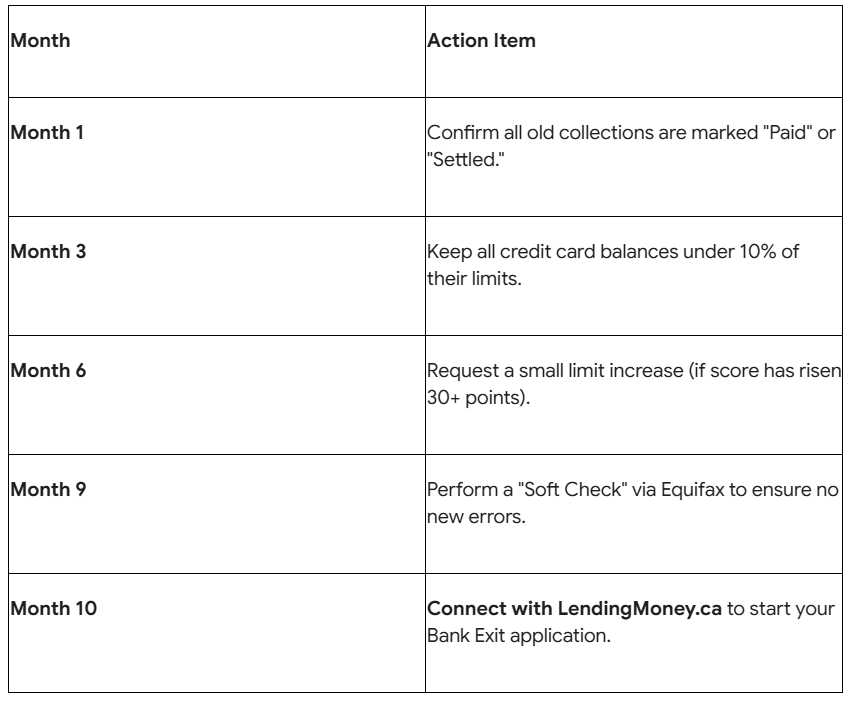
The Goal: Graduation Day

Fixing your credit while in a private mortgage requires discipline. You are paying a higher interest rate now so that you never have to pay it again. At LendingMoney.ca, we provide the tools and the coaching to ensure that when your private term ends, you are ready for a prime-rate mortgage.

Currently in a private mortgage and want to see your “Graduation Date”? [Get a Free Credit Rehabilitation Roadmap] from LendingMoney.ca today and let’s start moving you back to the bank.

Read blog – Breaking the Cycle: A Guide to Loans for Debt Consolidation with Poor Credit

Blogs Financial Recovery Personal Finance Private Lending

The Strategic Second: Why Canadians are Turning to Second Mortgages in 2026

For many, the term “second mortgage” once carried a certain stigma. It was something whispered about in times of crisis. However, as we move through 2026, the narrative has shifted. Today’s homeowners are using second mortgages to protect their low-rate first mortgages, fuel business growth, and navigate a complex tax environment.

A second mortgage is a loan secured against your property that sits behind your primary mortgage on the title. Because the lender is in “second position,” they take on more risk (if the home is sold, the first lender is paid first), which results in higher interest rates. But despite the cost, the benefits often far outweigh the price of the interest.

Here are the primary reasons why second mortgages have become the “Hero Move” for Ontario homeowners this year.

1. Protecting a Low-Rate First Mortgage

This is the #1 reason for a second mortgage in 2026. Many homeowners locked into 5-year fixed rates in 2021 or 2022 at rates between 1.5% and 2.5%.

If you need $50,000 today, you have two choices:

  • Refinance: Break your entire mortgage and move the whole balance to today’s rate (likely 4.5% – 5.5%). This triggers massive prepayment penalties and increases the cost of your entire debt.
  • The Second Mortgage: You leave your 2% mortgage exactly where it is. You only pay a higher rate on the new $50,000.

By keeping your “A-Lender” rate untouched, you save thousands in interest over the remaining years of your term.

2. High-Interest Debt Consolidation

In 2026, credit card interest rates have climbed to 21% – 24%, and personal lines of credit aren’t far behind. For a homeowner carrying $40,000 in consumer debt, the monthly interest alone can be “choking” their cash flow.

A second mortgage allows you to:

  • Replace 22% interest with 9% – 12% interest.
  • Collapse five or six monthly payments into one.
  • The Credit Rehab Win: By paying off your credit cards in full, your credit utilization drops to zero, often causing your credit score to jump 50 to 100 points in a single 90-day cycle.

3. Resolving CRA Tax Arrears

As we’ve discussed in our tax series, the CRA is the only creditor in Canada with “Super Priority.” They don’t need a court order to freeze your bank account or garnish your wages.

Traditional banks will almost never give you money to pay off the CRA. They view tax debt as a sign of instability. A private second mortgage lender, however, is happy to lend you the funds to “kill” the tax debt.

  • The Goal: Pay the CRA today to stop the 7% daily compounding interest and prevent a lien from being registered on your title.

4. Funding Value-Add Renovations

In 2026, many Canadians have decided to “Love It, Don’t List It.” With the costs of moving (land transfer taxes, real estate commissions, and legal fees) reaching $50,000+, many families prefer to renovate their existing space.

A second mortgage is perfect for:

  • ADUs (Additional Dwelling Units): Converting a basement or garage into a rental suite to generate extra income.
  • Major Overhauls: Kitchens and bathrooms that add more value to the home than the cost of the loan.
  • Speed: Unlike a bank-led “Improvement Mortgage,” which requires multiple inspections and draws, a second mortgage provides the cash upfront so you can pay your contractors and get the job done.

5. Business Capital and Entrepreneurial Growth

Banks are notoriously difficult for small business owners. If you are self-employed or starting a new venture in 2026, a bank will likely want to see two years of perfect tax returns before they lend you a dime.

Entrepreneurs use second mortgages as working capital:

  • To buy inventory in bulk at a discount.
  • To fund a marketing push or hire a key employee.
  • To bridge the gap while waiting for large invoices to be paid.
    Since the loan is based on equity, not your business’s current P&L statement, it is the fastest way to inject cash into a growing company.

6. Helping the Next Generation (The Bank of Mom and Dad)

With the 2026 real estate market still challenging for young buyers, many parents are using second mortgages to “gift” a down payment to their children.

  • By taking out a $100,000 second mortgage, parents can help their child enter the market today rather than waiting 10 years to save. This allows the family to build wealth across two properties simultaneously.

7. Emergency and Life Events

Life doesn’t always follow a budget. Unexpected medical expenses, a sudden divorce settlement, or helping a family member in a crisis can require a large amount of liquidity instantly.
A second mortgage can be funded in as little as 3 to 5 business days, making it the “Emergency Fund” for homeowners who are asset-rich but cash-poor.

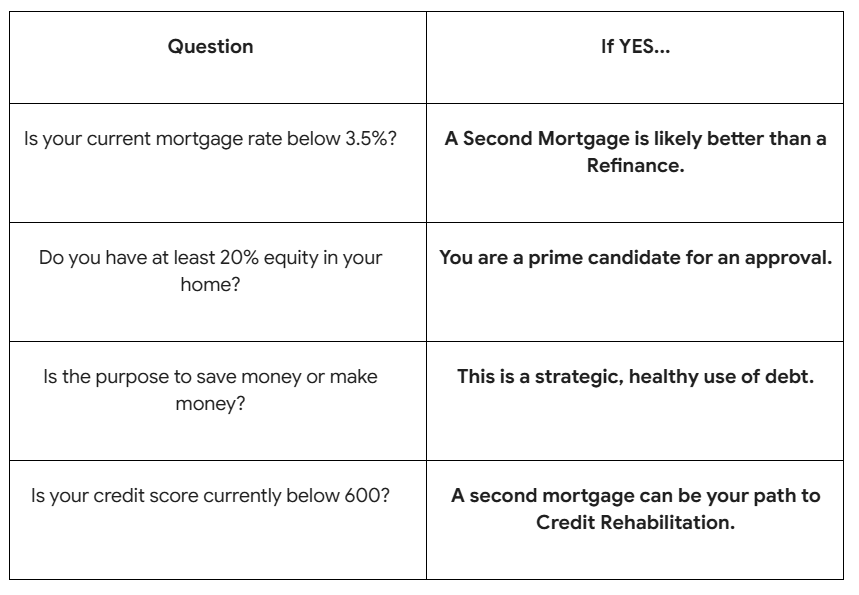
Is a Second Mortgage Right for You? (The 2026 Checklist)

Your Home, Your Future

At LendingMoney.ca, we don’t just see a second mortgage as a loan; we see it as a pivotal financial moment. Whether you are consolidating debt to save your credit or investing in your business to save your future, we match you with the lenders who value your equity and your story.

Ready to see how much equity you can unlock? [Get a Second Mortgage Quote] from a Financial Hero at LendingMoney.ca today. We’ll help you do the math and find the smartest path forward.

Blogs Credit Rehabilitation Mortgage Tips Ontario Real Estate Personal Finance Private Lending

The 2026 Guide to Private Mortgage Discharges

You’ve done the hard work: you’ve improved your credit, stabilized your income, or sold your property. Now comes the final step in your “Private-to-Bank” journey: The Discharge.

In 2026, discharging a private mortgage in Ontario is a formal legal process. While a bank discharge is often automated, a private discharge requires coordination between two sets of lawyers and a “Cessation of Charge” on your property title. At LendingMoney.ca, we consider this the “Graduation Day” of your Credit Rehabilitation.

Here is your 2026 guide to the final step of exiting a private mortgage.

1. Requesting the Payout Statement

The discharge process begins with a document called a Payout Statement (or Discharge Statement). This isn’t just your remaining balance; it is a legally binding breakdown of every dollar needed to release the lender’s claim on your home.

  • What’s Included: The principal balance, interest owing up to the payout date, and the Lender’s Discharge Fee (typically $300–$600 in 2026).
  • The “Daily Interest” Factor: Payout statements include a “per diem” (daily) interest amount. This ensures that if your new bank loan closes a day late, the private lender still gets their exact interest.
  • The Hero Move: Request your statement at least 10 business days before your closing date. Private lenders are often individuals or small firms and may not produce documents as quickly as a big bank.

2. The Lawyer’s Role: Cessation of Charge

In Ontario, you cannot simply hand a check to a private lender and be done. The “Charge” (the mortgage) is registered against your home’s title at the Land Registry Office.

  • The Process: Your lawyer sends the funds to the lender’s lawyer. In exchange, the lender’s lawyer provides a Discharge of Charge (Form 4).
  • The 2026 Registry: Once this is electronically filed, the mortgage is “discharged,” and your title is officially clear. This is vital because you cannot secure a new “A-Lender” mortgage or sell your home until the old private charge is gone.

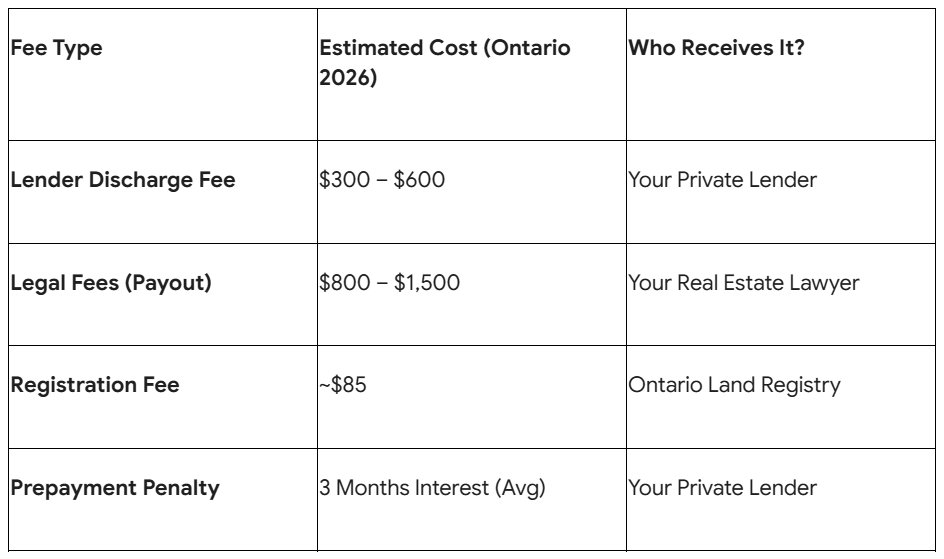
3. 2026 Payout Costs: What to Expect

Discharging a mortgage isn’t free. In 2026, you should budget for the following “Exit Costs”:

The Strategy: At LendingMoney.ca, we try to bake these costs into your new mortgage so you don’t have to pay them out of pocket on closing day.

4. The Holdback Trap

Sometimes, a private lender will “hold back” a small amount (e.g., $500–$1,000) for a few days after the payout to ensure all checks clear and there are no outstanding property tax issues.

  • The Hero Move: Ensure your lawyer confirms in writing that the holdback will be released within a specific timeframe (usually 48–72 hours).

5. Dealing with Difficult Private Lenders

Under the Ontario Mortgages Act (Section 22), a lender cannot “refuse” to give you a discharge statement if you are paying them in full.

  • The Reality: In 2026, if a private lender is ignoring your requests or trying to charge “mystery fees” at the last minute, your lawyer can apply for a Court Order to discharge the mortgage.

Discharge Checklist (2026)

  • [ ] 15 Days Out: Confirm your lawyer has requested the Payout Statement.
  • [ ] 10 Days Out: Review the statement for any “hidden fees” we didn’t agree to in the original commitment.
  • [ ] Closing Day: Ensure the funds are wired (not mailed) for the fastest discharge.
  • [ ] Post-Closing: Ask your lawyer for the “Registered Discharge” or a copy of your new, clean Title Search.

Celebrate Your Graduation

Discharging your private mortgage is the final hurdle in your Credit Rehabilitation. It means you have moved from “Emergency Financing” back into “Mainstream Stability.”

At LendingMoney.ca, we love seeing our clients reach this stage. It means the “bridge” did its job, and you are now standing on solid financial ground.

Getting ready to pay off your private loan? [Connect with our Discharge Specialist] at LendingMoney.ca. We’ll coordinate with your lawyer and ensure your exit is as smooth (and cheap) as possible.