
Blogs Tax Debt Solutions

Unexpected Debt to the CRA? What can you do to pay what you owe?

It is April 2026, and for many Canadians, the arrival of a Notice of Assessment (NOA) from the CRA brings a stomach-turning surprise: a balance owing that wasn’t in the budget.

Whether it’s due to a self-employment tax miscalculation, a clawback of benefits, or a simple filing error, unexpected tax debt is a financial fire that needs to be put out quickly. In 2026, the CRA’s interest rate on overdue tax sits at 7% compounded daily, meaning your debt grows every single morning you leave it unpaid.

At LendingMoney.ca, we specialize in Credit Rehabilitation. We know that tax debt is the #1 hurdle to getting a traditional mortgage or car loan. Here is what you need to do if you find yourself with an unexpected CRA bill this tax season.

1. Don’t Ghost the CRA (File Anyway!)

The biggest mistake homeowners make is delaying their tax filing because they know they can’t pay.

  • The Penalty: If you file late and owe money, the CRA hits you with an immediate 5% penalty on the balance, plus 1% for every month you are late.
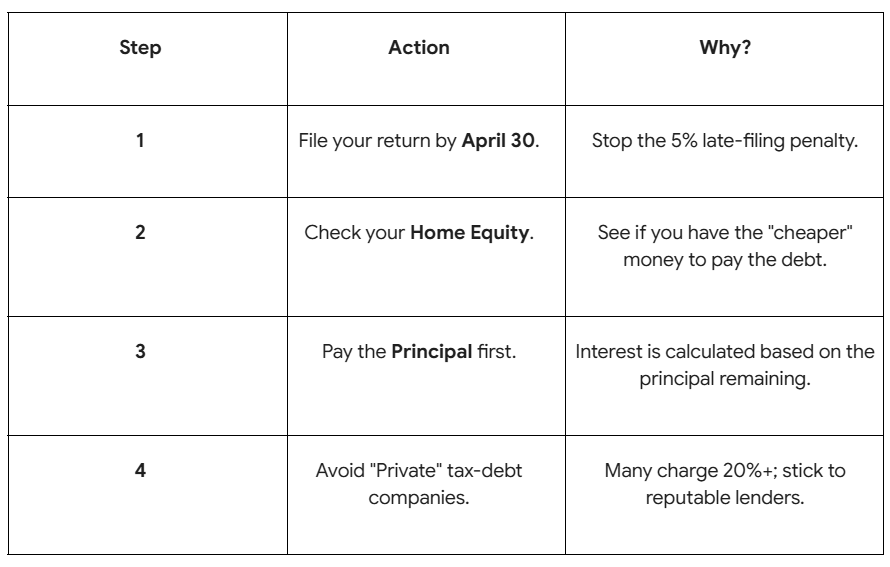
  • The Hero Move: File your taxes by the April 30th deadline (or June 15th if self-employed), even if you have $0 in the bank. Filing on time stops the late-filing penalty, leaving you with only the interest to manage.

2. Request a Payment Arrangement

If you can pay off the debt within a few months, the CRA is surprisingly reasonable-if you talk to them first.

  • TeleArrangement: You can call the CRA to set up a “Pre-Authorized Debit” plan to pay your debt over time (usually up to 12 months).
  • The Reality: While this stops aggressive collection action (like wage garnishing), the 7% daily interest continues to run. You are essentially taking a high-interest loan from the government.

3. Leverage Your Home Equity (The Interest “Hack”)

If your tax debt is substantial ($10,000 to $100,000+), using a payment plan is often the most expensive way to handle it.

  • The 2026 Math: * CRA Interest: ~7% daily compounded (effectively much higher).
  • Home Equity Loan: monthly compounded.
  • The Move: Using a Home Equity Line of Credit (HELOC) or a Second Mortgage from LendingMoney.ca to pay the CRA in full immediately. You swap “predatory” daily interest for a stable, lower-rate mortgage payment. Plus, the CRA is paid, which clears your name for future bank approvals.

4. The Taxpayer Relief Hail Mary

Did your debt happen because of a serious illness, a death in the family, or a natural disaster?

  • The Option: You can apply for Taxpayer Relief (Form RC4288).
  • What it does: If approved, the CRA can waive the penalties and interest on your account.
  • The Catch: They almost never waive the principal tax you owe. You still need a plan to pay the core debt, which is where an equity-based “bridge” loan becomes essential.

5. Why Banks Say No to Tax Debt

If you walk into a “Big Six” bank with a $20,000 CRA bill, they will likely decline your loan.

  • The Reason: Banks view CRA debt as a “Super Lien.” They know the government can freeze your accounts or put a lien on your house that takes priority over the bank’s own mortgage.
  • The LendingMoney.ca Solution: As an Alternative Lender, we aren’t afraid of CRA debt. We provide the funds to pay the CRA today, so your credit can begin its Rehabilitation tomorrow. Once the CRA is out of the picture, the big banks will be happy to talk to you again in a year.

CRA Debt Survival Checklist (April 2026)
Turn Your Tax Debt into a Strategy

Unexpected debt to the CRA is a crisis, but it’s also an opportunity to restructure your finances. By using your home equity to clear the slate, you protect your credit score, stop the daily interest bleed, and regain control of your financial future.

Stunned by your 2026 Tax Bill? [Connect with a Financial Hero] at LendingMoney.ca. We’ll look at your home equity and find a way to pay the CRA so you can get back to what matters.

Read blog How to Pay CRA Debt With Home Equity

Blogs Debt Consolidation Debt Relief Financial Recovery Tax Debt Solutions

How to Pay CRA Debt With Home Equity

For many Canadians, debt owed to the Canada Revenue Agency (CRA) is the most stressful type of financial burden. Unlike a credit card company, the CRA has “super-priority” powers – they can garnish your wages without a court order, freeze your bank accounts, and even place a “Restricting Lien” on your home.

In 2026, the CRA’s daily compounded interest rates remain significantly higher than secured mortgage rates. If you are a homeowner, using your home equity to clear tax debt isn’t just a convenience – it’s a vital Credit Rehabilitation strategy to protect your property.

1. Why the CRA Debt is a “Financial Fire”

The CRA is not a typical lender. They don’t care about your credit score, but they do care about getting paid.

  • Daily Compounding Interest: In 2026, CRA interest rates on overdue taxes are roughly 9% to 10%, compounded daily.
  • The “Lien” Risk: If you ignore the debt, the CRA can register a lien against your property. This makes it almost impossible to sell your home or renew your mortgage with a traditional bank until the debt is paid.
  • The Bank’s Reaction: If a “Big Six” bank sees you have CRA debt, they will often issue an immediate decline on any loan or mortgage application. They see the CRA as a “predatory” creditor that has a higher claim to your assets than they do.

2. Option A: The Mortgage Refinance (The Clean Sweep)

This is the most common way to handle large tax bills. You replace your current mortgage with a new one that includes the amount you owe to the CRA.

  • How it Works: If you have $50,000 in tax debt, you increase your mortgage by that amount and the lender pays the CRA directly at the time of closing.
  • The Benefit: You swap 10% daily interest for a much lower mortgage rate.
  • The 2026 Rule: You can typically borrow up to 80% of your home’s appraised value.

3. Option B: The Second Mortgage (The “Bridge” Solution)

If you have a very low interest rate on your primary mortgage that you don’t want to lose, a Second Mortgage is the “Hero Move.”

  • How it Works: You take out a separate, smaller loan that sits behind your main mortgage.
  • The Benefit: You don’t have to break your first mortgage or pay “prepayment penalties.”
  • Why it’s used for CRA debt: Second mortgages are often easier to qualify for if your credit is “bruised” by your tax issues. At LendingMoney.ca, we use this as a 12-month bridge to pay the CRA, clear your name, and then move you back to a traditional lender once the “fire” is out.

4. Option C: The Home Equity Line of Credit (HELOC)

If your tax debt is smaller or you are self-employed and expect ongoing tax obligations, a HELOC offers the most flexibility.

  • How it Works: It’s like a giant credit card secured by your house. You only pay interest on what you use.
  • The Benefit: You can pay the CRA immediately and then pay back the HELOC on your own schedule.
  • The 2026 Requirement: Most lenders require a credit score of 680+ for a HELOC. If your score has dropped due to tax arrears, you may need to look at Options A or B first.

5. What if the CRA Already Has a Lien on My House?

Many homeowners think that once a lien is registered, they are “stuck.” This is a myth.

The LendingMoney.ca Strategy: We are an alternative lender who specializes in “Lien Payoffs.”

  1. Approve the loan based on your home’s equity.
  2. On closing day, the lawyer sends the funds directly to the CRA.
  3. The CRA issues a “Cessation of Charge” (discharges the lien).
  4. Your title is clear, your “super-priority” debt is gone, and you can finally breathe again.

6. The 2026 Taxpayer Relief Factor

While you are organizing your home equity, don’t forget about Taxpayer Relief. In 2026, the CRA still allows for the “Cancellation of Penalties and Interest” in cases of extreme financial hardship or circumstances beyond your control (like a serious illness).

  • The Pro-Tip: Pay the principal tax debt using your home equity first. This shows the CRA you are acting in “Good Faith,” which significantly increases your chances of getting the extra penalties waived later.

Don’t Let the CRA Own Your Home

Tax debt is heavy, but your home equity is the lever that can lift it. By moving high-interest, high-stress tax debt into a low-interest, structured mortgage, you protect your family’s most valuable asset and begin your path to Credit Rehabilitation.

Ready to see how much equity you can unlock to clear your tax bill? [Get a Confidential CRA Debt Assessment] with LendingMoney.ca today.

Read Blog – The Difference Between a B-Lender and an Alternative Lender