Alternative Lending Blogs Credit Score Personal Finance

The Final Leap: Moving from Alternative Lending back to the Bank

Alternative mortgages and B-Lenders are fantastic “stabilization” tools. They gave you the cash to pay the CRA, consolidate debt, or bridge a gap in your self-employment income. But now that the dust has settled, you likely want the lowest possible interest rate and the prestige of a traditional bank mortgage.

Moving back to an A-Lender requires more than just a good score; it requires a “clean” financial story. Here are the five benchmarks you must hit to graduate in 2026.

1. The 700 Club: Your New Credit Target

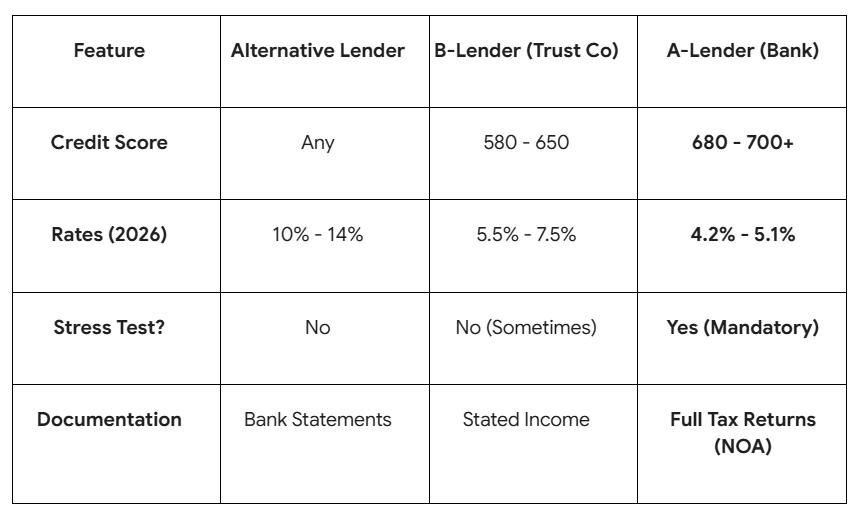
While you can get a B-Lender mortgage with a 600 score, the “Big Banks” in 2026 generally look for a minimum of 680, with 700+ being the “Golden Ticket” for the best advertised rates.

  • The Requirement: You need a “clean” credit bureau for the last 24 months. This means zero late payments on any credit card, car loan, or phone bill since you started your alternative mortgage.
  • The “Tradeline” Rule: Banks want to see at least two active credit cards with limits over $2,000, both with a history of at least two years.

2. The NOA Standard: Tax Transparence

This is often the biggest hurdle for entrepreneurs and those who previously owed the CRA.

  • The Rule: An A-Lender will require your two most recent Notices of Assessment (NOAs). They must show that you owe $0.00 to the government.
  • The 2026 Shift: Banks are now using digital verification. They may ask for a “Proof of Income” statement directly from the CRA portal. If there is any hint of a payment plan or outstanding balance, the bank will decline the application immediately.

3. The Federal Stress Test (Guideline B-20)

When you are with an alternative lender or a private lender, you often don’t have to pass the federal stress test. To move back to a bank, you must pass it.

  • The Math: In 2026, with the Bank of Canada policy rate near 2.25%, the “Benchmark” stress test is typically around 7.25%.
  • The Goal: Your total housing costs (mortgage + taxes + heat) must not exceed 39% of your gross income, and your total debt (including car loans) must not exceed 44%.

4. Stability of Income

Banks love “T4” employees (salaried workers). If you are self-employed, graduating back to a bank is harder but not impossible.

  • The 2-Year Average: The bank will take your “Line 15000” income from your last two years of tax returns and average them.
  • The Hero Move: If your business has grown significantly, we at LendingMoney.ca advise you to package your corporate financial statements to show “add-backs”-proving your true earning power is higher than what you show the taxman.

5. Property Appraisal & Marketability

A-Lenders are the most conservative when it comes to the “collateral” (your house).

  • The Inspection: If you used your alternative mortgage to fund renovations, the bank will want to see that those renovations are 100% complete. They will not take over a mortgage on a “construction zone.”
  • Location: Banks prioritize properties in major urban centers. If your home is in a very remote area, graduating back to a Big Six bank may require a higher credit score or a lower Loan-to-Value (LTV) ratio.

The Graduation Roadmap (Alternative → B → A)
Why Use LendingMoney.ca for Your Final Leap?

Most people think they can just walk into their local bank branch once their credit is fixed. However, if that bank sees a history of a private mortgage on your title, they may still be hesitant.

At LendingMoney.ca, we know which A-Lender underwriters are the most flexible with “recovered” borrowers. We tell your story in a way that highlights your successful rehabilitation, ensuring the bank sees you as a low-risk, high-value client.

Are you ready to stop paying “alternative” rates and start paying “bank” rates? [Request a Bank-Ready Audit] from LendingMoney.ca today. We’ll verify your score, your ratios, and your NOAs to see if today is your Graduation Day.

Read blog- How to Pay CRA Debt With Home Equity
Alternative Lending Blogs Mortgage Renewal Private Mortgages

The Silent Equity Killer: How to Avoid Private Mortgage Renewal Fees

If you have a private mortgage, you probably remember the “Lender Fee and Broker Fee you paid to get it. What many homeowners don’t realize is that most private lenders charge those fees every single year you stay with them.

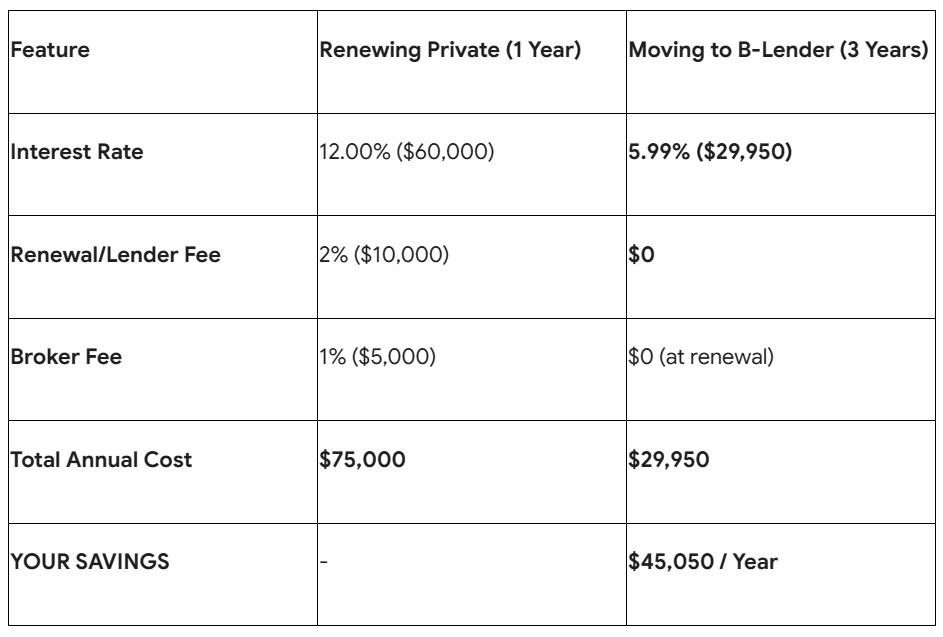
In 2026, with private interest rates already sitting between 10% and 15%, adding a 2% renewal fee means you are effectively paying an APR of nearly 17%. If you have a $500,000 mortgage, that’s $10,000 vanished in a single signature. Here is how to stop the bleed.

1. The 120-Day Rule (Start Before They Do)

Private lenders count on you being “trapped.” They often send your renewal notice just 21 to 30 days before the term ends, leaving you with no time to find an alternative.

  • The Hero Move: Start your search 4 months (120 days) before your maturity date.
  • The LendingMoney.ca Advantage: We track your maturity date from day one. At the 4-month mark, we perform a “Financial Health Check” to see if your Credit Rehabilitation is far enough along to move you to a B-Lender or a Credit Union where there are zero renewal fees.

2. Leverage Your Improved Story

A private lender charges a renewal fee because they claim the “risk” is still high. You need to prove them wrong.

  • Show the Progress: Since you took the private loan, have you paid off a collection? Has your income increased? Have you made every private mortgage payment on time?
  • The Negotiation: At LendingMoney.ca, we use these “wins” to negotiate. We tell the lender: “Our client’s credit score has jumped 60 points. They are now eligible for a B-Lender. If you want to keep this loan, you must waive the renewal fee.”

3. The B-Lender Pivot (The Fee-Free Zone)

The best way to avoid private renewal fees is to stop being a private borrower. In 2026, the jump from “Private” (C-Lender) to “Alternative” (B-Lender) is the most important step in your journey.

  • B-Lenders (Trust Companies): Unlike private individuals, B-Lenders are regulated institutions. They generally do not charge renewal fees. Once you are in, you simply renew at the current market rate.
  • The Savings: Moving to a B-Lender doesn’t just lower your interest rate; it saves you that 1%–2% annual fee forever.

4. Don’t Auto-Renew by Silence

Many private mortgage contracts have a clause that says if you don’t respond, the mortgage “auto-renews” for another year, including the fees.

  • The Action Step: Read your original commitment letter. Look for the “Renewal” section.
  • The 2026 Reality: Some lenders are now charging “Exit Fees” if you leave. We review your contract to ensure the cost of leaving is smaller than the cost of staying. Usually, paying a small discharge fee is much cheaper than paying a massive renewal fee.

5. Use a Bridge-to-Bank Strategy

If your credit isn’t quite ready for a bank yet, we can sometimes find a “Semi-Private” institution. These are lenders that sit between a private individual and a bank.

  • The Benefit: They offer 2-year or 3-year terms.
  • Why this works: By taking a 3-year term, you only pay a fee once instead of paying a renewal fee every 12 months. This gives you three years of stable payments to finish your Credit Rehabilitation.

Comparison: The Cost of Staying vs. The Cost of Moving (2026)

Based on a $500,000 Mortgage

Your Equity Belongs to You, Not the Lender

At LendingMoney.ca, we believe private mortgages should be short, sharp, and successful. If you are entering your second or third year in a private loan, you are no longer using a “bridge”, you are living on it.

Is your private mortgage renewal coming up in the next 120 days? [Upload Your Current Statement] for a free Exit Analysis. Let’s stop the fees and start your graduation back to the bank.