

Blogs Mortgage Renewal

How a CRA Lien Affects Your Mortgage Renewal

A CRA lien is one of the most serious red flags a mortgage lender can encounter. In the 2026 lending environment, banks have become even more cautious about property titles, and a lien from the Canada Revenue Agency (CRA) can bring your mortgage renewal to a grinding halt.

If you are approaching your renewal date and have an outstanding tax debt, here is how a CRA lien changes the game and what you can do to save your home.

1. The Super Priority Problem

The reason banks fear a CRA lien is simple: The government usually gets paid first. In Canada, the CRA can exercise Super Priority for certain debts (like unremitted GST/HST or Payroll Source Deductions). Even if your bank registered their mortgage years ago, a CRA “Deemed Trust” claim can actually leapfrog the bank in the payout line.

  • The Impact on Renewal: When you renew, your bank performs a title search. If they see a CRA lien (Notice of Certification), they may refuse to renew your mortgage because their security is now at risk. They don’t want to be “second in line” behind the taxman.

2. You Lose Your Switching Power

In 2026, many homeowners shop around at renewal to find a lower interest rate.

  • The Trap: A new lender will never take on a mortgage if there is an existing CRA lien on the title. You are effectively “trapped” with your current lender, who may charge you a much higher “default” rate because they know you can’t leave.
  • The Result: You lose all your negotiating leverage. You are forced to accept whatever rate your current lender offers-if they offer one at all.

3. The Automatic Payout Requirement

If your current lender does agree to renew or if you are trying to refinance to get extra cash, the CRA lien must be dealt with as part of the legal process.

  • How it works: Your lawyer is legally required to use the mortgage funds to pay off the CRA lien before any money goes to you or your other debts.
  • The Risk: If the tax debt is large enough, it might eat up all your equity, leaving you with a larger mortgage but no actual cash in hand to fix your financial situation.

4. The 2026 Risk Premium

Lenders in 2026 use AI-driven risk modeling. A CRA lien is seen as a sign of “systemic financial distress.”

  • The Cost: Even if a lender agrees to renew with a lien on title, they may add a “Risk Premium” to your interest rate. You could end up paying 2% to 3% more than a neighbor with a clean title. Over a 5-year term, this can cost you tens of thousands of dollars.

How to Fix the Situation Before Renewal

If you know you have a CRA debt but they haven’t placed a lien on your house yet, now is the time to act.
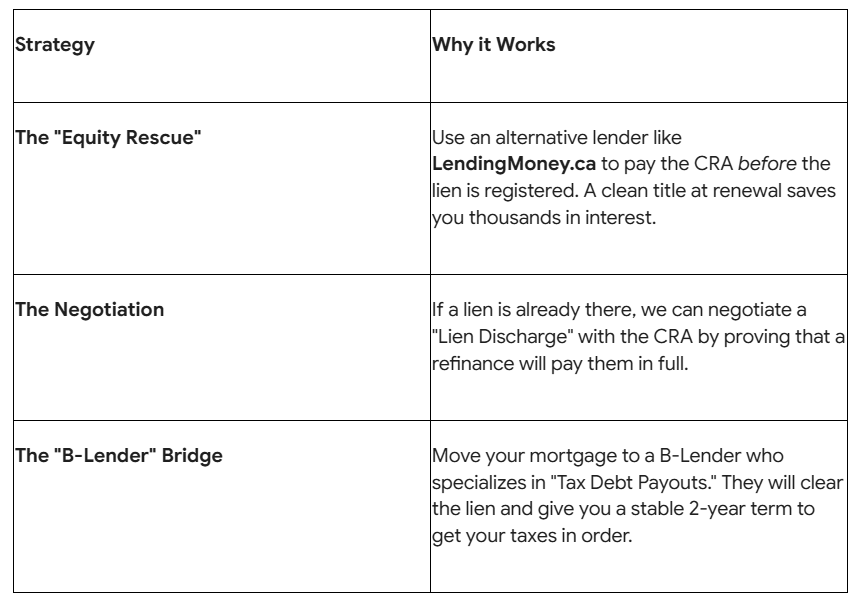
Don’t Let a Lien Steal Your Home

A CRA lien is a legal lock on your house, but LendingMoney.ca has the keys. We specialize in helping homeowners pay off the government so they can walk into their mortgage renewal with a clean title and a Financial Hero status.

Is your mortgage renewal coming up while you owe the CRA? [Connect with a Tax-Debt Specialist] at LendingMoney.ca today. We’ll help you clear the title and keep your home.

Reed More Blog – How to Fix Your Credit After a CRA Debt Settlement
CRA Rebuild Credit

The Aftermath: How to Rebuild Your Credit After a CRA Lien is Removed

Paying off the Canada Revenue Agency (CRA) and having a property lien discharged is a massive victory. You’ve stopped the daily compounding interest and protected your home. But for many Canadians, the celebration is cut short when they check their credit score a month later and see it hasn’t budged – or worse, it’s still being dragged down by the ghost of the lien.

In 2026, a CRA lien is considered a Public Record. Even after it is paid, the history of that legal action can stay on your credit report for up to six years. At LendingMoney.ca, we don’t just help you clear the debt; we help you navigate the aftermath. Here is how to rebuild your credit after a CRA lien has been removed.

1. Confirm the Release of Lien is Registered

The CRA does not automatically notify the credit bureaus when you pay your debt. They only update the Land Registry Office.

  • The Step: Once your debt is paid, the CRA will issue a Cessation of Charge or a Discharge of Lien. Ensure your lawyer has registered this document at the Land Registry Office.
  • The Verification: Perform a “Title Search” on your property a few weeks after payment to confirm the lien is officially gone. Without this legal step, the credit rebuilding process cannot begin.

2. Update the Credit Bureaus Manually

Because a tax lien is a matter of public record, Equifax and TransUnion only update their files when their automated systems sweep the public courts – which can take months.

  • The Strategy: Be proactive. Send a copy of your Certificate of Discharge directly to both Equifax and TransUnion.
  • What it Changes: They won’t delete the lien history, but they will update the status to Paid or Satisfied. To a 2026 lender, a satisfied lien is a sign of someone who took responsibility, whereas an “Active” lien is an automatic decline.

3. Distance Yourself from the R9 Mentality

If your tax issues were severe, some of your other accounts may have slipped into “R9” (Collection) status.

  • The Problem: The CRA lien is the “Big Fire, but the small “brush fires (like a $200 forgotten phone bill) are what keep your score in the 500s.
  • The Rehabilitation Move: Use a portion of the funds from your LendingMoney.ca Equity Loan to clear every single small collection account on your report. A Clean report with a satisfied lien is much easier to rebuild than a report littered with active mini-collections.

4. Re-Establish Tradelines (The 2+2+2 Rule)

To get back to A-Lender mortgage rates after a lien, you need to prove you are a reliable borrower again. In 2026, we recommend the 2+2+2 Rule:

  • 2 Years: Of clean, post-lien history.
  • 2 Credit Cards: With at least $1,500 to $2,000 limits (Secured cards are fine!).
  • 2 Installment Loans: Such as a car loan or a credit-builder loan.

5. Master the Interest-Free Growth Strategy

The fastest way to boost a score after a public record hit is to lower your Credit Utilization Ratio.

  • The Math: If your new secured card has a $1,000 limit, never let the balance sit above $100 (10%).
  • The 2026 Trick: Pay your balance three days before the statement date. This ensures that when the bureau “records” your balance, it shows as $0 or near-zero, which maximizes your score jump.

6. The Human Element: Explain the Story

Even with a lower score, your 2026 financial story matters. If you are applying for credit while the lien is still on your record (marked as Paid):

  • Provide a Letter of Explanation: Explain the circumstances (e.g., Business downturn during 2024,or Medical emergency).
  • Show the Proof: Include the CRA discharge papers. Lenders in the Alternative and B-Lending space – like our partners at LendingMoney.ca -are much more likely to approve a Rebuilder who is transparent about their past.

Your Score is a Moving Target

A CRA lien is a heavy hit, but it isn’t permanent. By clearing the debt, updating the bureaus, and adding new, positive “Hero” tradelines, you can move from a “Lien-Scarred” report to a “Mortgage-Ready” report in as little as 12 to 24 months.

Ready to start your post-lien recovery? [Connect with a Financial Hero] at LendingMoney.ca. We’ll help you structure the financing to pay the CRA and build the roadmap to your future R1 rating.