Blogs Financial Recovery Mortgage Tips Mortgages

Job Loss & Mortgages: Your 30-Day Action Plan

Unexpected job loss is a “Financial Heart Attack.” In the first few hours, your mind immediately goes to the biggest bill on the table: the mortgage. In the 2026 economic landscape, lenders and insurers have become more proactive about “Hardship Management.” The goal of the bank is not to take your house-it’s to keep you as a paying customer in the long run.If you’ve recently lost your job, your first 30 days are critical for protecting your title and your credit score. Here is your week-by-week survival guide.

Week 1: The Gather & Assess Phase

Before you call the bank, you need to know exactly where you stand.

  • Review Your Insurance: Check your mortgage documents or employer benefits for Job Loss Insurance (also called Creditor Insurance). Many homeowners pay for this without realizing it. It can cover your mortgage payments for 6–9 months while you look for work.
  • Identify Your Insurer: Is your mortgage insured by CMHC, Sagen, or Canada Guaranty? (This is typical if you put down less than 20%). These insurers have “Homeowner Assistance Programs” specifically designed to prevent foreclosure after a layoff.
  • Calculate Your “Runway”: Look at your liquid savings. How many months can you pay the mortgage if you cut all non-essential spending?

Week 2: The Heroic Outreach

The biggest mistake homeowners make is waiting until they miss a payment to call the bank.

  • The Call: Contact your lender’s “Loss Mitigation” or “Specialized Collections” department.
  • The Script: I have experienced a temporary job loss. I have never missed a payment, and I want to keep it that way. What hardship options do you have available?”
  • The Options: In 2026, lenders may offer:
  • Skip-a-Payment: Most banks allow one “vacation” payment per year.
  • Interest-Only Payments: Reducing your payment to just the interest portion for 3–6 months.
  • Payment Deferral: Pausing payments for up to 4 months (the interest is usually added to the back of the loan).

Week 3: The Strategic Pivot

If you suspect your job search might take longer than 90 days, you need a more robust solution than a simple “skip.”

  • Amortization Extension: If you have enough equity, you can “stretch” your mortgage back out to 30 years. This lowers your monthly payment permanently, giving you a massive cash-flow boost while you’re between roles.
  • The “Bridge” Equity Loan: At LendingMoney.ca, we help homeowners set up a “Emergency Line of Credit” or a small second mortgage while they still have some income/severance left. This provides a “War Chest” of cash that you can use to pay your first mortgage until you land your next “Hero” role.

Week 4: The Credit Shield

By day 30, you need to ensure your credit score isn’t being collateral damage.

  • Protect the R1: Your mortgage is an “R1” (paid on time) on your credit report. Even one “R2” (30 days late) can prevent you from refinancing or renewing at a good rate later.
  • The Consolidation Strike: If you are using credit cards to pay for groceries so you can afford the mortgage, stop. [Connect with LendingMoney.ca] to consolidate those 22% interest cards into a lower-rate equity loan. It’s better to have a slightly larger mortgage than a mountain of credit card debt that you can’t escape.

Job Loss Strategy Comparison (2026)

OptionBest For…Impact on Credit
Payment DeferralVery short-term gaps (1-3 months).Neutral (if approved).
Amortization StretchLong-term cash flow relief.Positive (Keeps payments low).
Equity Rescue LoanTotal income loss / No savings.Positive (Prevents missed payments).
Doing NothingNever Recommended.Fatal (Leads to Power of Sale).

You Are Not Your Employment Status

A layoff is a temporary setback, but your home is your foundation. At LendingMoney.ca, we don’t just look at your current pay stub; we look at your career history and your home’s equity to find a way through the storm.

Did you just receive a layoff notice? Don’t wait for Day 31. [Request a Hardship Analysis] from LendingMoney.ca today. Let’s protect your home while you find your next big opportunity.

Alternative Lending Blogs Mortgage Tips

The Underwriter’s Ear: How to Explain a Credit Hit and Win Your Mortgage

In the 2026 Canadian mortgage market, underwriters are no longer just looking at your 3-digit score; they are looking at your story. Thanks to new OSFI (Office of the Superintendent of Financial Institutions) guidelines, lenders are required to perform “enhanced due diligence” on any application with historical credit “bruising.”

If a lender asks you for a Letter of Explanation (LOX) regarding a late payment, a collection, or a past insolvency, don’t panic. This is actually a massive opportunity. It’s your chance to move beyond the cold math of the credit bureau and prove your “Hero” status.At LendingMoney.ca, we help our clients draft these letters every day. Here is the 2026 playbook for explaining a credit hit to a mortgage underwriter.

1. The Three Golden Rules of the LOX

Before you start typing, keep these three principles in mind:

  • Be Honest: Underwriters have access to more data than ever before. If you try to hide a detail, they will find it, and your application will be declined for “misrepresentation.”
  • Be Concise: An underwriter reviews dozens of files a day. They don’t want a 10-page novel; they want three paragraphs that explain the What, the Why, and the Resolution.
  • Be Factual: Avoid emotional language. Don’t say, “It was a really hard time.” Instead, say, “Due to a medical leave between June and August 2024, my household income was reduced by 40%.”

2. The Structure of a Winning Explanation

A professional Letter of Explanation should follow this exact 3-part flow:

Part A: The Incident (What Happened?)

Identify the specific item on your credit report.

  • Regarding the 30-day late payment on my RBC Credit Card in October 2024…

Part B: The Extenuating Circumstance (The Why)

Explain the specific, one-time event that caused the issue. Underwriters look for “isolated incidents” rather than “chronic habits.”

  • “This occurred during a transition between employers where my final paycheck was delayed by three weeks.”

Part C: The Resolution (Why it Won’t Happen Again)

This is the most important part. You must prove that the situation has been fixed and your finances are now stable.

  • The account was brought current immediately upon receipt of funds. Since then, I have established a 3-month emergency fund and set up automated minimum payments to ensure no future oversights.

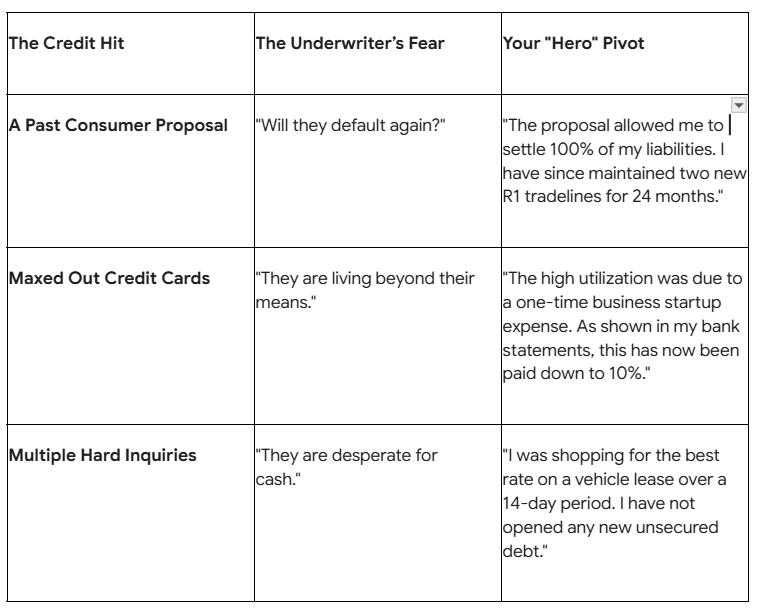
3. Common 2026 “Credit Hits” and How to Pivot Them

4. The Paper Trail (Supporting Documents)

In 2026, a letter isn’t enough – you need receipts. An underwriter is much more likely to accept your explanation if you attach:

  • Medical Notes: If a health issue caused the credit hit.
  • Termination/Hiring Letters: If it was due to a job gap.
  • Release of Lien/Discharge Papers: If it was a legal or tax issue.
  • Bank Statements: Showing the specific payment that cleared the debt.

5. Sample Template: The Late Payment Explanation

RE: Mortgage Application #12345 – Letter of Explanation for Credit Inquiry/Late Payment

To the Underwriting Department,

I am writing to provide context regarding the 60-day delinquency on my [Creditor Name] account in early 2025.

During this period, my family experienced a temporary financial strain due to [Reason: e.g., a localized flood not fully covered by insurance]. This was a one-time, unforeseen event.

Since that time, the account has been paid in full and maintained in good standing. My current employment at [Company] is stable, and I have maintained a 700+ score on all other tradelines. I have also implemented a [e.g., automated savings plan] to ensure total financial resilience moving forward.

Thank you for your consideration of my application.

Sincerely, [Your Name]

Why Your Story Matters at LendingMoney.ca

At LendingMoney.ca, we specialize in “Story-Based Underwriting.” We know that life happens—divorce, illness, and business pivots can all leave a mark on your credit report. But a mark isn’t a dead end.

We work with alternative lenders who prioritize the current person over the past score. We help you draft the explanations that turn a Maybe into an Approved.

Need help explaining your credit history to get a mortgage? [Connect with a Financial Hero] today and let’s tell your story the right way.

Read blog – How to Fix Your Credit After a CRA Debt Settlement

Blogs Mortgage Tips Self-Employed Mortgages

Tax Deductions That Hurt Mortgage Odds

In the world of Canadian tax planning, a “good year” for your accountant is often a “bad year” for your mortgage broker. As we move through 2026, the gap between tax savings and borrowing power has widened, with lenders applying forensic-level scrutiny to self-employed applications.

If you are a business owner planning to buy or refinance a home, you need to understand that every dollar you “write off” to save $0.25 in taxes could cost you $5.00 in mortgage qualifying room. Here are the top five tax deductions that are most likely to hurt your mortgage odds in 2026.

1. Aggressive Vehicle Expenses (Section 9)

While the CRA allows you to deduct fuel, insurance, and repairs based on your business-use percentage, lenders in 2026 are wary of high vehicle write-offs.

  • The Problem: If you brought in $100,000 but claimed $25,000 in “vehicle expenses,” a bank sees your income as $75,000.
  • The 2026 Impact: Lenders now require 24 months of detailed logs to prove these expenses are “non-discretionary.”
  • The “Hero” Strategy: Some alternative lenders will “add back” 15–20% of vehicle expenses to your income, but traditional “A-Lenders” will not. If you’re buying soon, consider scaling back the “detailed method” of vehicle deductions.

2. Large Capital Cost Allowance (CCA) Claims

CCA is “depreciation”—a non-cash expense that allows you to write off the cost of big items like computers (Class 50) or equipment over several years.

  • The Problem: In 2026, the “Immediate Expensing” rules allow you to write off up to $1.5M in equipment instantly. This can drop your taxable income to near-zero.
  • The Lender’s View: While this is a “paper loss” (you didn’t actually lose the money this year), most banks use your Line 15000 (Net Income) as the starting point for their math.
  • The Strategy: At LendingMoney.ca, we work with lenders who understand that CCA is a “non-cash” add-back. We can often add this back to your income to boost your borrowing power, whereas a big bank might just see a “loss” on your T1 General.

3. High Travel & Entertainment Costs

In a post-pandemic world, the CRA has increased scrutiny on “Meal and Entertainment” (50% deductible). Mortgage lenders have followed suit.

  • The Problem: High travel and dining costs suggest a “lifestyle-heavy” business. Lenders worry that if your business hits a slow patch, these costs are actually “essential” to keeping your clients, meaning they aren’t truly discretionary.
  • The 2026 Rule: Lenders are now comparing your entertainment-to-revenue ratio. If you’re spending 15% of your gross income on “networking meals,” it raises a red flag regarding your actual take-home pay.

4. Heavy Home Office Deductions (T2125)

In 2026, the “flat rate” $2/day method is a distant memory. Business owners must use the “Detailed Method,” pro-rating rent, utilities, and mortgage interest.

  • The Problem: While it’s great to write off 15% of your home costs, the lender sees this as a reduction in your net income.
  • The Irony: You are using your home to save on taxes, but that very deduction might prevent you from buying a better home.
  • The Strategy: If you are within 12 months of a mortgage application, speak to your accountant about “smoothing” these deductions. It might be worth paying a little more tax to show the $10,000 higher income the bank needs to see.

5. “Bad Debt” Write-Offs

If a client didn’t pay you and you write it off as “Bad Debt,” it tells a story to a lender.

  • The Problem: Beyond the lower income, a high “Bad Debt” line tells a lender that your business may have “collection issues” or “low-quality clients.”
  • The 2026 Impact: Lenders are looking for stability. They would rather see a slightly lower gross income than a high gross income with 10% in bad debt write-offs. It signals a lack of cash-flow predictability.

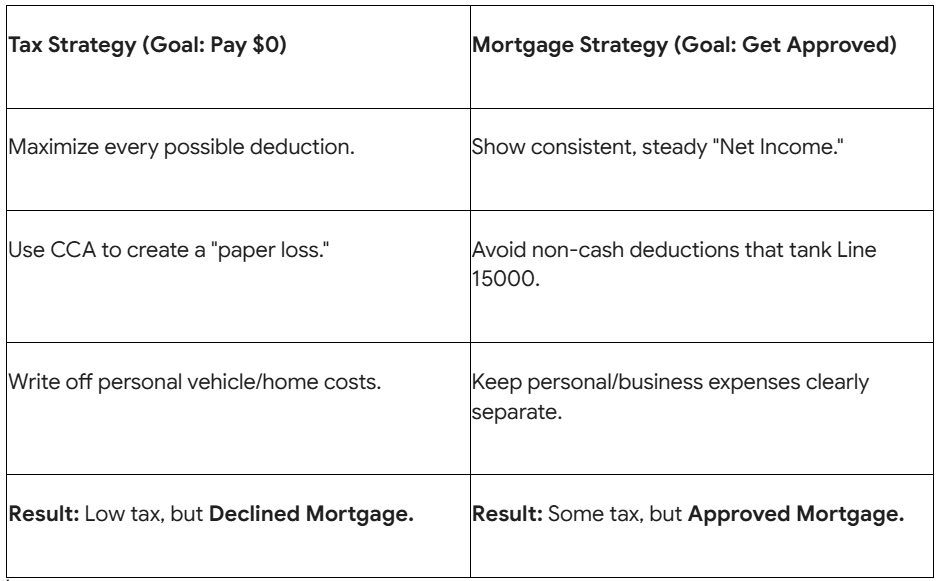
Comparison: Tax Strategy vs. Mortgage Strategy

The LendingMoney.ca “Add-Back” Solution

At LendingMoney.ca, we specialize in Credit Rehabilitation for the self-employed. We use an “Add-Back” approach that many big banks refuse to use. We can often take your net income and “gross it up” by adding back:

  • Amortization/Depreciation (CCA)
  • Home Office Expenses
  • One-time legal or professional fees

Don’t let a “great” tax return ruin your mortgage dreams. [Connect with a Financial Hero] at LendingMoney.ca for a “Pre-Tax Review” of your application today.

Blogs Mortgage Tips Mortgages

The 2026 Mortgage Renewal Guide: How to Beat “Payment Shock”

If you bought or refinanced your home in 2021, you likely enjoyed some of the lowest interest rates in Canadian history—some as low as 1.5% to 2%. As you approach your 2026 renewal, the landscape has changed. With the Bank of Canada holding its policy rate at 2.25% and fixed rates averaging between 4% and 5%, most homeowners are facing a monthly payment increase of 15% to 25%.

At LendingMoney.ca, we don’t want you to just “sign and send” your renewal papers. We want you to use this moment to optimize your entire financial life. Here is the 2026 guide to winning your renewal.

1. The Reality of the “2026 Payment Jump”

For a typical $500,000 mortgage, jumping from a 1.99% rate to a 4.79% rate means your monthly payment will climb by roughly $700 per month.

  • The “Auto-Renewal” Trap: Your bank will send you a letter about 21 days before your term ends. It will likely offer you their “posted rate,” which is often 0.5% higher than what you could get by shopping around. Never sign the first offer.
  • The “Stress Test” Myth: If you stay with your current lender, you do not have to re-qualify or pass the stress test. However, if you want to switch lenders to find a better rate, you may need to pass the 7.25% stress test.

2. Strategy: The 120-Day “Rate Hold”

In 2026, volatility is the only constant.

  • The Move: Start shopping four months before your renewal date. Most lenders (and all Financial Heroes at LendingMoney.ca) can lock in a rate for you for 120 days.
  • The Win: If rates go up before your renewal, you are protected at the lower locked-in rate. If rates go down, you can simply take the new, lower market rate. It’s a “no-lose” strategy.

3. Extending Amortization: The Cash-Flow Lifesaver

If the new 2026 payments are going to break your household budget, you have a powerful lever: Amortization.

  • The Pivot: If you originally had a 25-year mortgage and you are 5 years in, your remaining amortization is 20 years. At renewal, you can often “stretch” that back out to 25 or even 30 years.
  • The Result: While this increases the total interest you pay over the life of the loan, it can drop your monthly payment by $300 to $500, giving your family the breathing room you need to stay stable.

4. The “Consolidation Renewal” (Credit Rehab Move)

This is the most popular strategy at LendingMoney.ca in 2026. If you are renewing your mortgage but also carrying $30,000 in credit card debt at 22%, you are fighting a losing battle.

  • The Move: Instead of a “Straight Renewal,” do a Refinance Renewal. Roll that high-interest debt into your new mortgage.
  • The Result: Even if your mortgage rate goes up to 5%, you are still “killing” 22% debt. Your total monthly outflow for all debts will likely decrease, and your credit score will skyrocket as your utilization drops to zero.

5. New 2026 Rules for Investors (OSFI Changes)

If you are renewing a mortgage on a rental property, be prepared for new scrutiny.

  • The “Independent Qualification” Rule: As of January 2026, OSFI requires that rental properties “stand on their own” for qualification if you switch lenders.

The Catch: If your rental isn’t generating enough cash flow to cover the new, higher interest rates, you may be “trapped” with your current lender. This makes it even more important to have a clean credit profile before your renewal date.

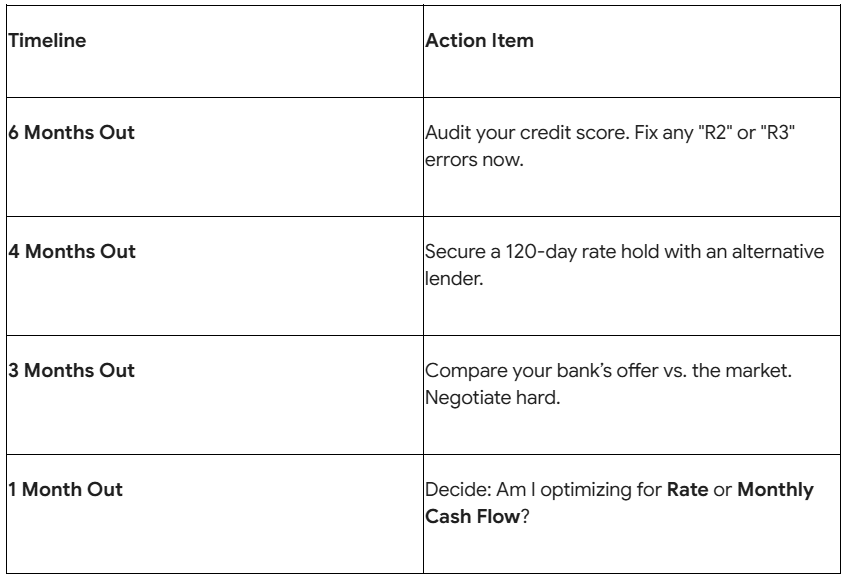
Your 2026 Renewal Checklist

Why Renew with LendingMoney.ca?

The big banks see renewal as an automated process. We see it as a financial reset. Whether you need to extend your amortization to save your budget or consolidate debt to save your credit, we are the alternative lending partnership to make it happen.

Is your renewal notice arriving soon? [Upload Your Renewal Offer] to LendingMoney.ca and let our Financial Heroes find you a better deal.

Blogs Credit Rehabilitation Mortgage Tips Ontario Real Estate Personal Finance Private Lending

The 2026 Guide to Private Mortgage Discharges

You’ve done the hard work: you’ve improved your credit, stabilized your income, or sold your property. Now comes the final step in your “Private-to-Bank” journey: The Discharge.

In 2026, discharging a private mortgage in Ontario is a formal legal process. While a bank discharge is often automated, a private discharge requires coordination between two sets of lawyers and a “Cessation of Charge” on your property title. At LendingMoney.ca, we consider this the “Graduation Day” of your Credit Rehabilitation.

Here is your 2026 guide to the final step of exiting a private mortgage.

1. Requesting the Payout Statement

The discharge process begins with a document called a Payout Statement (or Discharge Statement). This isn’t just your remaining balance; it is a legally binding breakdown of every dollar needed to release the lender’s claim on your home.

  • What’s Included: The principal balance, interest owing up to the payout date, and the Lender’s Discharge Fee (typically $300–$600 in 2026).
  • The “Daily Interest” Factor: Payout statements include a “per diem” (daily) interest amount. This ensures that if your new bank loan closes a day late, the private lender still gets their exact interest.
  • The Hero Move: Request your statement at least 10 business days before your closing date. Private lenders are often individuals or small firms and may not produce documents as quickly as a big bank.

2. The Lawyer’s Role: Cessation of Charge

In Ontario, you cannot simply hand a check to a private lender and be done. The “Charge” (the mortgage) is registered against your home’s title at the Land Registry Office.

  • The Process: Your lawyer sends the funds to the lender’s lawyer. In exchange, the lender’s lawyer provides a Discharge of Charge (Form 4).
  • The 2026 Registry: Once this is electronically filed, the mortgage is “discharged,” and your title is officially clear. This is vital because you cannot secure a new “A-Lender” mortgage or sell your home until the old private charge is gone.

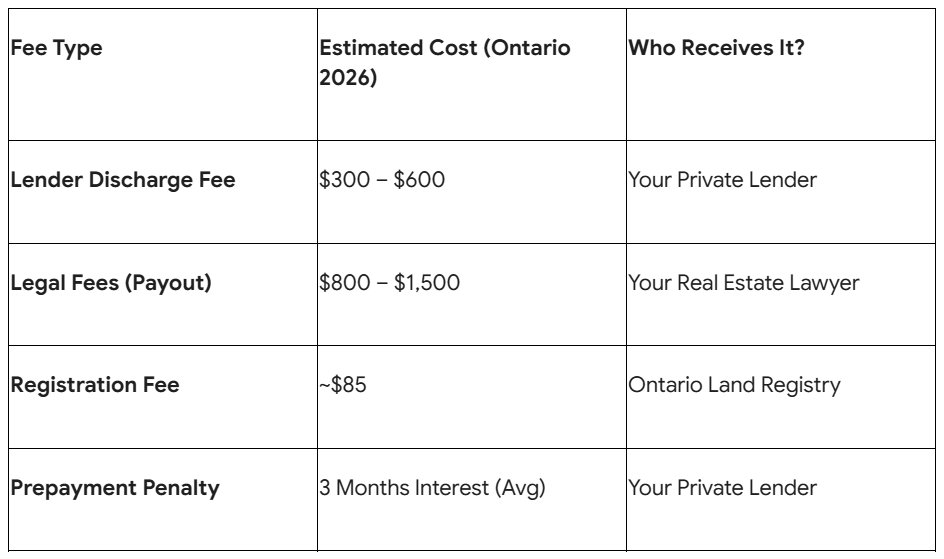
3. 2026 Payout Costs: What to Expect

Discharging a mortgage isn’t free. In 2026, you should budget for the following “Exit Costs”:

The Strategy: At LendingMoney.ca, we try to bake these costs into your new mortgage so you don’t have to pay them out of pocket on closing day.

4. The Holdback Trap

Sometimes, a private lender will “hold back” a small amount (e.g., $500–$1,000) for a few days after the payout to ensure all checks clear and there are no outstanding property tax issues.

  • The Hero Move: Ensure your lawyer confirms in writing that the holdback will be released within a specific timeframe (usually 48–72 hours).

5. Dealing with Difficult Private Lenders

Under the Ontario Mortgages Act (Section 22), a lender cannot “refuse” to give you a discharge statement if you are paying them in full.

  • The Reality: In 2026, if a private lender is ignoring your requests or trying to charge “mystery fees” at the last minute, your lawyer can apply for a Court Order to discharge the mortgage.

Discharge Checklist (2026)

  • [ ] 15 Days Out: Confirm your lawyer has requested the Payout Statement.
  • [ ] 10 Days Out: Review the statement for any “hidden fees” we didn’t agree to in the original commitment.
  • [ ] Closing Day: Ensure the funds are wired (not mailed) for the fastest discharge.
  • [ ] Post-Closing: Ask your lawyer for the “Registered Discharge” or a copy of your new, clean Title Search.

Celebrate Your Graduation

Discharging your private mortgage is the final hurdle in your Credit Rehabilitation. It means you have moved from “Emergency Financing” back into “Mainstream Stability.”

At LendingMoney.ca, we love seeing our clients reach this stage. It means the “bridge” did its job, and you are now standing on solid financial ground.

Getting ready to pay off your private loan? [Connect with our Discharge Specialist] at LendingMoney.ca. We’ll coordinate with your lawyer and ensure your exit is as smooth (and cheap) as possible.

Alternative Lending Blogs Credit Rehabilitation Mortgage Tips Personal Finance

Top 5 Private Lender Questions to ask to Avoid Traps

When you take out a private mortgage, you aren’t just signing a loan; you are entering a high-stakes business partnership. In the 2026 lending environment, private mortgages (often called “C-Lending”) are more common than ever, but they are also more complex.

At LendingMoney.ca, we believe that a “Financial Hero” is an informed borrower. Before you sign that commitment letter, you need to look past the interest rate and ask these five critical questions. The answers will determine whether your mortgage is a helpful bridge or a permanent trap.

1. What is the Total ‘Cost of Borrowing’ (APR)?

The interest rate is only one part of the story. Private lenders often layer on multiple fees that aren’t immediately obvious.

  • The Reality: You might see a rate of 9.99%, but once you add the Lender Fee (2%), the Broker Fee (2%), and the Legal Fees ($3,000), your actual Annual Percentage Rate (APR) could be closer to 15%.
  • The Hero Move: Ask for a full disclosure of all one-time and recurring fees. If the lender is hesitant to give you a “Truth in Lending” summary, that’s a red flag.

2. Is There a ‘Renewal Fee’ After 12 Months?

Most private mortgages in Ontario are one-year terms. The biggest “Equity Killer” is the surprise fee that hits you when that year is up.

  • The Trap: Some private lenders charge the same 2% fee to renew the loan for another year. If you have a $500,000 mortgage, you are paying $10,000 just to stay in the loan.
  • The Hero Move: Ask if the renewal fee can be waived or capped if you make all your payments on time.

3. What are the Pre-Payment Penalties?

A private mortgage is meant to be a short-term fix. You want the freedom to leave as soon as your credit score improves or you sell your home.

  • The Reality: Many private lenders “lock” you in for the full term. If you try to pay off the mortgage at month 6, they may charge you the remaining 6 months of interest as a penalty.
  • The Hero Move: Look for a “3-month interest” penalty or, better yet, a “Fully Open” mortgage. This allows you to “graduate” to a bank-rate mortgage the moment your Credit Rehabilitation is complete without paying a fortune to leave.

4. Is This an ‘Interest-Only’ or ‘Amortized’ Loan?

Most private mortgages are “Interest-Only,” meaning your monthly payment doesn’t reduce the amount you owe.

  • The Risk: If you borrow $400,000, you will still owe exactly $400,000 a year from now. If the housing market dips, you could end up owing more than the house is worth.
  • The Hero Move: Confirm exactly where your money is going. If it’s interest-only, you must have a separate plan to save for a principal reduction or a plan to refinance into an amortized “B-Lender” loan as soon as possible.

5. What Happens if I Miss a Single Payment?

Private lenders don’t have the same “Loss Mitigation” departments as big banks. Their tolerance for late payments is much lower.

  • The Trap: Some contracts include “Default Interest Rates” that can jump to 24% or higher the moment a payment is missed. They may also initiate Power of Sale proceedings after just 15 days of default.
  • The Hero Move: Ask about the “Grace Period” and the “NSF Fees.” You need to know exactly how much time you have to fix a mistake before legal action begins.

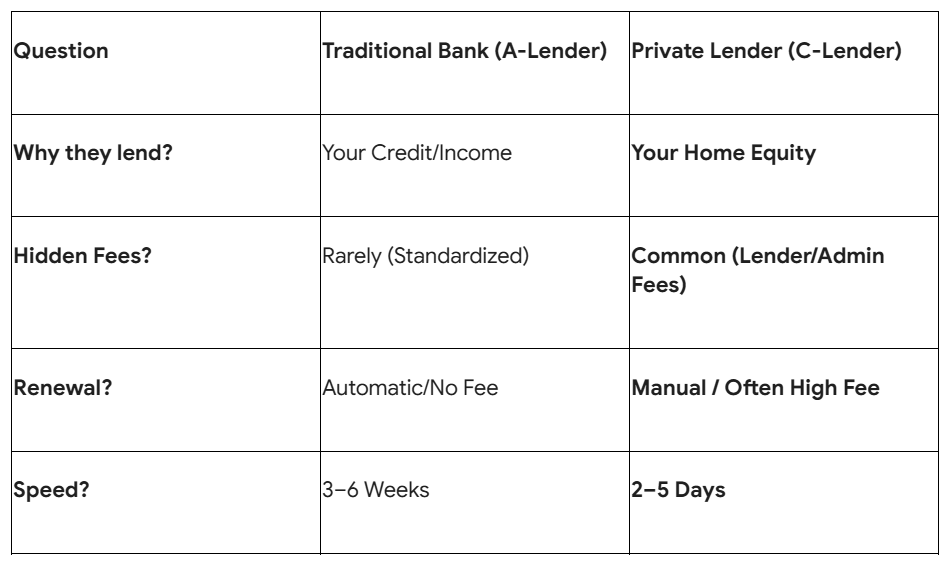
Comparison: Standard Bank vs. Private Lender Questions

Don’t Sign Until You’re Certain

At LendingMoney.ca, we act as your protective shield. We vet every private lender in our network to ensure their terms are fair and their “Exit Strategy” is clear. We don’t just want you to get the money; we want you to keep your equity.

Considering a private mortgage offer? [Upload Your Commitment Letter] for a “Second Opinion” from a Financial Hero at LendingMoney.ca. We’ll help you spot the traps before you sign.