Alternative Lending Blogs

The Lending Spectrum: B Lenders (Trust Companies) vs. Alternative Lenders

When a “Big Six” bank says no, most Canadians assume their only remaining option is a high-interest private loan. However, there is a massive middle ground occupied by B Lenders and Alternative Lenders.

While both are “alternatives” to traditional banks, they serve very different purposes. At LendingMoney.ca, we want you to understand exactly where you fit on this spectrum so you can choose the right tool for your financial recovery.

1. What is a B Lender ? (The Trust Company)

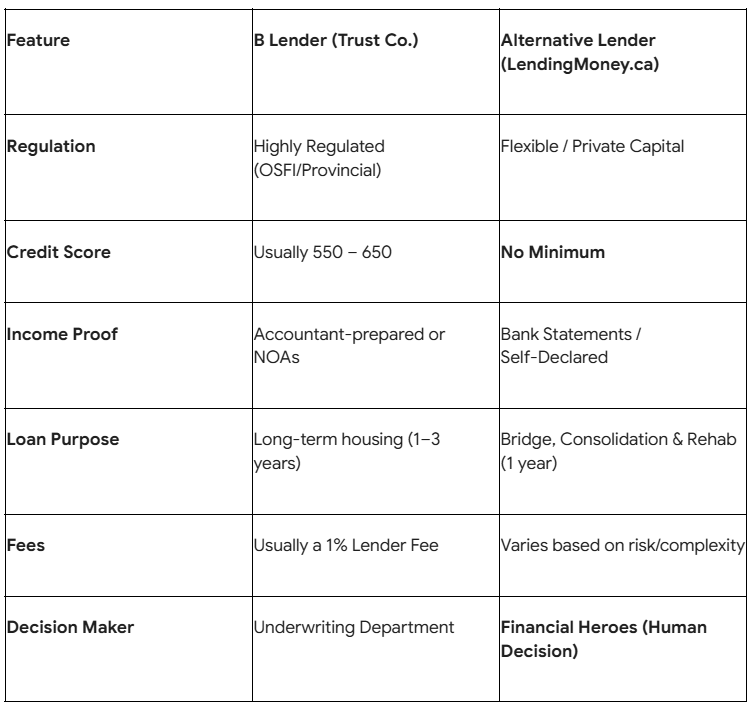
B Lenders are essentially “Bank-Lite.” They are federally or provincially regulated financial institutions, often including Trust Companies (like Home Trust or Community Trust) and specialized banks (like Equitable Bank).

  • Who they are for: The Near-Prime borrower. You have a decent job and a decent house, but maybe your credit score is 600 instead of 700, or you are self-employed and can’t prove every dollar of income.
  • The 2026 Rules: B Lenders are still heavily regulated. While they are more flexible than the Big Six, they still have strict boxes you must fit into regarding your debt-to-income ratios.
  • The Rates: They offer a “middle-ground” rate—usually 1% to 2% higher than a standard bank rate.

The Catch: They almost always require a 20% down payment because they do not offer CMHC-insured mortgages.

2. What is an Alternative Lender ? (LendingMoney.ca)

An Alternative Lender is a non-institutional provider of capital. We aren’t bound by the same rigid “stress tests” or federal “Capital Adequacy” rules that govern banks and trust companies.

  • Who we are for: The “Big Picture” borrower. You might be in a Consumer Proposal, recovering from a bankruptcy, or dealing with an “unconventional” property that an institution won’t touch.
  • The Flexibility: We don’t just look at a credit score. We look at equity, cash flow, and your plan for the future. If you have a solid Exit Strategy (a plan to get back to a bank in 1–2 years), we can provide the funding that institutions won’t
  • The Speed: Because we don’t have layers of institutional committees, we can move at lightning speed—often funding a deal in 24 to 48 hours.

Key Differences at a Glance (2026)

3. Why the B Lender Might Still Say No

In 2026, even B Lenders have become more cautious. Because they are “Deposit-Taking” institutions, they have to answer to regulators about the “quality” of their mortgage book.

If you have active collections, an un-discharged bankruptcy, or significant CRA debt, a B Lender Trust Company will likely still decline your application. They want “bruised” credit, not “broken” credit.

4. The LendingMoney.ca Bridge Strategy

This is where we come in. We don’t compete with B Lenders; we prepare you for them.

Most of our clients use our Alternative Lending solutions as a 12-month bridge.

  1. We provide the funds to pay off the collections, settle the CRA debt, or buy out the Consumer Proposal.
  2. While you are with us, we implement your Credit Rehabilitation plan.
  3. After 12 months, your “broken” credit has become “bruised” (or better), and we “graduate” you to a B Lender or even back to an A Lender bank.

Which One Do You Need?

  • Choose a B Lender if your credit is “okay” and you just need a bit more flexibility on your income proof than the Big Six allows.
  • Choose an Alternative Lender (LendingMoney.ca) if you need speed, have a complex situation, or need a financial “reset” to clear old debts before you can qualify anywhere else.

Still not sure which “box” you fit into? [Talk to a Financial Hero] at LendingMoney.ca. We’ll analyze your situation and tell you exactly which lender is the right stepping stone for your journey.

Alternative Lending Blogs Credit Score Personal Finance

The Final Leap: Moving from Alternative Lending back to the Bank

Alternative mortgages and B-Lenders are fantastic “stabilization” tools. They gave you the cash to pay the CRA, consolidate debt, or bridge a gap in your self-employment income. But now that the dust has settled, you likely want the lowest possible interest rate and the prestige of a traditional bank mortgage.

Moving back to an A-Lender requires more than just a good score; it requires a “clean” financial story. Here are the five benchmarks you must hit to graduate in 2026.

1. The 700 Club: Your New Credit Target

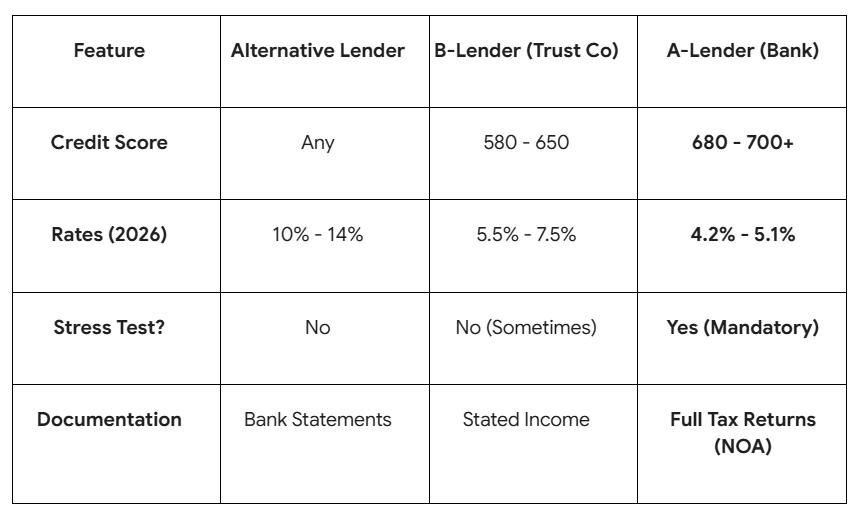
While you can get a B-Lender mortgage with a 600 score, the “Big Banks” in 2026 generally look for a minimum of 680, with 700+ being the “Golden Ticket” for the best advertised rates.

  • The Requirement: You need a “clean” credit bureau for the last 24 months. This means zero late payments on any credit card, car loan, or phone bill since you started your alternative mortgage.
  • The “Tradeline” Rule: Banks want to see at least two active credit cards with limits over $2,000, both with a history of at least two years.

2. The NOA Standard: Tax Transparence

This is often the biggest hurdle for entrepreneurs and those who previously owed the CRA.

  • The Rule: An A-Lender will require your two most recent Notices of Assessment (NOAs). They must show that you owe $0.00 to the government.
  • The 2026 Shift: Banks are now using digital verification. They may ask for a “Proof of Income” statement directly from the CRA portal. If there is any hint of a payment plan or outstanding balance, the bank will decline the application immediately.

3. The Federal Stress Test (Guideline B-20)

When you are with an alternative lender or a private lender, you often don’t have to pass the federal stress test. To move back to a bank, you must pass it.

  • The Math: In 2026, with the Bank of Canada policy rate near 2.25%, the “Benchmark” stress test is typically around 7.25%.
  • The Goal: Your total housing costs (mortgage + taxes + heat) must not exceed 39% of your gross income, and your total debt (including car loans) must not exceed 44%.

4. Stability of Income

Banks love “T4” employees (salaried workers). If you are self-employed, graduating back to a bank is harder but not impossible.

  • The 2-Year Average: The bank will take your “Line 15000” income from your last two years of tax returns and average them.
  • The Hero Move: If your business has grown significantly, we at LendingMoney.ca advise you to package your corporate financial statements to show “add-backs”-proving your true earning power is higher than what you show the taxman.

5. Property Appraisal & Marketability

A-Lenders are the most conservative when it comes to the “collateral” (your house).

  • The Inspection: If you used your alternative mortgage to fund renovations, the bank will want to see that those renovations are 100% complete. They will not take over a mortgage on a “construction zone.”
  • Location: Banks prioritize properties in major urban centers. If your home is in a very remote area, graduating back to a Big Six bank may require a higher credit score or a lower Loan-to-Value (LTV) ratio.

The Graduation Roadmap (Alternative → B → A)

Why Use LendingMoney.ca for Your Final Leap?

Most people think they can just walk into their local bank branch once their credit is fixed. However, if that bank sees a history of a private mortgage on your title, they may still be hesitant.

At LendingMoney.ca, we know which A-Lender underwriters are the most flexible with “recovered” borrowers. We tell your story in a way that highlights your successful rehabilitation, ensuring the bank sees you as a low-risk, high-value client.

Are you ready to stop paying “alternative” rates and start paying “bank” rates? [Request a Bank-Ready Audit] from LendingMoney.ca today. We’ll verify your score, your ratios, and your NOAs to see if today is your Graduation Day.

Read blog- How to Pay CRA Debt With Home Equity