Home Buying Mortgage Tips

Top 5 Reasons For Mortgage Declines In 2026

As we settle into 2026, the Canadian mortgage landscape has undergone a significant shift. Between the new OSFI (Office of the Superintendent of Financial Institutions) regulations and a stabilized but “stressful” interest rate environment, many borrowers are finding that the rules of the game have changed.

If you’ve recently been declined by a “Big Six” bank, it’s likely due to one of these top five reasons. Understanding these hurdles is the first step toward your Credit Rehabilitation and a successful approval with an alternative lender.

1. The Stress Test Ceiling (7.25%+)

Even though actual mortgage rates have stabilized, the Mortgage Stress Test remains the #1 reason for declines in 2026.

  • The Reality: Federally regulated banks must test your ability to pay at either 5.25% or your contract rate plus 2%, whichever is higher.
  • The 2026 Impact: With many contract rates sitting around 5.25%, you are effectively being “tested” at 7.25%.
  • The Result: This inflated rate pushes your debt-service ratios over the limit, even if you can comfortably afford the actual monthly payment.

2. The Double-Counting Ban for Investors

A major change that took effect in January 2026 has blindsided many property investors.

  • The Rule: OSFI has eliminated the practice of “double-counting” income. Previously, investors could use the same personal or rental income to support multiple mortgage applications.
  • The Impact: Now, every property must “stand on its own.” If a rental property isn’t generating enough independent cash flow to cover its own mortgage and expenses, it will trigger a decline for any new applications. This has effectively cut the borrowing power of small investors by nearly 50%.

3. High Debt-to-Income (TDS/GDS) Ratios

In 2026, lenders have tightened their “Total Debt Service” (TDS) requirements.

  • The Threshold: Most banks now strictly enforce a 42–44% TDS limit.
  • The Culprits: It’s often not the mortgage that causes the fail—it’s the “small” stuff. A $600 car payment or $15,000 in credit card debt can “eat” $50,000 to $80,000 of your potential mortgage principal.
  • The 2026 Shift: Lenders are now scrutinizing HELOCs and lines of credit more heavily, counting their full limits against you even if the balance is zero.

4. The CRA Debt Red Flag

As we move through the 2026 tax season, lenders are more focused on tax compliance than ever before.

  • The Rule: If you owe money to the Canada Revenue Agency (CRA), most traditional banks will issue an automatic decline.
  • The Reason: The CRA has “super-priority” status, meaning they can put a lien on your property that jumps ahead of the bank’s mortgage.
  • The Solution: Many of our clients at LendingMoney.ca use an alternative “bridge” loan to pay off their CRA arrears first, clearing the path for a traditional mortgage approval 12 months later.

5. Low Property Appraisals

In 2026, the market has stabilized, but appraisers remain incredibly cautious.

  • The Gap: If you buy a home for $800,000 but the bank’s appraiser says it’s only worth $750,000, the bank will only lend based on the lower number.
  • The Consequence: You are suddenly responsible for coming up with the $50,000 difference in cash. If you don’t have it, the mortgage is declined for “insufficient collateral.”
  • The 2026 Trend: This is especially common in “bidding war” scenarios where emotional buyers overpay beyond what the data-driven appraiser can justify.

Moving from Declined to Approved

A decline in 2026 isn’t a dead end—it’s a signal to change your strategy. While a Big Bank might see a “fail,” a Financial Hero at LendingMoney.ca sees an opportunity for a workaround.

  • We offer Alternative Solutions that don’t use the same rigid stress test.
  • We allow “Stated Income” for self-employed individuals.
  • We provide Equity-Based Lending that focuses on the value of your home rather than just your credit score.

Did a bank turn you down today? [Upload Your Decline Letter] to LendingMoney.ca and let us find the “Path to Yes” that the big banks missed.


Home Buying Mortgages Personal Finance

Side-Hustle Mortgage Guide for Gen Z

For Gen Z, the career path in 2026 isn’t a straight line-it’s a Side-Hustle Mosaic. Whether you are a graphic designer with an Etsy shop, a rideshare driver on weekends, or a content creator with brand deals, your income doesn’t come on a single T4 slip.

The traditional banks often look at this Gig Income with suspicion, but at LendingMoney.ca, we see it for what it is: Entrepreneurial Strength. Here is how you can use your side-hustle to pass the stress test and get the keys to your first home.

The Side-Hustle Mortgage: How to Use Gig Income to Qualify

In 2026, roughly 30% of Gen Z workers earn a significant portion of their income through digital platforms or freelance contracts. If you’re using that extra $1,500 a month to pay your rent, it’s time to start using it to qualify for a mortgage.

1. The Two-Year Consistency Rule

Most “A-Lenders” (big banks) require a two-year history of self-employment or side-hustle income before they will even count it.

  • The Reality: They will look at your Line 15000 (Total Income) on your CRA Notice of Assessment (NOA) for the last two years and average them.
  • The 2026 Shift: If your side-hustle income is increasing (e.g., $10k in 2024 and $25k in 2025), banks will often use the average ($17.5k). If it’s declining, they may only use the lower number.
  • The Hero Move: At LendingMoney.ca, we can sometimes look at a 12-month average if we can prove the income is stable and recurring.

2. Stop the Deduction Trap

This is the biggest hurdle for Gen Z entrepreneurs. You want to write off every coffee, every mile, and every software subscription to lower your tax bill.

  • The Problem: When you lower your taxable income, you lower your “borrowing power.” A $60,000 income that you “write down” to $35,000 makes you look like you can’t afford a mortgage.
  • The Strategy: In the 1-2 years before you buy a home, consider being more conservative with your deductions. Paying a little more in tax today could be the key to qualifying for an extra $100,000 in mortgage room tomorrow.

3. Bank Statement Underwriting: Your Cash Flow Asset

Traditional banks obsess over your tax returns. LendingMoney.ca alternative lenders obsess over your Bank Statements.

  • The 2026 Process: We can use 6 to 12 months of business bank statements to see the “Gross Deposits” coming in from platforms like Shopify, Uber, Upwork, or DoorDash.
  • Why it Works: We look at your actual cash flow-the real money you have available to pay a mortgage-rather than just the “Net Income” shown to the CRA. This “Stated Income” approach is the ultimate Gen Z bridge to homeownership.

4. Platform Reporting is Your Proof (The 2026 CRA Update)

As of 2026, digital platforms are now required to report earnings directly to the CRA. While this means you must be diligent about your taxes, it also provides you with official, third-party income reports.

  • The Action: Download your annual “Earnings Summary” from your platforms. These reports, combined with your tax filings, provide a high-tech “Pay Stub” that 2026 lenders are increasingly accepting as valid proof of income.

Income Qualification: T4 vs. Side-Hustle (2026)

Income SourceBig Bank ViewLendingMoney.ca View
Full-Time (T4)Gold StandardSolid Foundation
Gig/Platform IncomeRisky / Often IgnoredValuable “Top-Up” Income
Self-Employed (Sole Prop)Requires 2 years of NOAsRequires 6-12 months of Deposits
Side-Hustle “Write-offs”Reduces your loan amountWe “Add Back” certain expenses

5. The Gig-Worker Down Payment Strategy

If your side-hustle income is variable, use the “Big Months” to aggressively fund your FHSA (First Home Savings Account).

  • The Move: In 2026, you can contribute $8,000 a year tax-free. If you have a massive month on your side-hustle, dump that cash into your FHSA. This not only builds your down payment but also lowers your taxable income for the year, giving you a bigger tax refund to put toward your closing costs.

Don’t Let Your 9-to-5 Define Your Future

Your side-hustle isn’t just “extra money”- it’s your ticket out of the rental market. In 2026, the way you earn is changing, and the way you borrow needs to change with it.

Is your side-hustle making you Bank Rich but Tax Poor? [Connect with a Gig-Income Specialist] at LendingMoney.ca today. We’ll look at your bank statements and your platform reports to show you how much home your hustle can actually buy.

Blogs Mortgage Tips Self-Employed Mortgages

Tax Deductions That Hurt Mortgage Odds

In the world of Canadian tax planning, a “good year” for your accountant is often a “bad year” for your mortgage broker. As we move through 2026, the gap between tax savings and borrowing power has widened, with lenders applying forensic-level scrutiny to self-employed applications.

If you are a business owner planning to buy or refinance a home, you need to understand that every dollar you “write off” to save $0.25 in taxes could cost you $5.00 in mortgage qualifying room. Here are the top five tax deductions that are most likely to hurt your mortgage odds in 2026.

1. Aggressive Vehicle Expenses (Section 9)

While the CRA allows you to deduct fuel, insurance, and repairs based on your business-use percentage, lenders in 2026 are wary of high vehicle write-offs.

  • The Problem: If you brought in $100,000 but claimed $25,000 in “vehicle expenses,” a bank sees your income as $75,000.
  • The 2026 Impact: Lenders now require 24 months of detailed logs to prove these expenses are “non-discretionary.”
  • The “Hero” Strategy: Some alternative lenders will “add back” 15–20% of vehicle expenses to your income, but traditional “A-Lenders” will not. If you’re buying soon, consider scaling back the “detailed method” of vehicle deductions.

2. Large Capital Cost Allowance (CCA) Claims

CCA is “depreciation”—a non-cash expense that allows you to write off the cost of big items like computers (Class 50) or equipment over several years.

  • The Problem: In 2026, the “Immediate Expensing” rules allow you to write off up to $1.5M in equipment instantly. This can drop your taxable income to near-zero.
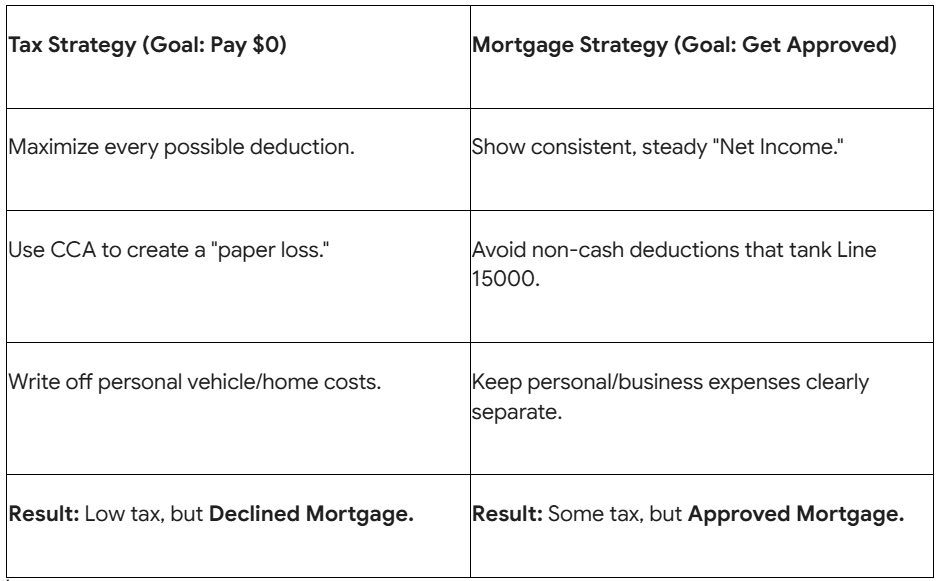
  • The Lender’s View: While this is a “paper loss” (you didn’t actually lose the money this year), most banks use your Line 15000 (Net Income) as the starting point for their math.
  • The Strategy: At LendingMoney.ca, we work with lenders who understand that CCA is a “non-cash” add-back. We can often add this back to your income to boost your borrowing power, whereas a big bank might just see a “loss” on your T1 General.

3. High Travel & Entertainment Costs

In a post-pandemic world, the CRA has increased scrutiny on “Meal and Entertainment” (50% deductible). Mortgage lenders have followed suit.

  • The Problem: High travel and dining costs suggest a “lifestyle-heavy” business. Lenders worry that if your business hits a slow patch, these costs are actually “essential” to keeping your clients, meaning they aren’t truly discretionary.
  • The 2026 Rule: Lenders are now comparing your entertainment-to-revenue ratio. If you’re spending 15% of your gross income on “networking meals,” it raises a red flag regarding your actual take-home pay.

4. Heavy Home Office Deductions (T2125)

In 2026, the “flat rate” $2/day method is a distant memory. Business owners must use the “Detailed Method,” pro-rating rent, utilities, and mortgage interest.

  • The Problem: While it’s great to write off 15% of your home costs, the lender sees this as a reduction in your net income.
  • The Irony: You are using your home to save on taxes, but that very deduction might prevent you from buying a better home.
  • The Strategy: If you are within 12 months of a mortgage application, speak to your accountant about “smoothing” these deductions. It might be worth paying a little more tax to show the $10,000 higher income the bank needs to see.

5. “Bad Debt” Write-Offs

If a client didn’t pay you and you write it off as “Bad Debt,” it tells a story to a lender.

  • The Problem: Beyond the lower income, a high “Bad Debt” line tells a lender that your business may have “collection issues” or “low-quality clients.”
  • The 2026 Impact: Lenders are looking for stability. They would rather see a slightly lower gross income than a high gross income with 10% in bad debt write-offs. It signals a lack of cash-flow predictability.

Comparison: Tax Strategy vs. Mortgage Strategy

The LendingMoney.ca “Add-Back” Solution

At LendingMoney.ca, we specialize in Credit Rehabilitation for the self-employed. We use an “Add-Back” approach that many big banks refuse to use. We can often take your net income and “gross it up” by adding back:

  • Amortization/Depreciation (CCA)
  • Home Office Expenses
  • One-time legal or professional fees

Don’t let a “great” tax return ruin your mortgage dreams. [Connect with a Financial Hero] at LendingMoney.ca for a “Pre-Tax Review” of your application today.