
Home Buying Personal Finance

Fresh Starts: How to Buy a Home After Divorce in 2026

A divorce is more than a legal ending; it is a financial beginning. One of the most significant hurdles in this transition is securing a new home while your assets, income, and credit are in flux.

In 2026, the rules for “newly single” buyers in Canada have become more flexible, but the documentation requirements have become more strict. At LendingMoney.ca, we specialize in helping you navigate this “Bridge Phase” of your life. Here is how to move from a shared matrimonial home to a space that is truly yours.

1. The 90-Day Rule and the New Home Buyers’ Plan (HBP)

One of the best pieces of news for 2026 is that you no longer have to wait four years to be considered a “First-Time Home Buyer” again.

  • The Rule: If you have lived “separate and apart” from your spouse for at least 90 days, you can qualify for the federal Home Buyers’ Plan (HBP) even if you previously owned a home together.
  • The Benefit: You can withdraw up to $35,000 tax-free from your RRSP to use as a down payment on your new home.
  • The Catch: You cannot be living in a home owned by a new spouse or common-law partner at the time of withdrawal.

2. The Power of the Spousal Buyout Program

If you want to stay in your current family home but need to pay out your ex-spouse’s share of the equity, you don’t necessarily need a 20% down payment.

  • How it Works: Under special insured programs (CMHC, Sagen, Canada Guaranty), you can refinance your home up to 95% of its value to buy out your partner’s equity.
  • Why this is a Hero Move: Usually, a refinance is capped at 80%. This special “Buyout Program” allows you to access the extra 15% of equity you need to settle the divorce and keep the roof over your head.
  • Requirement: You must have a legally binding Separation Agreement that specifically outlines the buyout amount.

3. Support Payments: The Double-Edged Sword

In 2026, lenders view spousal and child support through a very specific lens. Depending on whether you are the payer or the receiver, it changes your borrowing power.

  • If You RECEIVE Support: Most lenders will count support payments as qualifying income. To use it, you generally need to show a court order or signed separation agreement and 3–6 months of consistent bank deposits proving the money actually arrives.
  • If You PAY Support: Lenders treat support payments as a fixed monthly debt (similar to a car payment). Because this is deducted from your income before your “Debt-Service Ratios” are calculated, it can significantly lower the maximum mortgage amount you qualify for.

4. Why the Separation Agreement is Non-Negotiable

You might have a “handshake deal” with your ex, but in 2026, a bank will not touch your application without a Legal Separation Agreement.

  • What Lenders Look For: They need to see the final word on asset division, ongoing support obligations, and any “Joint Debts” you are still responsible for.
  • The “Zombie Debt” Risk: If your name is still on your ex-partner’s car loan or credit card, the bank counts that full payment against you. Your agreement must clearly state who is responsible for which debt so the lender can “exclude” those items from your ratios.

5. Rebuilding Your Solo Credit Score

Often, divorce involves late payments on joint accounts during the “messy” months of separation. This can tank your credit score right when you need it most.

  • The Audit: Check your credit report for any “Joint Accounts” that your ex may have neglected.
  • The Rehabilitation: If your score has dropped below 680, you may not qualify for the best bank rates. At LendingMoney.ca, we offer Alternative “Bridge” Mortgages. These allow you to buy your new home now, and we work with you over the next 12–24 months to rebuild your score so you can “graduate” to a lower-rate bank mortgage once the divorce is finalized.

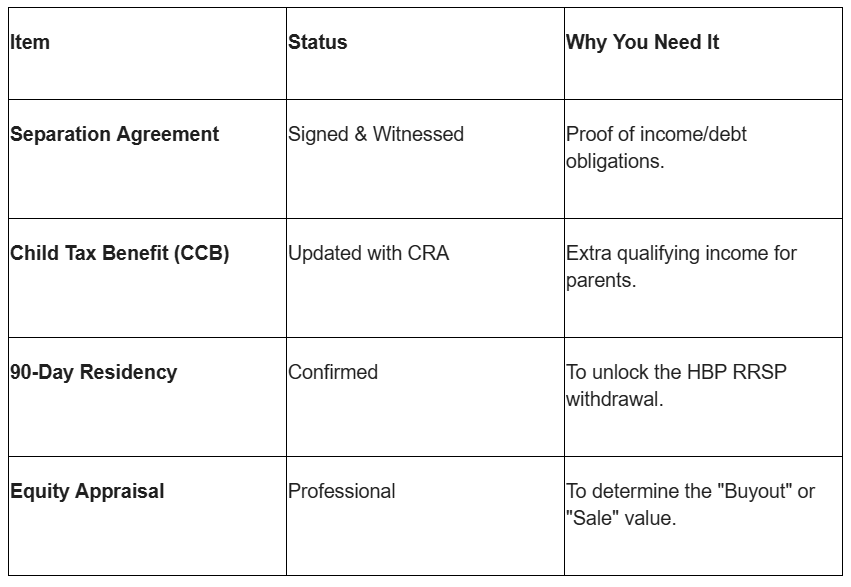
The Post-Divorce Mortgage Checklist (2026)
You Don’t Have to Do This Alone

Navigating a mortgage during a divorce is emotionally draining and technically complex. At LendingMoney.ca, we see the person behind the paperwork. Whether you are buying out a partner or starting fresh in a new neighborhood, we have the alternative lending tools to make it happen.

Starting your next chapter? [Get a Confidential Divorce Mortgage Assessment] from LendingMoney.ca today. We’ll help you find the equity and the path to your new front door.

Home Buying Mortgage Tips

Top 5 Reasons For Mortgage Declines In 2026

As we settle into 2026, the Canadian mortgage landscape has undergone a significant shift. Between the new OSFI (Office of the Superintendent of Financial Institutions) regulations and a stabilized but “stressful” interest rate environment, many borrowers are finding that the rules of the game have changed.

If you’ve recently been declined by a “Big Six” bank, it’s likely due to one of these top five reasons. Understanding these hurdles is the first step toward your Credit Rehabilitation and a successful approval with an alternative lender.

1. The Stress Test Ceiling (7.25%+)

Even though actual mortgage rates have stabilized, the Mortgage Stress Test remains the #1 reason for declines in 2026.

  • The Reality: Federally regulated banks must test your ability to pay at either 5.25% or your contract rate plus 2%, whichever is higher.
  • The 2026 Impact: With many contract rates sitting around 5.25%, you are effectively being “tested” at 7.25%.
  • The Result: This inflated rate pushes your debt-service ratios over the limit, even if you can comfortably afford the actual monthly payment.

2. The Double-Counting Ban for Investors

A major change that took effect in January 2026 has blindsided many property investors.

  • The Rule: OSFI has eliminated the practice of “double-counting” income. Previously, investors could use the same personal or rental income to support multiple mortgage applications.
  • The Impact: Now, every property must “stand on its own.” If a rental property isn’t generating enough independent cash flow to cover its own mortgage and expenses, it will trigger a decline for any new applications. This has effectively cut the borrowing power of small investors by nearly 50%.

3. High Debt-to-Income (TDS/GDS) Ratios

In 2026, lenders have tightened their “Total Debt Service” (TDS) requirements.

  • The Threshold: Most banks now strictly enforce a 42–44% TDS limit.
  • The Culprits: It’s often not the mortgage that causes the fail—it’s the “small” stuff. A $600 car payment or $15,000 in credit card debt can “eat” $50,000 to $80,000 of your potential mortgage principal.
  • The 2026 Shift: Lenders are now scrutinizing HELOCs and lines of credit more heavily, counting their full limits against you even if the balance is zero.

4. The CRA Debt Red Flag

As we move through the 2026 tax season, lenders are more focused on tax compliance than ever before.

  • The Rule: If you owe money to the Canada Revenue Agency (CRA), most traditional banks will issue an automatic decline.
  • The Reason: The CRA has “super-priority” status, meaning they can put a lien on your property that jumps ahead of the bank’s mortgage.
  • The Solution: Many of our clients at LendingMoney.ca use an alternative “bridge” loan to pay off their CRA arrears first, clearing the path for a traditional mortgage approval 12 months later.

5. Low Property Appraisals

In 2026, the market has stabilized, but appraisers remain incredibly cautious.

  • The Gap: If you buy a home for $800,000 but the bank’s appraiser says it’s only worth $750,000, the bank will only lend based on the lower number.
  • The Consequence: You are suddenly responsible for coming up with the $50,000 difference in cash. If you don’t have it, the mortgage is declined for “insufficient collateral.”
  • The 2026 Trend: This is especially common in “bidding war” scenarios where emotional buyers overpay beyond what the data-driven appraiser can justify.

Moving from Declined to Approved

A decline in 2026 isn’t a dead end—it’s a signal to change your strategy. While a Big Bank might see a “fail,” a Financial Hero at LendingMoney.ca sees an opportunity for a workaround.

  • We offer Alternative Solutions that don’t use the same rigid stress test.
  • We allow “Stated Income” for self-employed individuals.
  • We provide Equity-Based Lending that focuses on the value of your home rather than just your credit score.

Did a bank turn you down today? [Upload Your Decline Letter] to LendingMoney.ca and let us find the “Path to Yes” that the big banks missed.

Home Buying Mortgages Personal Finance

Side-Hustle Mortgage Guide for Gen Z

For Gen Z, the career path in 2026 isn’t a straight line-it’s a Side-Hustle Mosaic. Whether you are a graphic designer with an Etsy shop, a rideshare driver on weekends, or a content creator with brand deals, your income doesn’t come on a single T4 slip.

The traditional banks often look at this Gig Income with suspicion, but at LendingMoney.ca, we see it for what it is: Entrepreneurial Strength. Here is how you can use your side-hustle to pass the stress test and get the keys to your first home.

The Side-Hustle Mortgage: How to Use Gig Income to Qualify

In 2026, roughly 30% of Gen Z workers earn a significant portion of their income through digital platforms or freelance contracts. If you’re using that extra $1,500 a month to pay your rent, it’s time to start using it to qualify for a mortgage.

1. The Two-Year Consistency Rule

Most “A-Lenders” (big banks) require a two-year history of self-employment or side-hustle income before they will even count it.

  • The Reality: They will look at your Line 15000 (Total Income) on your CRA Notice of Assessment (NOA) for the last two years and average them.
  • The 2026 Shift: If your side-hustle income is increasing (e.g., $10k in 2024 and $25k in 2025), banks will often use the average ($17.5k). If it’s declining, they may only use the lower number.
  • The Hero Move: At LendingMoney.ca, we can sometimes look at a 12-month average if we can prove the income is stable and recurring.

2. Stop the Deduction Trap

This is the biggest hurdle for Gen Z entrepreneurs. You want to write off every coffee, every mile, and every software subscription to lower your tax bill.

  • The Problem: When you lower your taxable income, you lower your “borrowing power.” A $60,000 income that you “write down” to $35,000 makes you look like you can’t afford a mortgage.
  • The Strategy: In the 1-2 years before you buy a home, consider being more conservative with your deductions. Paying a little more in tax today could be the key to qualifying for an extra $100,000 in mortgage room tomorrow.

3. Bank Statement Underwriting: Your Cash Flow Asset

Traditional banks obsess over your tax returns. LendingMoney.ca alternative lenders obsess over your Bank Statements.

  • The 2026 Process: We can use 6 to 12 months of business bank statements to see the “Gross Deposits” coming in from platforms like Shopify, Uber, Upwork, or DoorDash.
  • Why it Works: We look at your actual cash flow-the real money you have available to pay a mortgage-rather than just the “Net Income” shown to the CRA. This “Stated Income” approach is the ultimate Gen Z bridge to homeownership.

4. Platform Reporting is Your Proof (The 2026 CRA Update)

As of 2026, digital platforms are now required to report earnings directly to the CRA. While this means you must be diligent about your taxes, it also provides you with official, third-party income reports.

  • The Action: Download your annual “Earnings Summary” from your platforms. These reports, combined with your tax filings, provide a high-tech “Pay Stub” that 2026 lenders are increasingly accepting as valid proof of income.

Income Qualification: T4 vs. Side-Hustle (2026)

Income SourceBig Bank ViewLendingMoney.ca View
Full-Time (T4)Gold StandardSolid Foundation
Gig/Platform IncomeRisky / Often IgnoredValuable “Top-Up” Income
Self-Employed (Sole Prop)Requires 2 years of NOAsRequires 6-12 months of Deposits
Side-Hustle “Write-offs”Reduces your loan amountWe “Add Back” certain expenses

5. The Gig-Worker Down Payment Strategy

If your side-hustle income is variable, use the “Big Months” to aggressively fund your FHSA (First Home Savings Account).

  • The Move: In 2026, you can contribute $8,000 a year tax-free. If you have a massive month on your side-hustle, dump that cash into your FHSA. This not only builds your down payment but also lowers your taxable income for the year, giving you a bigger tax refund to put toward your closing costs.

Don’t Let Your 9-to-5 Define Your Future

Your side-hustle isn’t just “extra money”- it’s your ticket out of the rental market. In 2026, the way you earn is changing, and the way you borrow needs to change with it.

Is your side-hustle making you Bank Rich but Tax Poor? [Connect with a Gig-Income Specialist] at LendingMoney.ca today. We’ll look at your bank statements and your platform reports to show you how much home your hustle can actually buy.

Home Buying Personal Finance Second Mortgages

The Bank of Mom and Dad: Using a Second Mortgage to Fund a Down Payment

1. Why a Second Mortgage Beats a Bank Refinance

Many parents in 2026 are still holding onto low-rate first mortgages from 2021 or 2022 (around 2%-3%).

  • The Bank Trap: If you ask your bank to “add $100,000” to your mortgage for your child’s down payment, they will likely force you to break your entire mortgage and refinance at today’s rates (likely 5%-6%).
  • The Hero Move: A Second Mortgage from LendingMoney.ca sits behind your current mortgage. You keep your 2% bank rate on the bulk of your debt and only pay a higher rate on the new $100,000. This saves you thousands in interest and avoids massive prepayment penalties.

2. Turning Equity into a Gifted Down Payment

To help your child qualify for an “A-Lender” mortgage, the money you give them must be a gift, not a loan.

  • The Gift Letter: Most lenders require a signed letter stating that the funds are a non-repayable gift.
  • The Benefit: By providing a 20% down payment (e.g., $120,000 on a $600,000 condo), you save your child from paying CMHC Mortgage Insurance, which can cost them $15,000 to $25,000 upfront.

3. The Living Inheritance Strategy

In 2026, many Canadians are choosing to “give while living.

  • Tax Efficiency: In Canada, there is no “gift tax” on cash given to your children. Giving the money now allows you to see the impact of your hard work while reducing the future size (and potential probate fees) of your estate.
  • Property Protection: Using a Second Mortgage to provide a down payment keeps the child’s mortgage in their name only. This encourages their own financial independence while your primary home remains securely in your hands.

4. Protecting Yourself: The Equity Buffer

At LendingMoney.ca, we never want a parent to put their own retirement at risk. We follow a strict “Equity Buffer” rule:

  • We typically recommend only borrowing against equity that exceeds 35% to 40% of your home’s value.
  • This ensures that even if the 2026 market fluctuates, your own home remains safe, and you still have plenty of equity left for your own future needs (like long-term care or travel).

The Cost of Giving: $100,000 Case Study (2026)

FeatureBreaking First MortgageLendingMoney.ca Second Mortgage
Prepayment Penalty~$12,000 – $20,000$0
New Rate (Bulk of Debt)5.85% (Entire Balance)2.85% (Stays the same)
Approval Time2-3 Weeks3-5 Business Days
Impact on Mom & DadHigher monthly costs.Small, manageable interest-only payment.
Impact on ChildEntry into Market Today.Entry into Market Today.

5. The Co-Signing Alternative

If your child has the down payment but lacks the income to pass the 2026 Stress Test, parents often consider co-signing.

  • The Warning: Co-signing makes you 100% liable for their debt. It also counts against your credit, which might make it harder for you to get a car loan or renew your own mortgage later.
  • The Better Way: Often, providing a larger “Gifted Down Payment” via a Second Mortgage allows the child to qualify on their own, keeping your name (and your credit) off their legal documents.

Be the Hero of Their Story

The “Great Wealth Transfer” is happening right now. You’ve worked hard to build equity in your home; a Second Mortgage is simply the tool that lets you deploy that wealth when your family needs it most.

Want to help your kids buy their first home in 2026? [Get an Equity Assessment] from LendingMoney.ca today. Let’s look at your home’s value and find a way to fund their future without compromising yours.

Read Blog – Second Mortgage Stops CRA Collections

Home Buying Personal Finance

Is Homeownership a Reality for Gen Z? (The 2026 Update)

If you are a Gen Z’er looking at the market today, you are likely facing the Triple Threat: high carrying costs, strict stress tests, and a stubborn inventory shortage. But while the barriers are high, the exit ramps from renting to owning have never been more strategically designed.

1. The FHSA: Your Secret Weapon

The First Home Savings Account (FHSA) is the single most powerful tool for Gen Z in 2026.

  • The Math: You can contribute up to $8,000 per year (lifetime limit of $40,000).
  • The Hero Move: Contributions are tax-deductible (like an RRSP), but withdrawals are tax-free (like a TFSA). If you started your FHSA when it launched, you could have over $40,000 plus investment growth ready to go right now.
  • Double Up: If you are buying with a partner, you can combine your FHSAs for a $80,000+ tax-free down payment.

2. The New $1.5M Ceiling (2026 Rule Change)

In late 2025, the government adjusted the rules for High-Ratio mortgages. Previously, any home over $1 million required a 20% down payment.

  • The Reality: In 2026, you can now purchase a home up to $1.5 million with as little as 5% down on the first $500k and 10% on the remainder.
  • The Impact: This opens up thousands of starter townhomes and condos in the GTA and GVA that were previously out of reach because of the $200,000+ down payment requirement.

3. The 30-Year Amortization Breather

To combat the 2026 Payment Shock, first-time buyers are now eligible for 30-year amortizations on new builds and certain high-ratio purchases.

  • The Benefit: Spreading the loan over 30 years instead of 25 lowers your monthly payment. This can be the difference between “barely qualifying” and comfortably passing the bank’s stress test.

4. The Side-Hustle Income Audit

Gen Z is the most entrepreneurial generation in history. Whether it’s content creation, freelancing, or an e-commerce store, your “side income” is a valid asset.

  • The LendingMoney.ca Advantage: Traditional banks still struggle to count “Gig Economy” income. We specialize in using Bank Statement Underwriting to prove that your diverse income streams make you a solid, “Heroic” candidate for a mortgage.

The Gen Z Homeownership Roadmap

MilestoneYour Goal2026 Tool to Use
The SaveBuild $40,000 Tax-FreeFHSA + RRSP Home Buyers’ Plan
The RebateGet $50,000 back on TaxesNew FTHB GST/HST Rebate
The BuyLower Monthly Payments30-Year Amortization
The QualificationCount all your incomeLendingMoney.ca Alternative Lending

5. House Hacking as a Strategy

For Gen Z, the first home is rarely a “forever home.” Many are buying properties with “mortgage helpers”- basement suites or secondary dwelling units.

  • The Strategy: Lenders in 2026 are more willing to count a portion of potential rental income from these suites to help you qualify for a larger mortgage. Your house isn’t just a home; it’s a co-investor.

Your Era, Your Equity

The 2026 market doesn’t reward the standard approach; it rewards the strategic one. You don’t need a massive inheritance to own a home-you need a plan that uses every tax credit, rebate, and alternative lending tool available.

Think you’re stuck in the “Rent Trap”? [Request a Gen Z Path-to-Homeownership Audit] from LendingMoney.ca today. Let’s look at your FHSA, your side-hustles, and the new 2026 rules to see how close you actually are to the keys.

Blogs Home Buying Mortgages Personal Finance

Strength in Numbers: How to Qualify for a Mortgage as a Single Parent in Canada (2026 Guide)

The dream of homeownership shouldn’t disappear just because you are a single parent. Whether you are starting over after a divorce or raising a family on your own, the path to a mortgage is often clearer than you think. While the “single income” challenge is real, Canada’s 2026 mortgage rules include several “boosters” specifically designed to help families succeed.

At LendingMoney.ca, we believe every family deserves a stable place to call home. Our “Hero” approach means we help you find the hidden income and special programs that traditional banks might overlook. Here is how to qualify for a mortgage as a single parent in 2026.

1. Unlock "Hidden" Qualifying Income

When a bank looks at your mortgage application, they calculate your Debt-to-Income (DTI) ratio. For a single parent, your salary is only one part of the equation. In 2026, lenders are more flexible than ever about what counts as “qualifying income.”

  • Canada Child Benefit (CCB): Most lenders now accept 100% of your CCB payments as qualifying income for children under the age of 15. This monthly “lifeline” can add thousands of dollars to your annual qualifying total.
  • Child Support & Spousal Support: If you have a written separation agreement or a court order, this support is considered stable income. Most lenders allow support payments to make up to 30–50% of your total qualifying income, provided you can show a history of consistent payments.
  • Boarder or Rental Income: If you are buying a home with a “mortgage helper” (a legal basement suite), you can often use 50–100% of the projected rental income to help you qualify for a larger mortgage.

2. Leverage New 2026 Government Incentives

The Canadian government has introduced several landmark measures in the Making Life More Affordable for Canadians Act (Bill C-4) that directly benefit single-parent households.

  • The First-Time Home Buyer GST Rebate: As of 2026, the GST is fully eliminated on new homes priced up to $1 million for first-time buyers. This can save you up to $50,000 on the purchase price of a new build—money that stays in your pocket for furniture or emergency savings.30-
  • Year Amortization: Single parents buying newly constructed homes can now qualify for 30-year mortgages (up from the traditional 25). This lower monthly payment makes it much easier to pass the “Stress Test” on a single income.
  • The “Second Chance” First-Time Buyer Rule: Even if you owned a home with your ex-spouse, you can qualify as a “first-time buyer” again if you have been living separate and apart for at least 90 days due to a relationship breakdown. This unlocks the Home Buyers’ Plan (HBP), allowing you to withdraw up to $60,000 tax-free from your RRSP.

3. The Power of "Home Start" and Low Down Payments

You don’t need a 20% down payment to buy a home. Through CMHC-insured mortgages, you can enter the market with as little as 5% down.

  • CMHC Home Start: This program is specifically designed to help families with a minimum credit score of 600. If your score took a dip during a separation, this program provides a realistic pathway back into homeownership without requiring a “perfect” 700+ score.
  • Flex Down Options: Some lenders allow you to use “non-traditional” sources for your down payment, such as a gift from a family member or even a personal loan, provided your credit and income are stable.

4. Tackle the "Stress Test" with Credit Rehabilitation

The biggest hurdle for single parents is the “Mortgage Stress Test,” which requires you to prove you could handle payments if interest rates were higher.

  • Consolidate Before You Apply: If you are carrying high-interest car loans or credit card debt, it eats into your “Total Debt Service” ratio. Using a LendingMoney.ca consolidation loan to pay off these small debts before applying for a mortgage can drastically increase the amount a mortgage lender will give you.
  • The “Hero” Strategy: By clearing $400/month in credit card payments through consolidation, you could potentially qualify for an additional $50,000 to $70,000 in mortgage principal.

5. Build Your "Professional Team"

Qualifying as a single parent requires a more nuanced approach than a standard application. You need experts who understand family law and alternative lending.

  • Mortgage Brokers: They have access to “B-Lenders” who are more flexible with child support and CCB income than the major banks.
  • Financial Heroes: At LendingMoney.ca, we help you bridge the gap by cleaning up your credit and consolidating debt so your mortgage application is “bank-ready.”

Final Thoughts: Your Family's New Chapter

Being a single parent takes incredible strength, and that same strength can build a financial foundation for your children. By combining government rebates, child-related tax benefits, and a smart credit rehabilitation strategy, the keys to your own front door are within reach.

Ready to see how much home you can actually afford? [Connect with a Financial Hero] at LendingMoney.ca and let’s build your path to homeownership today.

Blogs Home Buying Mortgages in Canada Newcomer Mortgages Ontario Real Estate

Ontario’s Top 5 Newcomer Neighborhoods

For a newcomer in 2026, choosing a neighborhood isn’t just about the house – it’s about the “ecosystem.” You need transit to get to your new job, schools for your children, and a community that understands the immigrant experience.

While Toronto is the famous choice, the 2026 “Smart Money” for newcomers has shifted toward cities that offer a better balance of affordability and opportunity. Here are the top five neighborhoods and regions in Ontario for newcomers this year.

1. Kanata (Ottawa) – The Silicon Valley of the North

If you are arriving with a background in Tech, Engineering, or Healthcare, Kanata is arguably the best destination in Ontario for 2026.

  • Why it’s perfect for newcomers: It is home to Canada’s largest technology park (tech giants like Nokia, Cisco, and Shopify are here). This means high-paying jobs are often within a 10-minute commute of residential streets.
  • The Lifestyle: It offers a suburban feel with top-tier schools and much more affordable detached homes than the GTA.

2026 Advantage: Ottawa consistently ranks #1 in Canada for “Quality of Life” due to its safety and stable public-sector economy.

2. Fairview & City Centre (Mississauga)

Mississauga has long been a newcomer favorite, but the City Centre area is the 2026 hotspot thanks to massive infrastructure completions.

  • Why it’s perfect for newcomers: This is one of the most multicultural hubs in the world. You will find grocery stores, places of worship, and community centers representing almost every culture on earth.
  • The Transit Factor: With the Hurontario LRT now fully operational in 2026, commuting to Brampton or down to the Port Credit GO station (for a 25-minute train to downtown Toronto) is seamless.
  • The Housing: Ideal for those looking for modern condos or townhomes near Square One Shopping Centre.

3. Midtown (Kitchener-Waterloo)

Located right between Kitchener and Waterloo, the Midtown area has emerged as a vibrant, “up-and-coming” tech and education hub.

  • Why it’s perfect for newcomers: It’s the heart of the “Innovation Corridor.” With two world-class universities and a thriving startup scene, it’s perfect for international students graduating in Canada or young professional families.
  • The Affordability: While prices have risen, you still get significantly more “square footage” for your dollar here than in Toronto.
  • 2026 Advantage: The expanded ION Light Rail makes the entire region accessible without needing a car on Day 1.

4. Danforth Village & East York (Toronto)

If you have your heart set on Toronto but want a neighborhood that feels like a “village,” the Danforth is the place to be in 2026.

  • Why it’s perfect for newcomers: It is famous for its “Greektown” roots but has evolved into a diverse melting pot. It is incredibly walkable, meaning you can do all your shopping on foot.
  • The Transit Factor: You are right on Line 2 (the Subway), giving you effortless access to the entire city.
  • The Housing: Great for newcomers looking for semi-detached homes or older bungalows with “character.” It’s a family-oriented area with some of the city’s best community centers.

5. North End (Hamilton)

Once an industrial secret, Hamilton’s North End has undergone a massive revitalization, making it the “Affordability Hero” of 2026.

  • Why it’s perfect for newcomers: It offers a stunning waterfront location and some of the most competitive property prices in the Greater Golden Horseshoe.
  • The Vibe: It’s becoming an artistic and culinary hub, perfect for those who want a “cool” urban lifestyle without the Toronto price tag.
  • The 2026 Advantage: With improved GO Transit frequency, many newcomers live here while working in Toronto or Mississauga, enjoying a lower cost of living and a tighter-knit community.

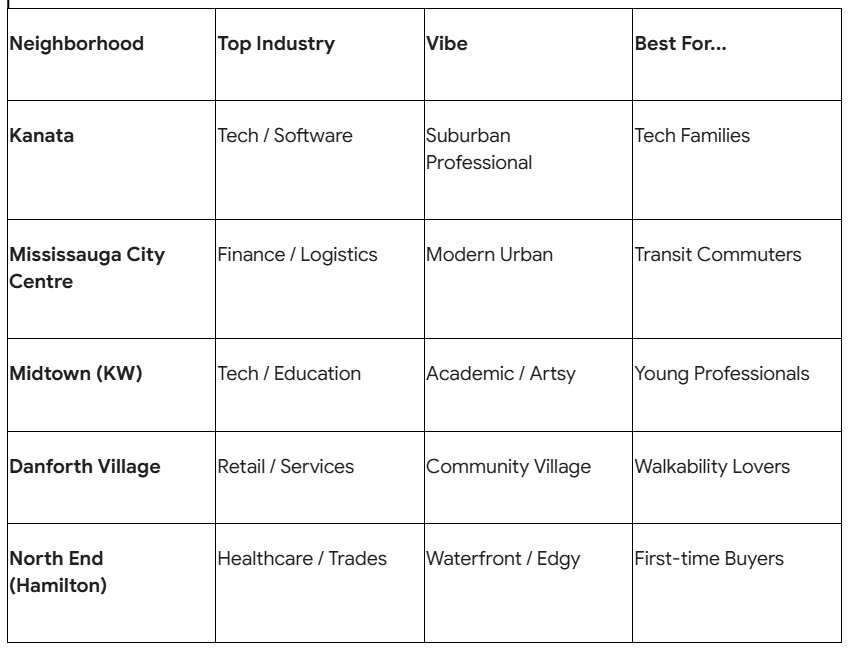
Neighborhood Comparison at a Glance (2026)

Mapping Your Future with LendingMoney.ca

Choosing a neighborhood is the first step; securing the financing to live there is the second. At LendingMoney.ca, we specialize in helping newcomers understand the specific market values in these high-growth areas.

Whether you’re looking for a condo in Mississauga or a tech-hub home in Kanata, our Financial Heroes can help you navigate the newcomer mortgage programs that the big banks often make too complicated.

Found a neighborhood you love? [Get a Location-Specific Pre-Approval] with LendingMoney.ca today and let’s make your Ontario dream a reality.

Read blog –Welcome to Canada: Your 2026 Guide to Building Credit from Day 1