Blogs Tax Debt Solutions

Unexpected Debt to the CRA? What can you do to pay what you owe?

It is April 2026, and for many Canadians, the arrival of a Notice of Assessment (NOA) from the CRA brings a stomach-turning surprise: a balance owing that wasn’t in the budget.

Whether it’s due to a self-employment tax miscalculation, a clawback of benefits, or a simple filing error, unexpected tax debt is a financial fire that needs to be put out quickly. In 2026, the CRA’s interest rate on overdue tax sits at 7% compounded daily, meaning your debt grows every single morning you leave it unpaid.

At LendingMoney.ca, we specialize in Credit Rehabilitation. We know that tax debt is the #1 hurdle to getting a traditional mortgage or car loan. Here is what you need to do if you find yourself with an unexpected CRA bill this tax season.

1. Don’t Ghost the CRA (File Anyway!)

The biggest mistake homeowners make is delaying their tax filing because they know they can’t pay.

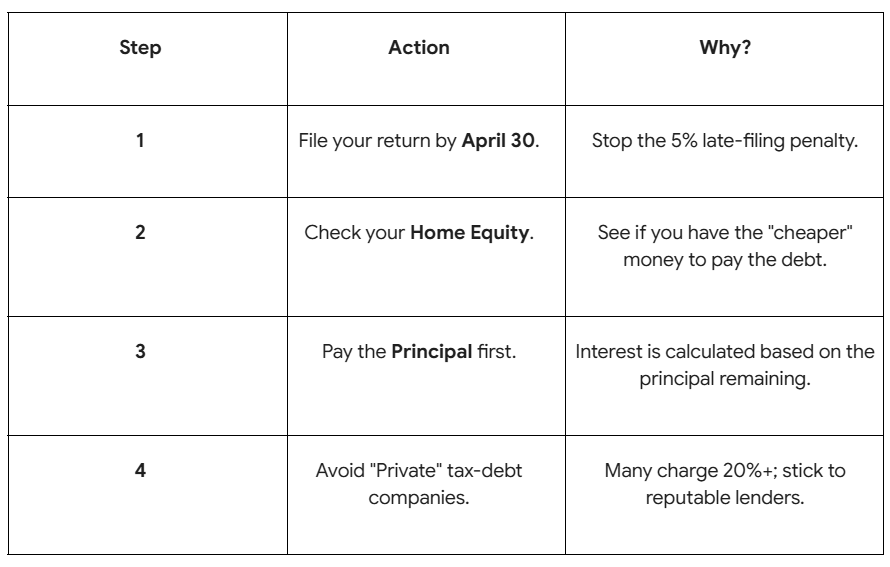
  • The Penalty: If you file late and owe money, the CRA hits you with an immediate 5% penalty on the balance, plus 1% for every month you are late.
  • The Hero Move: File your taxes by the April 30th deadline (or June 15th if self-employed), even if you have $0 in the bank. Filing on time stops the late-filing penalty, leaving you with only the interest to manage.

2. Request a Payment Arrangement

If you can pay off the debt within a few months, the CRA is surprisingly reasonable-if you talk to them first.

  • TeleArrangement: You can call the CRA to set up a “Pre-Authorized Debit” plan to pay your debt over time (usually up to 12 months).
  • The Reality: While this stops aggressive collection action (like wage garnishing), the 7% daily interest continues to run. You are essentially taking a high-interest loan from the government.

3. Leverage Your Home Equity (The Interest “Hack”)

If your tax debt is substantial ($10,000 to $100,000+), using a payment plan is often the most expensive way to handle it.

  • The 2026 Math: * CRA Interest: ~7% daily compounded (effectively much higher).
  • Home Equity Loan: monthly compounded.
  • The Move: Using a Home Equity Line of Credit (HELOC) or a Second Mortgage from LendingMoney.ca to pay the CRA in full immediately. You swap “predatory” daily interest for a stable, lower-rate mortgage payment. Plus, the CRA is paid, which clears your name for future bank approvals.

4. The Taxpayer Relief Hail Mary

Did your debt happen because of a serious illness, a death in the family, or a natural disaster?

  • The Option: You can apply for Taxpayer Relief (Form RC4288).
  • What it does: If approved, the CRA can waive the penalties and interest on your account.
  • The Catch: They almost never waive the principal tax you owe. You still need a plan to pay the core debt, which is where an equity-based “bridge” loan becomes essential.

5. Why Banks Say No to Tax Debt

If you walk into a “Big Six” bank with a $20,000 CRA bill, they will likely decline your loan.

  • The Reason: Banks view CRA debt as a “Super Lien.” They know the government can freeze your accounts or put a lien on your house that takes priority over the bank’s own mortgage.
  • The LendingMoney.ca Solution: As an Alternative Lender, we aren’t afraid of CRA debt. We provide the funds to pay the CRA today, so your credit can begin its Rehabilitation tomorrow. Once the CRA is out of the picture, the big banks will be happy to talk to you again in a year.

CRA Debt Survival Checklist (April 2026)
Turn Your Tax Debt into a Strategy

Unexpected debt to the CRA is a crisis, but it’s also an opportunity to restructure your finances. By using your home equity to clear the slate, you protect your credit score, stop the daily interest bleed, and regain control of your financial future.

Stunned by your 2026 Tax Bill? [Connect with a Financial Hero] at LendingMoney.ca. We’ll look at your home equity and find a way to pay the CRA so you can get back to what matters.

Read blog How to Pay CRA Debt With Home Equity
Blogs Debt Consolidation Debt Relief Financial Recovery Tax Debt Solutions

How to Pay CRA Debt With Home Equity
For many Canadians, debt owed to the Canada Revenue Agency (CRA) is the most stressful type of financial burden. Unlike a credit card company, the CRA has “super-priority” powers – they can garnish your wages without a court order, freeze your bank accounts, and even place a “Restricting Lien” on your home.

In 2026, the CRA’s daily compounded interest rates remain significantly higher than secured mortgage rates. If you are a homeowner, using your home equity to clear tax debt isn’t just a convenience – it’s a vital Credit Rehabilitation strategy to protect your property.

1. Why the CRA Debt is a “Financial Fire”

The CRA is not a typical lender. They don’t care about your credit score, but they do care about getting paid.

  • Daily Compounding Interest: In 2026, CRA interest rates on overdue taxes are roughly 9% to 10%, compounded daily.
  • The “Lien” Risk: If you ignore the debt, the CRA can register a lien against your property. This makes it almost impossible to sell your home or renew your mortgage with a traditional bank until the debt is paid.
  • The Bank’s Reaction: If a “Big Six” bank sees you have CRA debt, they will often issue an immediate decline on any loan or mortgage application. They see the CRA as a “predatory” creditor that has a higher claim to your assets than they do.

2. Option A: The Mortgage Refinance (The Clean Sweep)

This is the most common way to handle large tax bills. You replace your current mortgage with a new one that includes the amount you owe to the CRA.

  • How it Works: If you have $50,000 in tax debt, you increase your mortgage by that amount and the lender pays the CRA directly at the time of closing.
  • The Benefit: You swap 10% daily interest for a much lower mortgage rate.
  • The 2026 Rule: You can typically borrow up to 80% of your home’s appraised value.

3. Option B: The Second Mortgage (The “Bridge” Solution)

If you have a very low interest rate on your primary mortgage that you don’t want to lose, a Second Mortgage is the “Hero Move.”

  • How it Works: You take out a separate, smaller loan that sits behind your main mortgage.
  • The Benefit: You don’t have to break your first mortgage or pay “prepayment penalties.”
  • Why it’s used for CRA debt: Second mortgages are often easier to qualify for if your credit is “bruised” by your tax issues. At LendingMoney.ca, we use this as a 12-month bridge to pay the CRA, clear your name, and then move you back to a traditional lender once the “fire” is out.

4. Option C: The Home Equity Line of Credit (HELOC)

If your tax debt is smaller or you are self-employed and expect ongoing tax obligations, a HELOC offers the most flexibility.

  • How it Works: It’s like a giant credit card secured by your house. You only pay interest on what you use.
  • The Benefit: You can pay the CRA immediately and then pay back the HELOC on your own schedule.
  • The 2026 Requirement: Most lenders require a credit score of 680+ for a HELOC. If your score has dropped due to tax arrears, you may need to look at Options A or B first.

5. What if the CRA Already Has a Lien on My House?

Many homeowners think that once a lien is registered, they are “stuck.” This is a myth.

The LendingMoney.ca Strategy: We are an alternative lender who specializes in “Lien Payoffs.”

  1. Approve the loan based on your home’s equity.
  2. On closing day, the lawyer sends the funds directly to the CRA.
  3. The CRA issues a “Cessation of Charge” (discharges the lien).
  4. Your title is clear, your “super-priority” debt is gone, and you can finally breathe again.

6. The 2026 Taxpayer Relief Factor

While you are organizing your home equity, don’t forget about Taxpayer Relief. In 2026, the CRA still allows for the “Cancellation of Penalties and Interest” in cases of extreme financial hardship or circumstances beyond your control (like a serious illness).

  • The Pro-Tip: Pay the principal tax debt using your home equity first. This shows the CRA you are acting in “Good Faith,” which significantly increases your chances of getting the extra penalties waived later.

Don’t Let the CRA Own Your Home

Tax debt is heavy, but your home equity is the lever that can lift it. By moving high-interest, high-stress tax debt into a low-interest, structured mortgage, you protect your family’s most valuable asset and begin your path to Credit Rehabilitation.

Ready to see how much equity you can unlock to clear your tax bill? [Get a Confidential CRA Debt Assessment] with LendingMoney.ca today.

Read Blog – The Difference Between a B-Lender and an Alternative Lender

Personal Finance Second Mortgages Tax Debt Solutions

How to Use a Second Mortgage to Stop CRA Collection Action

In the 2026 financial landscape, the Canada Revenue Agency (CRA) has moved toward “Aggressive Automation.” If you owe back taxes, the transition from a friendly reminder to a frozen bank account or a registered lien on your home can happen in weeks, not months.

When the CRA begins “Collection Action,” they are no longer asking for the money-they are taking it. This is where a Second Mortgage from LendingMoney.ca acts as the ultimate defensive shield. Here is how it works.

The CRA Shield: Using a Second Mortgage to Stop Collections

A Second Mortgage is a loan taken out against the equity in your home, sitting behind your primary bank mortgage. While a “Big Six” bank will almost never give you a loan to pay off tax debt, Alternative Lenders see it differently. We see your home equity as the key to your Credit Rehabilitation.

1. Why a Second Mortgage is Faster Than a Refinance

When the CRA is threatening to garnish your wages or freeze your accounts, you don’t have 30 days to wait for a bank appraisal and a full mortgage refinance.

  • The Speed: A Second Mortgage can often be funded in 3 to 5 business days.
  • The Strategy: You leave your low-rate first mortgage exactly where it is. You only borrow the specific amount needed to “kill” the CRA debt, minimizing your interest costs.

2. Stopping the Daily Compounding Interest

As of April 2026, the CRA’s prescribed interest rate is significantly higher than it was in the early 2020s.

  • The Math: CRA interest is compounded daily. This means you are paying interest on yesterday’s interest, every single morning.
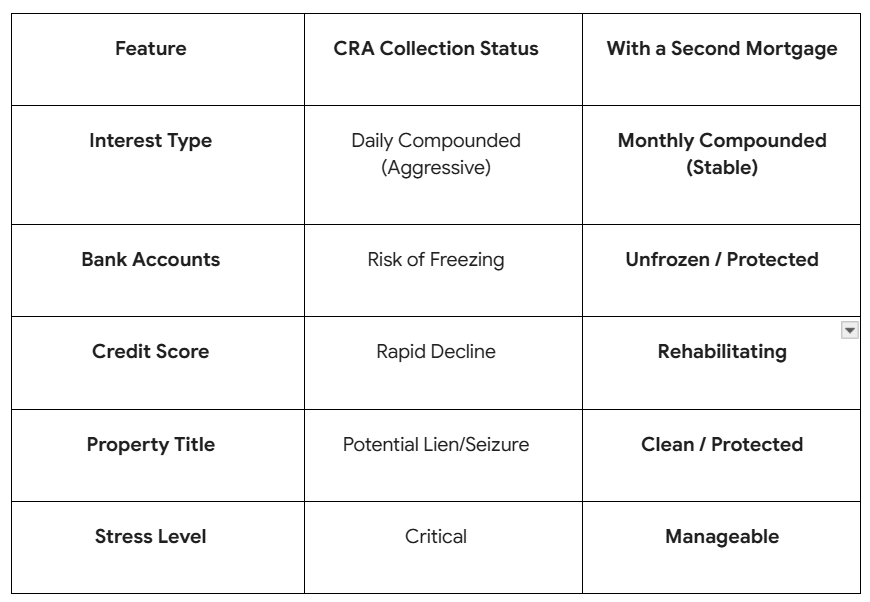
  • The Move: A Second Mortgage from LendingMoney.ca uses monthly compounding. By paying the CRA in full with a Second Mortgage, you immediately stop the “interest snowball” and move to a predictable, stable monthly payment.

3. Preventing the Notice of Certification (Lien)

The moment the CRA registers a “Notice of Certification” against your property title, your credit score will plummet, and your traditional bank will likely flag your account for “Default.”

  • The Hero Move: By using a Second Mortgage to pay the debt before the lien is registered, you keep your property title clean. This is vital for when your primary mortgage comes up for renewal-your bank will never know there was a tax issue, allowing you to renew at the best possible rates.

4. How the Payout Process Works

At LendingMoney.ca, we don’t just give you the cash and hope you pay the government. To protect you, the process is handled legally:

  1. The Approval: We approve your loan based on your home’s remaining equity.
  2. The Payout: Our lawyer sends the funds directly to the CRA on your behalf.
  3. The Proof: We obtain a “Statement of Account” showing a zero balance.
  4. The Release: If a freeze or garnishment was already in place, the CRA issues a formal release, and your financial life returns to normal within 48 hours.

Second Mortgage vs. CRA Collection Action

Reclaim Your Peace of Mind

Tax debt is the only debt in Canada that can bypass the normal court system to take your assets. Don’t wait for the CRA to make the first move. By using a Second Mortgage as a “Bridge Loan,” you take the power back, clear your name, and buy the time you need to get your finances in order.

Has the CRA sent you a Final Notice or a “Legal Warning”? [Get a Second Mortgage Quote] from LendingMoney.ca today. We specialize in fast, equity-based solutions that stop the taxman in his tracks.

Read blog – Unexpected Debt to the CRA? What can you do to pay what you owe?

Alternative Lending Blogs Education Personal Finance Tax Debt Solutions

Breaking the Cycle: Why Payday Loans are a Financial Trap in 2026

We’ve all been there: an unexpected car repair, a dental emergency, or a utility bill that’s higher than usual. When you need cash today and the bank has already said no, a neon sign for a payday loan can look like a beacon of hope.

In Ontario, names like Money Mart are everywhere, promising “instant cash” with “no credit check.” But in 2026, the price of that speed has reached a breaking point for many Canadian families. At LendingMoney.ca, we believe that true Credit Rehabilitation starts with understanding why payday loans are designed to keep you in debt-and how alternative lending can set you free.

1. The 365% Reality Check

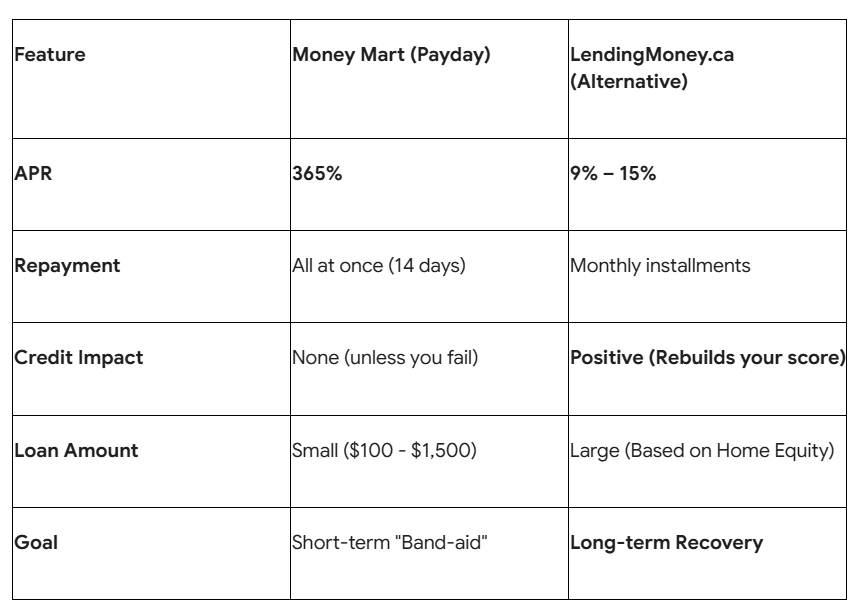
In Ontario, the law limits payday lenders to charging $14 per $100 borrowed. On the surface, $14 doesn’t sound like much. But payday loans are designed to be paid back in just 14 days.

  • The Math: If you borrow $500 for two weeks, you pay $70 in fees. If you were to carry that same debt for a full year, the Annual Percentage Rate (APR) is a staggering 365%.
  • The Comparison: At LendingMoney.ca, an alternative equity loan or second mortgage typically carries an APR between 9% and 15%. That is a difference of over 350%.

2. The Vicious Cycle of Re-Borrowing

The biggest pitfall of a payday loan isn’t the first one—it’s the second one.

  • The Trap: When your next paycheck arrives, the payday lender takes their $570 (principal + fees) directly from your account. This leaves you with $570 less to pay your rent and buy groceries for the next two weeks.
  • The Result: Most borrowers find themselves short again within days, forcing them to take out a new payday loan to cover the gap left by the first one.
  • The 2026 Data: Statistics Canada reports that the average payday loan user in 2026 takes out 8 to 10 loans per year. This isn’t a “bridge”-it’s a treadmill.

3. The No Credit Check Illusion

Payday lenders often advertise “No Credit Check” as a benefit. While this makes it easy to get the money, it has a hidden sting: Payday loans almost never help your credit score.

  • The Logic: Because they don’t report your on-time payments to Equifax or TransUnion, you get zero “points” for paying them back.
  • The Sting: However, if you miss a payment, they will send the debt to a collection agency immediately, which will tank your score. It is a “no-win” scenario for your Credit Rehabilitation.

4. The Balloon Payment vs. Installments

A payday loan is a “balloon” payment—the whole amount is due at once. This is the hardest way to pay back debt.

  • The LendingMoney.ca Difference: We offer Installment-Based alternative loans. Instead of losing $500 of your next paycheck, you might pay $50 a month over a longer term. This protects your daily cash flow and allows you to breathe.

5. Aggressive Collection Tactics in 2026

With the 2026 digital banking updates, payday lenders use “Pre-Authorized Debit” agreements that are notoriously difficult to stop. If you try to block the payment to buy food, they may charge you NSF fees of $20–$50 on top of the 30% default interest they are legally allowed to charge.

Payday Loan vs. LendingMoney.ca Alternative Loan

Stop Digging. Start Building.

If you are currently using payday loans to stay afloat, you aren’t alone-but there is a better way. If you own your home, your equity is a “Financial Hero” waiting to be used.

At LendingMoney.ca, we use your home equity to provide a low-interest alternative to the payday trap. We pay off the high-interest lenders, lower your monthly payments, and start the process of moving you back to a traditional bank.

Ready to break the cycle? [Get a Payday Loan Exit Quote] from LendingMoney.ca today. Let’s trade your 365% debt for a plan that actually works.

Read blog – Breaking the Cycle: A Guide to Loans for Debt Consolidation with Poor Credit