
Alternative Lending Solutions Credit & Debt Management Mortgages in Canada

The Entrepreneur’s Edge: A 2026 Guide to Self-Employed Mortgages in Canada

Running your own business is the Canadian dream. You have the freedom to set your own hours, choose your clients, and- most importantly – optimize your taxes through legitimate business write-offs. However, when it comes time to buy a home, that same tax efficiency can become your biggest obstacle.

Traditional banks often look at your Net Income after all those deductions and conclude you can’t afford the home you want. At LendingMoney.ca, we know that your tax return doesn’t tell your whole story. Here is how to navigate the 2026 self-employed mortgage landscape and get the keys to your dream home.

1. The 2026 Reality: Why the Big Banks are Tightening

As of 2026, the Big Six banks have implemented stricter forensic-level scrutiny on self-employed applications.

  • The “Stress Test” Hurdle: With benchmark stress tests hitting 7.25% this year, many business owners are being disqualified because their “taxable income” is too low to pass the math, even if their bank accounts are healthy.
  • Documentation Fatigue: Banks are now asking for 24 months of business bank statements (up from 12) to prove that your income hasn’t fluctuated wildly during recent economic shifts.

2. Choosing Your Path: A-Lending vs. B-Lending

For a self-employed borrower, there are two primary routes to an approval.

Path A: The Traditional Qualified Mortgage

This is for the business owner who pays themselves a consistent salary or dividends and shows a strong net income on their tax returns.

  • Requirement: Two years of Notices of Assessment (NOA) and T1 Generals.
  • The Benefit: You get the lowest “Prime” interest rates and can put down as little as 5% to 10%.
  • The Strategy: “Income Smoothing.” In 2026, lenders favor a consistent $8,000/month draw over erratic $25,000 quarterly distributions.

Path B: The Stated Income or BFS (Business-for-Self) Program

This is where LendingMoney.ca shines. We are an alternative lender who understands that business owners “write down” their income.

  • How it works: Instead of looking at your taxable income, we look at your gross business revenue and 6–12 months of business bank statements.
  • The Requirement: You typically need a 20% down payment.
  • The Benefit: We can “gross up” your income by adding back common deductions like vehicle expenses, home office costs, and depreciation. This often doubles your borrowing power overnight.

3. The Financial Hero Documentation Checklist

To win a mortgage in 2026, you need to be “lender-ready” before you even start house hunting. You will need:

  • Proof of Business Existence: Articles of Incorporation or a Master Business License showing you’ve been active for at least 2 years.
  • Clean Tax Records: Confirmation that your GST/HST and personal income taxes are fully paid. Lenders in 2026 view “CRA Debt” as a major red flag.
  • The “Dual Account” Rule: Lenders love seeing clean separation between personal and business spending. If you’re still paying for groceries out of your corporate account, it’s time to stop.

4. 2026 Strategy: The 2-Year Runway

If you’re planning to buy a home in the next 12 to 24 months, your Credit Rehabilitation starts now.

  • Minimize Write-offs: In the two years before applying, consider taking fewer deductions. Yes, you’ll pay a bit more in tax, but the “interest savings” on a lower mortgage rate can be significantly higher.
  • Boost Your Credit Score: For self-employed borrowers, a score of 680+ is the new “gold standard” for conventional rates. If you’re below that, use the LendingMoney.ca tools to pay down revolving debt 90 days before you apply.

5. The Gig Economy & Contract Professionals

In 2026, more Canadians are “Contractors” rather than traditional employees.

  • The Good News: If you are a Commissioned Professional or a long-term contractor with one or two major clients, we can often treat your income as “quasi-salaried,” allowing for lower down payments.
  • The Key: Showing signed contracts for future work is a powerful way to mitigate the risk of fluctuating income in the eyes of a lender.

Why Your Business Deserves a Hero Approach

At LendingMoney.ca, we are entrepreneurs ourselves. We know that your business is your passion and your primary wealth-builder. You shouldn’t be penalized for being your own boss.

We specialize in “B-Lending” and alternative solutions that bridge the gap between your tax returns and your true financial strength. We don’t just look for a “No”; we look for the “Path to Yes.”

Ready to see what you qualify for as a business owner? [Start Your Self-Employed Pre-Approval] with LendingMoney.ca today.

Read blog –Breaking the Cycle: A Guide to Loans for Debt Consolidation with Poor Credit

Blogs Home Buying Mortgages in Canada Newcomer Mortgages Ontario Real Estate

Ontario’s Top 5 Newcomer Neighborhoods

For a newcomer in 2026, choosing a neighborhood isn’t just about the house – it’s about the “ecosystem.” You need transit to get to your new job, schools for your children, and a community that understands the immigrant experience.

While Toronto is the famous choice, the 2026 “Smart Money” for newcomers has shifted toward cities that offer a better balance of affordability and opportunity. Here are the top five neighborhoods and regions in Ontario for newcomers this year.

1. Kanata (Ottawa) – The Silicon Valley of the North

If you are arriving with a background in Tech, Engineering, or Healthcare, Kanata is arguably the best destination in Ontario for 2026.

  • Why it’s perfect for newcomers: It is home to Canada’s largest technology park (tech giants like Nokia, Cisco, and Shopify are here). This means high-paying jobs are often within a 10-minute commute of residential streets.
  • The Lifestyle: It offers a suburban feel with top-tier schools and much more affordable detached homes than the GTA.

2026 Advantage: Ottawa consistently ranks #1 in Canada for “Quality of Life” due to its safety and stable public-sector economy.

2. Fairview & City Centre (Mississauga)

Mississauga has long been a newcomer favorite, but the City Centre area is the 2026 hotspot thanks to massive infrastructure completions.

  • Why it’s perfect for newcomers: This is one of the most multicultural hubs in the world. You will find grocery stores, places of worship, and community centers representing almost every culture on earth.
  • The Transit Factor: With the Hurontario LRT now fully operational in 2026, commuting to Brampton or down to the Port Credit GO station (for a 25-minute train to downtown Toronto) is seamless.
  • The Housing: Ideal for those looking for modern condos or townhomes near Square One Shopping Centre.

3. Midtown (Kitchener-Waterloo)

Located right between Kitchener and Waterloo, the Midtown area has emerged as a vibrant, “up-and-coming” tech and education hub.

  • Why it’s perfect for newcomers: It’s the heart of the “Innovation Corridor.” With two world-class universities and a thriving startup scene, it’s perfect for international students graduating in Canada or young professional families.
  • The Affordability: While prices have risen, you still get significantly more “square footage” for your dollar here than in Toronto.
  • 2026 Advantage: The expanded ION Light Rail makes the entire region accessible without needing a car on Day 1.

4. Danforth Village & East York (Toronto)

If you have your heart set on Toronto but want a neighborhood that feels like a “village,” the Danforth is the place to be in 2026.

  • Why it’s perfect for newcomers: It is famous for its “Greektown” roots but has evolved into a diverse melting pot. It is incredibly walkable, meaning you can do all your shopping on foot.
  • The Transit Factor: You are right on Line 2 (the Subway), giving you effortless access to the entire city.
  • The Housing: Great for newcomers looking for semi-detached homes or older bungalows with “character.” It’s a family-oriented area with some of the city’s best community centers.

5. North End (Hamilton)

Once an industrial secret, Hamilton’s North End has undergone a massive revitalization, making it the “Affordability Hero” of 2026.

  • Why it’s perfect for newcomers: It offers a stunning waterfront location and some of the most competitive property prices in the Greater Golden Horseshoe.
  • The Vibe: It’s becoming an artistic and culinary hub, perfect for those who want a “cool” urban lifestyle without the Toronto price tag.
  • The 2026 Advantage: With improved GO Transit frequency, many newcomers live here while working in Toronto or Mississauga, enjoying a lower cost of living and a tighter-knit community.

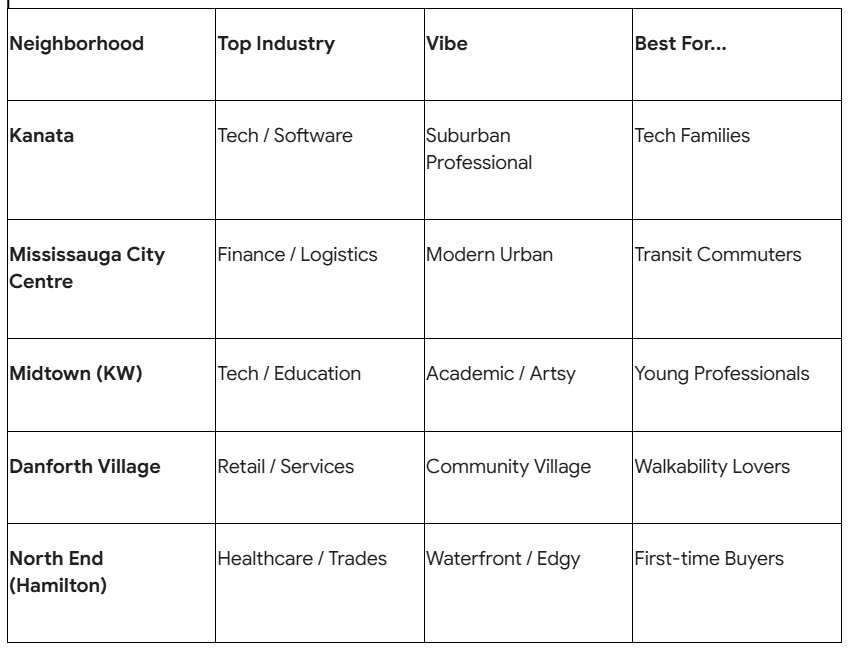
Neighborhood Comparison at a Glance (2026)

Mapping Your Future with LendingMoney.ca

Choosing a neighborhood is the first step; securing the financing to live there is the second. At LendingMoney.ca, we specialize in helping newcomers understand the specific market values in these high-growth areas.

Whether you’re looking for a condo in Mississauga or a tech-hub home in Kanata, our Financial Heroes can help you navigate the newcomer mortgage programs that the big banks often make too complicated.

Found a neighborhood you love? [Get a Location-Specific Pre-Approval] with LendingMoney.ca today and let’s make your Ontario dream a reality.

Read blog –Welcome to Canada: Your 2026 Guide to Building Credit from Day 1

Blogs Mortgages in Canada Personal Finance Second Mortgages

Falling Behind? How to Catch Up on Your Mortgage and Stop Foreclosure

Life in 2026 is expensive. Between groceries, utilities, and the new reality of higher mortgage rates, it only takes one unexpected event, a job transition, a medical emergency, or a major home repair, to fall behind on your mortgage.

If you’ve missed a payment, you might be avoiding your bank’s calls out of fear. But in Canada, lenders actually prefer helping you catch up over the long, expensive process of a “Power of Sale.” Here is your step-by-step Credit Rehabilitation plan to get back on track.

1. The First Strike Rule: Call Your Lender

The moment you know a payment is going to bounce, or if you’ve already missed one, pick up the phone.

  • What to Ask For: Ask to speak to the Loss Mitigation Department.
  • The 2026 Options: Most “Big Six” banks and credit unions have structured relief programs, including:
  • Capitalizing the Arrears: The lender takes the missed payments and adds them back into your total mortgage balance, spreading the cost over the remaining years.
  • Payment Deferral: Some lenders may allow a “pause” for up to 4 months if you can prove the hardship is temporary.

Interest-Only Payments: A temporary shift where you only pay the interest, giving you a 3–6 month window to stabilize your income.

2. Leverage Your Hero Tool: Home Equity

If your bank isn’t willing to work with you, or if you owe more than three months of payments, the “institutional” door may close. This is where your home’s value becomes your lifesaver.

  • The Equity Bailout: If you have at least 20% equity in your home, you can use a Second Mortgage or an Alternative Equity Loan from LendingMoney.ca to “clear the slate.”
  • Why this works: We provide the lump sum needed to pay the bank the full amount of your arrears (including their legal fees). This stops the foreclosure process instantly. You then have a manageable monthly payment with us while you get back on your feet.

3. The Amortization Stretch

If the reason you fell behind is that your monthly payment is simply too high for your current income, a “catch-up” payment is only a temporary fix. You need a structural change.

  • The Move: Re-amortize your mortgage. If you have 15 years left, ask to move back to a 25 or 30-year schedule.
  • The Result: This lowers your monthly obligation, making it much harder to fall behind again in the future.

4. Watch Out for the Legal Fee Trap

In 2026, once a mortgage goes into “Default,” lenders move quickly.

  • The Danger: After 2 or 3 missed payments, the bank’s lawyer will issue a “Statement of Claim.” The moment this happens, thousands of dollars in legal fees are added to your debt.
  • The Strategy: The faster you act, the less you pay. Settling your arrears in month two might cost you $200 in fees; waiting until month four could cost you $5,000.

5. The CRA Connection

Check your tax status. In 2026, many mortgage arrears are actually caused by the CRA freezing a homeowner’s bank account due to unpaid taxes.

  • The Fix: If your mortgage is bouncing because your accounts are frozen, you must resolve the CRA issue simultaneously. Using home equity to pay off both the CRA and the mortgage arrears is the ultimate “Double-Hero” move.

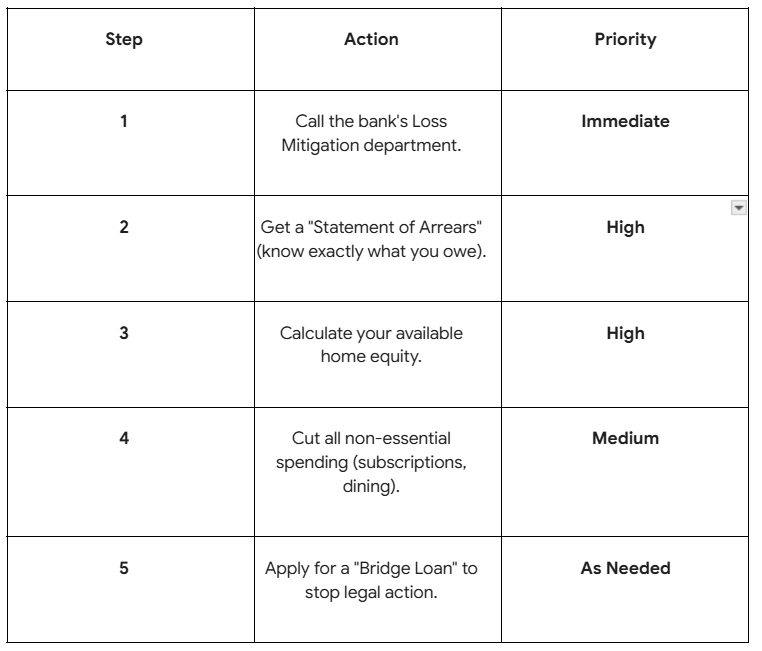
Your “Catch-Up” Checklist (2026)

You Don’t Have to Lose Your Home

At LendingMoney.ca, we specialize in the “Second Chance.” We know that being behind on your mortgage is a heavy burden, but we have the alternative lending tools to lift it. We help you pay the arrears, stop the legal fees, and build a plan to return to a traditional lender when your Credit Rehabilitation is complete.

Are the calls from the bank getting louder? [Get an Arrears Rescue Quote] from LendingMoney.ca today. Let’s protect your equity and keep your family in their home.