Blogs Financial Recovery Mortgage Tips Mortgages

Job Loss & Mortgages: Your 30-Day Action Plan

Unexpected job loss is a “Financial Heart Attack.” In the first few hours, your mind immediately goes to the biggest bill on the table: the mortgage. In the 2026 economic landscape, lenders and insurers have become more proactive about “Hardship Management.” The goal of the bank is not to take your house-it’s to keep you as a paying customer in the long run.If you’ve recently lost your job, your first 30 days are critical for protecting your title and your credit score. Here is your week-by-week survival guide.

Week 1: The Gather & Assess Phase

Before you call the bank, you need to know exactly where you stand.

  • Review Your Insurance: Check your mortgage documents or employer benefits for Job Loss Insurance (also called Creditor Insurance). Many homeowners pay for this without realizing it. It can cover your mortgage payments for 6–9 months while you look for work.
  • Identify Your Insurer: Is your mortgage insured by CMHC, Sagen, or Canada Guaranty? (This is typical if you put down less than 20%). These insurers have “Homeowner Assistance Programs” specifically designed to prevent foreclosure after a layoff.
  • Calculate Your “Runway”: Look at your liquid savings. How many months can you pay the mortgage if you cut all non-essential spending?

Week 2: The Heroic Outreach

The biggest mistake homeowners make is waiting until they miss a payment to call the bank.

  • The Call: Contact your lender’s “Loss Mitigation” or “Specialized Collections” department.
  • The Script: I have experienced a temporary job loss. I have never missed a payment, and I want to keep it that way. What hardship options do you have available?”
  • The Options: In 2026, lenders may offer:
  • Skip-a-Payment: Most banks allow one “vacation” payment per year.
  • Interest-Only Payments: Reducing your payment to just the interest portion for 3–6 months.
  • Payment Deferral: Pausing payments for up to 4 months (the interest is usually added to the back of the loan).

Week 3: The Strategic Pivot

If you suspect your job search might take longer than 90 days, you need a more robust solution than a simple “skip.”

  • Amortization Extension: If you have enough equity, you can “stretch” your mortgage back out to 30 years. This lowers your monthly payment permanently, giving you a massive cash-flow boost while you’re between roles.
  • The “Bridge” Equity Loan: At LendingMoney.ca, we help homeowners set up a “Emergency Line of Credit” or a small second mortgage while they still have some income/severance left. This provides a “War Chest” of cash that you can use to pay your first mortgage until you land your next “Hero” role.

Week 4: The Credit Shield

By day 30, you need to ensure your credit score isn’t being collateral damage.

  • Protect the R1: Your mortgage is an “R1” (paid on time) on your credit report. Even one “R2” (30 days late) can prevent you from refinancing or renewing at a good rate later.
  • The Consolidation Strike: If you are using credit cards to pay for groceries so you can afford the mortgage, stop. [Connect with LendingMoney.ca] to consolidate those 22% interest cards into a lower-rate equity loan. It’s better to have a slightly larger mortgage than a mountain of credit card debt that you can’t escape.

Job Loss Strategy Comparison (2026)

OptionBest For…Impact on Credit
Payment DeferralVery short-term gaps (1-3 months).Neutral (if approved).
Amortization StretchLong-term cash flow relief.Positive (Keeps payments low).
Equity Rescue LoanTotal income loss / No savings.Positive (Prevents missed payments).
Doing NothingNever Recommended.Fatal (Leads to Power of Sale).

You Are Not Your Employment Status

A layoff is a temporary setback, but your home is your foundation. At LendingMoney.ca, we don’t just look at your current pay stub; we look at your career history and your home’s equity to find a way through the storm.

Did you just receive a layoff notice? Don’t wait for Day 31. [Request a Hardship Analysis] from LendingMoney.ca today. Let’s protect your home while you find your next big opportunity.
Blogs Debt Consolidation Debt Relief Financial Recovery Tax Debt Solutions

How to Pay CRA Debt With Home Equity

For many Canadians, debt owed to the Canada Revenue Agency (CRA) is the most stressful type of financial burden. Unlike a credit card company, the CRA has “super-priority” powers – they can garnish your wages without a court order, freeze your bank accounts, and even place a “Restricting Lien” on your home.

In 2026, the CRA’s daily compounded interest rates remain significantly higher than secured mortgage rates. If you are a homeowner, using your home equity to clear tax debt isn’t just a convenience – it’s a vital Credit Rehabilitation strategy to protect your property.

1. Why the CRA Debt is a “Financial Fire”

The CRA is not a typical lender. They don’t care about your credit score, but they do care about getting paid.

  • Daily Compounding Interest: In 2026, CRA interest rates on overdue taxes are roughly 9% to 10%, compounded daily.
  • The “Lien” Risk: If you ignore the debt, the CRA can register a lien against your property. This makes it almost impossible to sell your home or renew your mortgage with a traditional bank until the debt is paid.
  • The Bank’s Reaction: If a “Big Six” bank sees you have CRA debt, they will often issue an immediate decline on any loan or mortgage application. They see the CRA as a “predatory” creditor that has a higher claim to your assets than they do.

2. Option A: The Mortgage Refinance (The Clean Sweep)

This is the most common way to handle large tax bills. You replace your current mortgage with a new one that includes the amount you owe to the CRA.

  • How it Works: If you have $50,000 in tax debt, you increase your mortgage by that amount and the lender pays the CRA directly at the time of closing.
  • The Benefit: You swap 10% daily interest for a much lower mortgage rate.
  • The 2026 Rule: You can typically borrow up to 80% of your home’s appraised value.

3. Option B: The Second Mortgage (The “Bridge” Solution)

If you have a very low interest rate on your primary mortgage that you don’t want to lose, a Second Mortgage is the “Hero Move.”

  • How it Works: You take out a separate, smaller loan that sits behind your main mortgage.
  • The Benefit: You don’t have to break your first mortgage or pay “prepayment penalties.”
  • Why it’s used for CRA debt: Second mortgages are often easier to qualify for if your credit is “bruised” by your tax issues. At LendingMoney.ca, we use this as a 12-month bridge to pay the CRA, clear your name, and then move you back to a traditional lender once the “fire” is out.

4. Option C: The Home Equity Line of Credit (HELOC)

If your tax debt is smaller or you are self-employed and expect ongoing tax obligations, a HELOC offers the most flexibility.

  • How it Works: It’s like a giant credit card secured by your house. You only pay interest on what you use.
  • The Benefit: You can pay the CRA immediately and then pay back the HELOC on your own schedule.
  • The 2026 Requirement: Most lenders require a credit score of 680+ for a HELOC. If your score has dropped due to tax arrears, you may need to look at Options A or B first.

5. What if the CRA Already Has a Lien on My House?

Many homeowners think that once a lien is registered, they are “stuck.” This is a myth.

The LendingMoney.ca Strategy: We are an alternative lender who specializes in “Lien Payoffs.”

  1. Approve the loan based on your home’s equity.
  2. On closing day, the lawyer sends the funds directly to the CRA.
  3. The CRA issues a “Cessation of Charge” (discharges the lien).
  4. Your title is clear, your “super-priority” debt is gone, and you can finally breathe again.

6. The 2026 Taxpayer Relief Factor

While you are organizing your home equity, don’t forget about Taxpayer Relief. In 2026, the CRA still allows for the “Cancellation of Penalties and Interest” in cases of extreme financial hardship or circumstances beyond your control (like a serious illness).

  • The Pro-Tip: Pay the principal tax debt using your home equity first. This shows the CRA you are acting in “Good Faith,” which significantly increases your chances of getting the extra penalties waived later.

Don’t Let the CRA Own Your Home

Tax debt is heavy, but your home equity is the lever that can lift it. By moving high-interest, high-stress tax debt into a low-interest, structured mortgage, you protect your family’s most valuable asset and begin your path to Credit Rehabilitation.

Ready to see how much equity you can unlock to clear your tax bill? [Get a Confidential CRA Debt Assessment] with LendingMoney.ca today.

Read Blog – The Difference Between a B-Lender and an Alternative Lender

Blogs Debt Relief Financial Recovery

Breaking the Streak: How to Rebuild Your Credit After Online Gambling Addiction

Recovering from an online gambling addiction is a double-sided battle. On one side is the emotional recovery—the work done through counseling and support groups. On the other side is the financial recovery—the daunting task of looking at maxed-out credit cards, payday loans, and a damaged credit score.

At LendingMoney.ca, we don’t look at where you’ve been; we look at where you are going. If you are in recovery and ready to stabilize your finances, you are making the most important bet of your life: a bet on yourself. Here is your step-by-step guide to fixing your credit and reclaiming your financial future in Canada.

1. Safety First: Install Financial "Guardrails"

Before you can fix your credit, you must ensure that your recovery is protected. The credit bureaus don’t see “gambling” on your report, but they do see the late payments and high utilization that often follow.

  • Self-Exclusion: Ensure you are registered for provincial self-exclusion programs (like iGaming Ontario or BCLC’s GameSense). This is your first line of defense.
  • Banking Blocks: Most major Canadian banks now allow you to toggle off “Gambling Transactions” within their mobile apps. Turn this on immediately.
  • The Two-Signature Rule: If you have a trusted partner or family member, consider moving your savings into an account that requires two signatures for withdrawals. This adds a “pause” button to impulsive decisions.

2. Face the Numbers (The Credit Audit)

The “fear of the mailbox” is real during recovery. However, you cannot fix what you do not measure.

  • Action Step: Download your free reports from Equifax and TransUnion.
  • Identify the Damage: Are there accounts in collections? How many payday loans are active? Payday loans are particularly damaging because they often don’t help your score when paid on time, but they ruin it if they go to collections.
  • Add a “Notice of Correction”: You can actually add a short statement to your credit file. Some people in recovery add a note asking lenders not to approve new credit applications to help prevent a relapse.

3. The Payday Loan "Pivot"

Online gambling often leads to a cycle of high-interest payday loans. These are the “kryptonite” of your credit score.

  • The Problem: Payday loans carry interest rates equivalent to 300%–500% APR. They are designed to keep you in debt.
  • The Hero Strategy: Consolidate these small, high-interest “fires” into a single, lower-interest installment loan. At LendingMoney.ca, we specialize in this “Pivot.” By moving from a payday loan to a structured installment loan, you stop the interest bleed and start reporting positive payment history to the bureaus every month.

4. Rebuild with "Micro-Victories"

Once your high-interest debt is stabilized, you need to start feeding the credit bureaus positive data.

  • The Secured Card Strategy: If your score is too low for a standard card, get a Secured Credit Card. Put a small deposit down (e.g., $200), and use it only for a fixed, recurring cost like your Netflix subscription.
  • The 30% Utilization Rule: Never let the balance on that card exceed $60. Low utilization combined with on-time payments is the fastest way to “rehabilitate” a score.

5. Address Collections Strategically

If your gambling led to accounts being sold to collection agencies, don’t panic.

  • Verify the Debt: Ensure the amount is correct.
  • Pay vs. Settle: Paying a collection in full looks better than settling for a partial amount, but both are better than leaving it active. Once a collection is “Paid,” its negative impact on your score begins to diminish over time.
  • Keep the Paperwork: Always get a “Release Letter” or “Letter of Satisfaction” once a debt is paid.

6. Focus on "Total Debt Service"

If you are aiming for a major goal—like a car or a home—lenders will look at your Debt-to-Income (DTI) ratio. Even if your credit score is still recovering, showing a steady decrease in your total debt over 6 to 12 months proves you have changed your financial behavior.

This “trended data” is what helps alternative lenders like us say “Yes” when a big bank says “No.”

Final Thoughts: You Are More Than Your Score

Recovery is a marathon. A credit score that took months to drop may take a year to climb back up, but every month of on-time payments is a victory. At LendingMoney.ca, we respect the hard work it takes to overcome addiction. We are here to provide the professional financial tools—not judgment—that you need to turn the page.

Ready to take control of your story? [Apply for a Consolidation Loan] today and let’s start your credit rehabilitation together.

Blogs Education Financial Recovery Mortgage Renewal Personal Finance

Payday vs. Installment Loan Costs

In 2026, the marketing around “fast cash” has become incredibly sophisticated. Big-name lenders like Money Mart are no longer just “payday” shops; they have aggressively pivoted into High-Cost Installment Loans.

While these might look like a better deal than a 14-day payday loan, the “Real Cost” over 12 to 36 months can be devastating to your long-term wealth. At LendingMoney.ca, we believe in Credit Rehabilitation, which means using the lowest cost of capital available to you-your home equity-to kill high-interest debt forever.

Here is the breakdown of the real cost between high-interest installments and an alternative equity-backed loan.

Payday vs. Installments vs. Equity: What’s the Real Cost?

When you’re in a financial pinch, lenders know you are focused on one number: the monthly payment. But the monthly payment is a mask. To see the true cost of a loan, you have to look at the Total Cost of Borrowing.

In 2026, the federal government has capped the criminal interest rate at 35% APR. While this sounds like a win for consumers, high-cost lenders have responded by adding “optional” insurance, administration fees, and longer terms to keep their profits high.

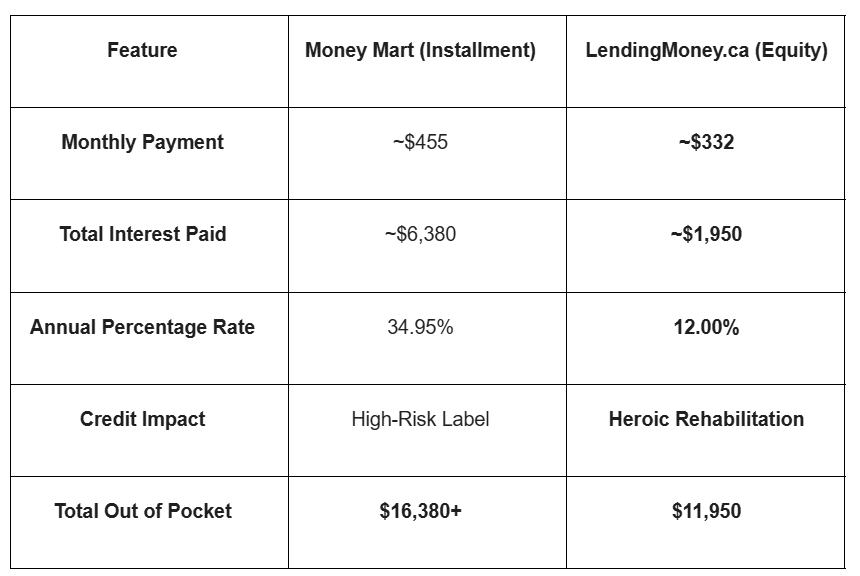
1. The Money Mart Installment Loan (35% APR + Fees)

If you borrow $10,000 from a high-cost installment lender in 2026 to consolidate your debts, your contract might look like this:

  • Interest Rate: ~34.95% APR
  • Term: 36 Months
  • Monthly Payment: ~$455.00
  • Optional Insurance: ~$92.00/month (often “highly recommended” for approval)

The Real Cost: After 3 years, you haven’t just paid back $10,000. You’ve paid back roughly $16,380 (or over $19,000 with insurance). You have effectively paid for your debt nearly twice.

2. The Payday Loan Treadmill (The 365% Trap)

If you skip the installment loan and go for a classic $500 payday loan:

  • The Fee: $14 per $100 borrowed ($70 fee).
  • The Cycle: Because you have to pay the full $570 back in 14 days, you likely have to borrow again to pay rent.
  • The Real Cost: If you “roll over” this debt for just six months, you will have paid over $900 in fees while still owing the original $500.

3. The LendingMoney.ca Alternative (9% – 15% APR)

Now, let’s look at using a Second Mortgage or Equity Loan to solve the same $10,000 problem:

  • Interest Rate: ~12% APR
  • Term: 36 Months (Amortized)
  • Monthly Payment: ~$332.00
  • Insurance/Hidden Fees: $0 (We focus on the equity in your home, not selling you add-ons).

The Real Cost: After 3 years, you’ve paid back $11,950.

2026 Cost Comparison: Borrowing $10,000

Why the Alternative Path Wins Every Time

The reason Money Mart’s costs are so high is that they are lending to thousands of people with no collateral. They expect many of them to fail, so you (the person who pays) have to cover the cost of those who don’t.

At LendingMoney.ca, we use your Home Equity as your “Financial Hero.” Because the loan is secured by your home, the risk is lower, which allows us to provide a rate that is one-third the cost of an unsecured installment loan.

The Hidden Danger of High-Interest Installments

In 2026, many banks see a “High-Interest Installment Loan” on a credit bureau as a sign of financial instability. Even if you pay it on time, it can actually make it harder to graduate to a traditional bank mortgage later. An equity-backed loan from LendingMoney.ca, however, shows you are a savvy homeowner using your assets strategically.

Stop Overpaying for Your Own Money

Every dollar you pay in 35% interest is a dollar taken away from your retirement, your children’s education, or your next home. If you own your home, you have already earned the right to lower interest rates.

Comparing a loan offer from Money Mart or another high-cost lender? [Upload Your Quote] to LendingMoney.ca for a “Real Cost Analysis.” Let us show you how much of your own money you can keep.

Read blog – Navigating Your Options: A Guide to Professional Debt Consolidation Services in Canada

Blogs Financial Recovery Personal Finance Private Lending

The Strategic Second: Why Canadians are Turning to Second Mortgages in 2026

For many, the term “second mortgage” once carried a certain stigma. It was something whispered about in times of crisis. However, as we move through 2026, the narrative has shifted. Today’s homeowners are using second mortgages to protect their low-rate first mortgages, fuel business growth, and navigate a complex tax environment.

A second mortgage is a loan secured against your property that sits behind your primary mortgage on the title. Because the lender is in “second position,” they take on more risk (if the home is sold, the first lender is paid first), which results in higher interest rates. But despite the cost, the benefits often far outweigh the price of the interest.

Here are the primary reasons why second mortgages have become the “Hero Move” for Ontario homeowners this year.

1. Protecting a Low-Rate First Mortgage

This is the #1 reason for a second mortgage in 2026. Many homeowners locked into 5-year fixed rates in 2021 or 2022 at rates between 1.5% and 2.5%.

If you need $50,000 today, you have two choices:

  • Refinance: Break your entire mortgage and move the whole balance to today’s rate (likely 4.5% – 5.5%). This triggers massive prepayment penalties and increases the cost of your entire debt.
  • The Second Mortgage: You leave your 2% mortgage exactly where it is. You only pay a higher rate on the new $50,000.

By keeping your “A-Lender” rate untouched, you save thousands in interest over the remaining years of your term.

2. High-Interest Debt Consolidation

In 2026, credit card interest rates have climbed to 21% – 24%, and personal lines of credit aren’t far behind. For a homeowner carrying $40,000 in consumer debt, the monthly interest alone can be “choking” their cash flow.

A second mortgage allows you to:

  • Replace 22% interest with 9% – 12% interest.
  • Collapse five or six monthly payments into one.
  • The Credit Rehab Win: By paying off your credit cards in full, your credit utilization drops to zero, often causing your credit score to jump 50 to 100 points in a single 90-day cycle.

3. Resolving CRA Tax Arrears

As we’ve discussed in our tax series, the CRA is the only creditor in Canada with “Super Priority.” They don’t need a court order to freeze your bank account or garnish your wages.

Traditional banks will almost never give you money to pay off the CRA. They view tax debt as a sign of instability. A private second mortgage lender, however, is happy to lend you the funds to “kill” the tax debt.

  • The Goal: Pay the CRA today to stop the 7% daily compounding interest and prevent a lien from being registered on your title.

4. Funding Value-Add Renovations

In 2026, many Canadians have decided to “Love It, Don’t List It.” With the costs of moving (land transfer taxes, real estate commissions, and legal fees) reaching $50,000+, many families prefer to renovate their existing space.

A second mortgage is perfect for:

  • ADUs (Additional Dwelling Units): Converting a basement or garage into a rental suite to generate extra income.
  • Major Overhauls: Kitchens and bathrooms that add more value to the home than the cost of the loan.
  • Speed: Unlike a bank-led “Improvement Mortgage,” which requires multiple inspections and draws, a second mortgage provides the cash upfront so you can pay your contractors and get the job done.

5. Business Capital and Entrepreneurial Growth

Banks are notoriously difficult for small business owners. If you are self-employed or starting a new venture in 2026, a bank will likely want to see two years of perfect tax returns before they lend you a dime.

Entrepreneurs use second mortgages as working capital:

  • To buy inventory in bulk at a discount.
  • To fund a marketing push or hire a key employee.
  • To bridge the gap while waiting for large invoices to be paid.
    Since the loan is based on equity, not your business’s current P&L statement, it is the fastest way to inject cash into a growing company.

6. Helping the Next Generation (The Bank of Mom and Dad)

With the 2026 real estate market still challenging for young buyers, many parents are using second mortgages to “gift” a down payment to their children.

  • By taking out a $100,000 second mortgage, parents can help their child enter the market today rather than waiting 10 years to save. This allows the family to build wealth across two properties simultaneously.

7. Emergency and Life Events

Life doesn’t always follow a budget. Unexpected medical expenses, a sudden divorce settlement, or helping a family member in a crisis can require a large amount of liquidity instantly.
A second mortgage can be funded in as little as 3 to 5 business days, making it the “Emergency Fund” for homeowners who are asset-rich but cash-poor.

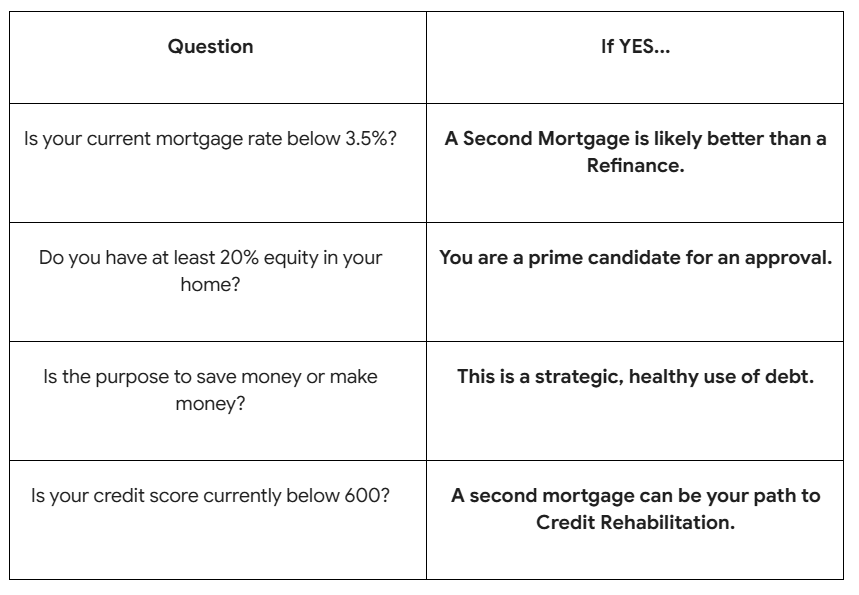
Is a Second Mortgage Right for You? (The 2026 Checklist)

Your Home, Your Future

At LendingMoney.ca, we don’t just see a second mortgage as a loan; we see it as a pivotal financial moment. Whether you are consolidating debt to save your credit or investing in your business to save your future, we match you with the lenders who value your equity and your story.

Ready to see how much equity you can unlock? [Get a Second Mortgage Quote] from a Financial Hero at LendingMoney.ca today. We’ll help you do the math and find the smartest path forward.

Alternative Lending Blogs Financial Education Financial Recovery Personal Finance

The Big Six vs. The Alternatives: Which Lender is Your Best Financial Partner?

If you’ve ever walked into a major Canadian bank to apply for a loan or a mortgage only to be told you don’t “fit the box,” you aren’t alone. In 2026, Canada’s “Big Six” banks have some of the strictest lending criteria in the world. But a “no” from a bank isn’t the end of your financial journey – it’s often just a sign that you need an alternative lender.

At LendingMoney.ca, we operate in the “Alternative” space. But what does that actually mean for your wallet? Let’s break down the fundamental differences between traditional banks and alternative lenders so you can choose the partner that actually fits your life.

1. The Box vs. The Big Picture

The most significant difference lies in how a lender views you.

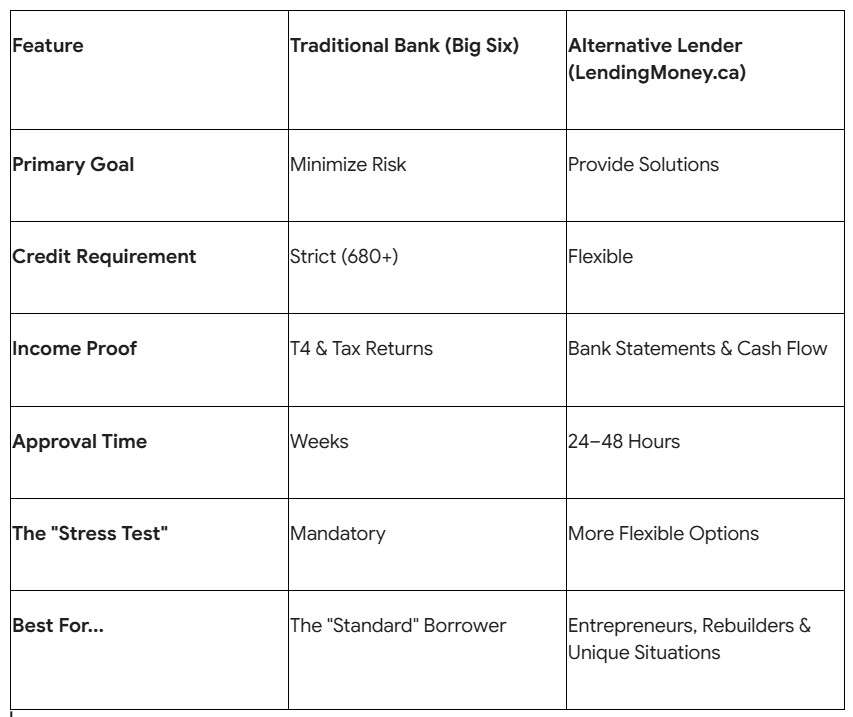
  • The Bank (Traditional): Banks are “Algorithm-First.” They use standardized underwriting templates. If your credit score is below a certain number (usually 680+) or if your income is fluctuating, the computer automatically triggers a decline. They rely on “T4 income” and stable 2-year employment histories.
  • The Alternative Lender: We are “Holistic-First.” While we still look at credit, we focus more on current cash flow, home equity, and future potential. We understand that a self-employed entrepreneur or someone recovering from a divorce is more than just a three-digit score.

2. 2026 Regulations and the Stress Test

In 2026, federal regulators (OSFI) have introduced even tighter rules for big banks, particularly regarding rental properties and debt-service ratios.

  • The Bank: Must apply the Mortgage Stress Test to every federally regulated product. They often “double-count” your debts but “single-count” your income, making it incredibly hard to qualify if you have existing loans.
  • The Alternative Lender: Many alternative lenders are provincially regulated, meaning they have more flexibility. We can often look at “global income” or “stated income” for business owners, providing a pathway to homeownership that simply doesn’t exist at a big bank in 2026.

3. Speed of Adjudication

If you are in a “bridge” situation – like needing to close on a house before your old one sells—time is your biggest enemy.

  • The Bank: Because of their massive size and layers of bureaucracy, a bank approval can take 3 to 8 weeks.
  • The Alternative Lender: We are built for speed. At LendingMoney.ca, we can often provide an approval in 24 to 48 hours. We don’t have layers of committees; we have Financial Heroes ready to make decisions.

4. Why the Rate Isn’t the Only Number That Matters

The most common argument for banks is that they offer the lowest interest rates. While this is often true, it comes with a hidden cost.

  • The Bank: Offers a “Prime” rate but requires “Prime” circumstances. If you don’t qualify, the rate is irrelevant.
  • The Alternative Lender: Our rates are slightly higher to reflect the customized risk we take. 
  • The Strategy: Think of an alternative lender as a bridge. You use us to secure your home or consolidate your debt now, and while you’re with us, we work on your Credit Rehabilitation. Once your score is back in the 700s, we help you “graduate” back to a traditional bank rate.

5. Flexibility for the Self-Employed and Gig Workers

In 2026, the Canadian workforce is changing. More people are freelancers, contractors, or small business owners.

  • The Bank: Prefers “stable” paychecks. If you write off expenses to save on taxes (as every smart business owner does), the bank sees a lower income and denies your loan.

The Alternative Lender: We look at your gross revenue and your bank statements. We understand how businesses actually work and don’t punish you for being your own boss.

Comparison at a Glance (2026)

Why Choice is Your Greatest Asset

Relying solely on a bank relationship can limit your growth. In 2026, the most successful Canadians treat financing as a strategy. They use alternative lenders when they need speed and flexibility, and they use traditional banks when they fit the “standard” mold.

At LendingMoney.ca, we are your partners in that strategy. We provide the capital when the bank says “no,” and we provide the roadmap to ensure they eventually say “yes.”

Tired of the bank’s “No”? [Connect with a Financial Hero] at LendingMoney.ca and let’s look at the big picture of your finances today.

Alternative Lending Blogs Business Finance Credit Rehabilitation Financial Recovery

Starting Over: How to Rebuild Your Credit After a Business Failure

In the entrepreneurial world, failure is often just a prerequisite for future success. However, while your spirit might be ready for the next venture, your credit report usually tells a different story. Between personally guaranteed business loans, maxed-out credit cards used to keep the doors open, and potential CRA arrears, a business closure can leave your credit score in the 400s or 500s.

At LendingMoney.ca, we don’t define you by your last business – we help you fund your next one. Here is your 2026 roadmap for financial recovery and credit rehabilitation after a business failure.

1. Inventory the Personal Guarantee Damage

The first step in recovery is separating what you owe personally from what the business owed.

  • The “PG” Audit: Go through your business contracts. Which loans did you personally guarantee (PG)? These will follow you even after the corporation is dissolved.
  • The “Silent” Hit: If you had a business credit card that you were a Co-Applicant on, that balance is now 100% your personal responsibility.
  • The Action Step: Get your Equifax and TransUnion reports immediately. Ensure no business debts are being “double-counted” as personal debts unless there was a legal guarantee in place.

2. Address the CRA Director Liability

This is the biggest “Hero” move you can make. If your business owed GST/HST or Payroll Deductions, the CRA can hold you personally liable as a Director.

  • The 2026 Risk: The CRA has become more aggressive this year in pursuing directors for unpaid corporate taxes.
  • The Solution: If you have home equity, use an Alternative Equity Loan from LendingMoney.ca to settle these government debts first. The CRA is the only creditor that can “leapfrog” other lenders to freeze your personal assets.

3. The Strategic Settlement Phase

If you have five different credit cards with balances from the failed business, don’t try to pay them all at once.

  • The “Lump Sum” Strategy: It is often better to save a lump sum and offer a settlement to one creditor at a time (e.g., offering $0.40 on the dollar).
  • The Credit Code: A settled debt will be marked as an R7. While not perfect, an R7 is infinitely better than an “R9” (Collection/Charge-off) because it shows the account is closed and settled.

4. Re-Establish Your Personal Tradelines

After a business failure, your Credit Mix is usually a mess of high-interest loans. You need to re-introduce “Normal” credit.

  • The Two-Card Rule: Secure two small Secured Credit Cards. Do not use them for business. Use them for your personal groceries and pay them off every single Friday.

The “Activity” Signal: You need to show the bureaus that you are back to a “stable personal lifestyle.” Consistent, small, weekly payments are the fastest way to signal a turnaround in 2026.

5. Wait, Don’t Rush the New Business Credit

It’s tempting to start a new corporation and apply for credit immediately.

  • The Warning: In 2026, lenders are using AI-driven “Identity Linking.” If you start a new business but your personal score is still 520, you will be declined for everything.
  • The Goal: Focus 100% on your personal Credit Rehabilitation for 6–12 months. Once your personal score crosses the 650 mark, your “Director” status becomes an asset again rather than a liability.

6. Use an Alternative Bridge Loan

If the business failure left you with high-interest personal debt that is “choking” your cash flow, an installment loan from LendingMoney.ca can act as your bridge.

  • Consolidate the “Failure”: Move the high-interest cards into one manageable payment.
  • The Result: Your credit utilization drops, your score rises, and you stop the emotional stress of multiple collections calls.

You Are Not Your Business Failure

A business failure is a masterclass in experience, but it shouldn’t be a life sentence of bad credit. By taking a structured approach to your Credit Rehabilitation, you can be back in a “Mortgage-Ready” position sooner than you think.

Ready to leave the stress of your past business behind? [Talk to a Financial Hero] at LendingMoney.ca today. We’ll help you clean up the debris and build a foundation for your next success.

Read blog –The Head Start: How to Rebuild Your Credit During a Consumer Proposal

Credit Score Debt Relief Financial Recovery Personal Finance

The Head Start: How to Rebuild Your Credit During a Consumer Proposal

A common misconception in Canada is that you have to wait until you receive your “Certificate of Full Performance” to start fixing your credit score. Many people believe they are in a financial penalty boxfor the entire duration of their 5-year proposal.

The truth is much more exciting.

At LendingMoney.ca, we specialize in the “early rebuild.” While your Consumer Proposal is active and coded as an R7, you can – and should—begin layering in new, positive credit history. By the time you make your final proposal payment, you could already have 2–3 years of perfect “rehabilitated” history ready to show a mortgage lender.

Here is your 2026 playbook for rebuilding credit while still in a proposal.

1. The Clean Slate Audit

Before adding new credit, you must ensure the old “ghosts” aren’t haunting your report incorrectly.

  • Check the Coding: Ensure the debts included in your proposal are marked as “Included in Proposal” or “Settled” with an R7 rating. If a creditor is still reporting a debt as “Delinquent” or “R9” after your proposal was accepted, it’s a reporting error that is dragging your score down.
  • Dispute Errors Early: Don’t wait. Use the online dispute tools at Equifax and TransUnion to fix these clerical errors immediately.

2. Secure Your First Hero Tool: The Secured Card

Since your old credit cards were cancelled when you filed, you need a new “tradeline” to prove you can handle credit again.

  • Instant Approval Options: In 2026, cards like the Secured Neo Mastercard or the Capital One Guaranteed Mastercard are the gold standard for people in active proposals. They often require as little as a $50 deposit and don’t require a hard credit check.
  • The Strategy: Use the card for one small, recurring monthly bill (like your internet or a streaming service) and set up an auto-payment to pay it in full every month.
  • The Goal: You want the credit bureau to see 12 consecutive months of “Paid as Agreed” status while your proposal is still running.

3. Layer in a Credit Builder Loan

Lenders love Credit Mix. If you only have a credit card, your score will plateau. Adding a Credit Builder Loan is the perfect secondary move.

  • How it works: You make a small monthly payment (e.g., $50) into a locked savings account. The lender reports this as a “loan payment” to the bureaus. At the end of the term, you get the cash back.
  • The “Double Win”: Not only are you rebuilding your score, but you are also building an emergency fund that you can use to pay off your Consumer Proposal early (see Step 5).

4. Master the 10/30 Rule

During a proposal, your total available credit will be low (likely just your $500 secured card). This makes it very easy to accidentally “max out” your utilization.

  • The Rule: Never let your balance exceed 30% of your limit. However, if you want “Hero” results, keep it under 10%.
  • Example: On a $500 card, keep your reported balance under $50. This tells the credit bureau’s algorithm that you have access to credit but don’t need it to survive.

5. The Accelerator Strategy: Finishing Early

The 3-year clock for a Consumer Proposal to drop off your credit report only starts after your final payment.

  • Lump-Sum Power: If you receive a tax refund, a bonus, or use the savings from your Credit Builder Loan (Step 3), you can pay off the remainder of your proposal at any time with no penalty.
  • Why this matters: If you finish a 5-year proposal in 2 years, the “R7” mark will disappear from your record 3 years sooner. This is the fastest way to get back to “A-Lender” mortgage rates.

6. Don’t Let the Small Stuff Slip

While you are hyper-focused on your proposal payments, don’t forget the bills that don’t usually show up on your credit report—until they go wrong.

  • Cell Phones & Utilities: In Ontario, a missed Rogers or Bell bill can be sent to collections, creating a brand new “R9” hit that will reset your progress.
  • Parking Tickets & Fines: These can eventually trigger “Government Collections” which look terrible to mortgage lenders. Stay current on everything.

Why Start Now?

At LendingMoney.ca, we see the difference between clients who wait and clients who rebuild. A client who starts rebuilding during their proposal is often “Mortgage Ready” the very day they get their completion certificate. A client who waits has to start that 2-year rebuilding process from scratch.

Don’t spend 5 years in a financial shadow. You’ve already taken the brave step of filing a proposal—now take the smart step of rehabilitating your future.

Ready to find the right credit-building tools for your specific situation? [Connect with a Financial Hero] at LendingMoney.ca today.