

Duis mollis, est non commodo luctus, nisi erat porttitor ligula, eget lacinia odio sem nec elit. Morbi leo risus, porta ac consectetur ac, vestibu lum at eros. Nulla vitae elit libero, a pharetra augue.
Trapped in a High-Interest Private Mortgage? Here’s Your 2026 Exit Strategy
Power of Sale, pay off a large CRA debt, or bridge a gap while self-employed. But a private mortgage is like a spare tire: it’s designed to get you to the repair shop, not to drive on for years.
In 2026, many Ontario homeowners are finding that their “temporary” private loans have become permanent weights. If you’re paying 12% or higher interest plus monthly fees, you’re likely not making a dent in your principal. At LendingMoney.ca, we specialize in the “Private-to-Bank Pivot.” Here is how to renegotiate your position and lower your rates.
1. Why You Need an Exit Strategy Now
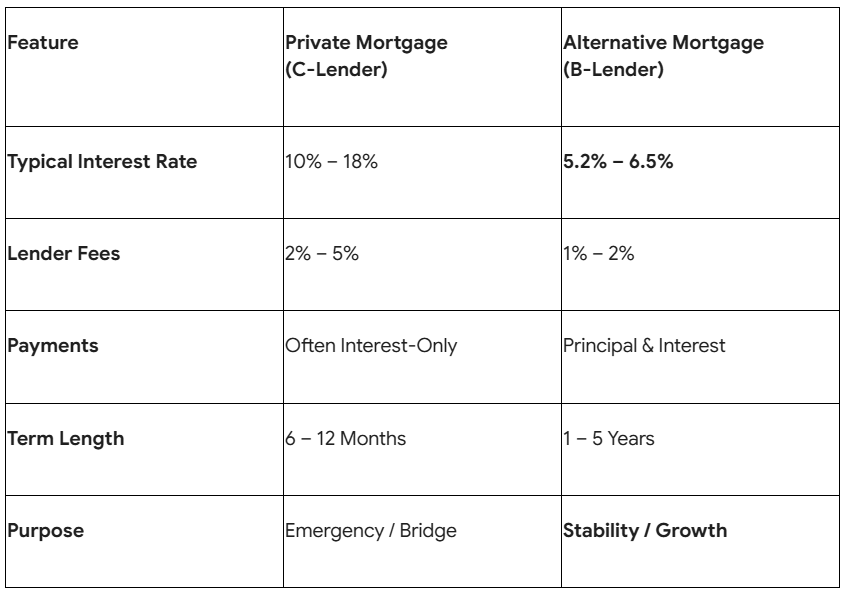
In 2026, the Bank of Canada has stabilized rates around 2.25%, meaning “B-Lenders” (Trust Companies) are offering rates in the 5% to 6% range.
- The Cost of Waiting: If you have a $500,000 private mortgage at 12%, you are paying $5,000 per month in interest alone.
- The B-Lender Alternative: Moving that same loan to a B-Lender at 5.9% would drop your interest cost to roughly $2,450 per month.
- The Result: That’s $2,550 per month back in your pocket—money that could be used to actually pay off your home.
2. Step 1: The Mid-Term Credit Audit
Most private mortgages have 12-month terms. The biggest mistake homeowners make is waiting until month 11 to think about an exit.
- The LendingMoney.ca Approach: We start your Credit Rehabilitation on Day 1. If you took a private loan because of a low credit score, we use the first 6 months of that term to ensure your “tradelines” (credit cards and small loans) are being paid perfectly.
- The Goal: To move to a B-Lender, you generally need a credit score of 550–600. To move back to an A-Lender (Bank), you need 680+. We track your progress to ensure you hit these benchmarks before your private loan expires.
3. Step 2: Income Storytelling
Many people are in private mortgages because they are self-employed and the bank didn’t “understand” their income.
- The Renegotiation: At LendingMoney.ca, we don’t just send your tax returns to a lender. We package your bank statements, contracts, and business growth plans.
- The 2026 Shift: In today’s market, alternative lenders are much more willing to look at “Gross Revenue” rather than “Net Income.” We use this to prove you can handle a lower-interest institutional loan.
4. Step 3: The Equity Appraisal Update
In 2026, home values in Ontario have stabilized. If your home has increased in value since you took your private mortgage, your Loan-to-Value (LTV) ratio has improved.
- Why LTV Matters: Private lenders take the highest risk, so they charge the highest rates. As your equity grows, your risk profile drops.
- The Move: We order a new appraisal to show that you now have 25% or 30% equity. This “unlocks” the door to B-Lenders who require a 20% equity stake but offer rates that are half of what you’re currently paying.
Private vs. B-Lender Comparison (2026)
5. How LendingMoney.ca Renegotiates for You
When you work with a Financial Hero at LendingMoney.ca, we act as your advocate. We don’t just wait for your private lender to send a renewal notice (which often comes with a massive “Renewal Fee”).
- We Negotiate the Add-Backs: We argue for your business expenses and one-time costs to be added back to your income, qualifying you for better rates.
We Manage the Paperwork: Moving from a private individual to a regulated institution requires a lot of documentation. We handle the heavy lifting so you don’t have to.
Don’t Renew Your Stress-Refinance Your Future
A private mortgage renewal notice is a wake-up call. Don’t just sign it and accept another year of high interest. Use the equity you’ve built to “graduate” to a better class of lender.
Is your private mortgage term coming to an end? [Request a Private-to-Bank Analysis] from LendingMoney.ca today. Let’s see how much we can drop your rate and start your journey back to the bank.
Top 5 Private Lender Questions to ask to Avoid Traps
When you take out a private mortgage, you aren’t just signing a loan; you are entering a high-stakes business partnership. In the 2026 lending environment, private mortgages (often called “C-Lending”) are more common than ever, but they are also more complex.
At LendingMoney.ca, we believe that a “Financial Hero” is an informed borrower. Before you sign that commitment letter, you need to look past the interest rate and ask these five critical questions. The answers will determine whether your mortgage is a helpful bridge or a permanent trap.
1. What is the Total ‘Cost of Borrowing’ (APR)?
The interest rate is only one part of the story. Private lenders often layer on multiple fees that aren’t immediately obvious.
- The Reality: You might see a rate of 9.99%, but once you add the Lender Fee (2%), the Broker Fee (2%), and the Legal Fees ($3,000), your actual Annual Percentage Rate (APR) could be closer to 15%.
- The Hero Move: Ask for a full disclosure of all one-time and recurring fees. If the lender is hesitant to give you a “Truth in Lending” summary, that’s a red flag.
2. Is There a ‘Renewal Fee’ After 12 Months?
Most private mortgages in Ontario are one-year terms. The biggest “Equity Killer” is the surprise fee that hits you when that year is up.
- The Trap: Some private lenders charge the same 2% fee to renew the loan for another year. If you have a $500,000 mortgage, you are paying $10,000 just to stay in the loan.
- The Hero Move: Ask if the renewal fee can be waived or capped if you make all your payments on time.
3. What are the Pre-Payment Penalties?
A private mortgage is meant to be a short-term fix. You want the freedom to leave as soon as your credit score improves or you sell your home.
- The Reality: Many private lenders “lock” you in for the full term. If you try to pay off the mortgage at month 6, they may charge you the remaining 6 months of interest as a penalty.
- The Hero Move: Look for a “3-month interest” penalty or, better yet, a “Fully Open” mortgage. This allows you to “graduate” to a bank-rate mortgage the moment your Credit Rehabilitation is complete without paying a fortune to leave.
4. Is This an ‘Interest-Only’ or ‘Amortized’ Loan?
Most private mortgages are “Interest-Only,” meaning your monthly payment doesn’t reduce the amount you owe.
- The Risk: If you borrow $400,000, you will still owe exactly $400,000 a year from now. If the housing market dips, you could end up owing more than the house is worth.
- The Hero Move: Confirm exactly where your money is going. If it’s interest-only, you must have a separate plan to save for a principal reduction or a plan to refinance into an amortized “B-Lender” loan as soon as possible.
5. What Happens if I Miss a Single Payment?
Private lenders don’t have the same “Loss Mitigation” departments as big banks. Their tolerance for late payments is much lower.
- The Trap: Some contracts include “Default Interest Rates” that can jump to 24% or higher the moment a payment is missed. They may also initiate Power of Sale proceedings after just 15 days of default.
- The Hero Move: Ask about the “Grace Period” and the “NSF Fees.” You need to know exactly how much time you have to fix a mistake before legal action begins.
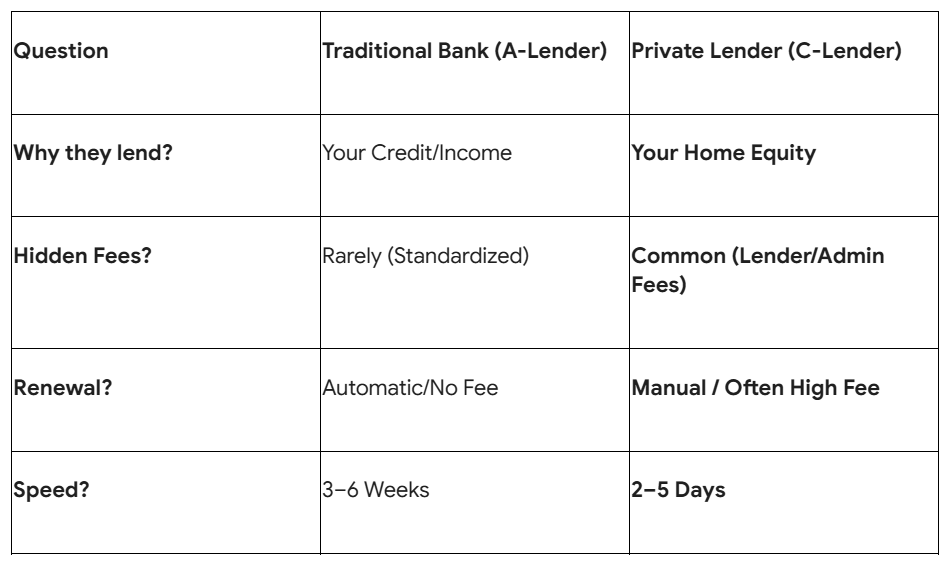
Comparison: Standard Bank vs. Private Lender Questions
Don’t Sign Until You’re Certain
At LendingMoney.ca, we act as your protective shield. We vet every private lender in our network to ensure their terms are fair and their “Exit Strategy” is clear. We don’t just want you to get the money; we want you to keep your equity.
Considering a private mortgage offer? [Upload Your Commitment Letter] for a “Second Opinion” from a Financial Hero at LendingMoney.ca. We’ll help you spot the traps before you sign.