Debt Management Financial Education

The Hidden Costs of Caregiving: How to Manage Family Debt

Caregiving often starts small-a few grocery trips here, a pharmacy run there. But as 2026’s cost of living continues to climb, these small expenses quickly migrate to high-interest credit cards.

1. The Out-of-Pocket Leak

Caregivers in Canada now provide an average of 30 hours of unpaid care per week. This shadow economy costs families in ways that aren’t always obvious:

  • Medical Gaps: Specialized equipment, home nursing, and non-covered medications.
  • Home Accessibility: Ramps, chair lifts, and bathroom modifications that can cost $10,000+.
  • Transportation: Fuel and parking for constant hospital visits.
  • The “Lost Income” Factor: Nearly 25% of Canadian caregivers have had to reduce their working hours or pass up promotions, leading to a permanent dip in household income.

2. Maximizing the 2026 Tax Relief

Before you borrow, make sure you are claiming every “Heroic” tax benefit available this year. In 2026, the CRA has streamlined several credits:

  • The Canada Caregiver Credit (CCC): A non-refundable credit for supporting a spouse or dependent with a physical or mental impairment.
  • New PSW Tax Credit (2026-2030): A refundable credit of up to $1,100 for those using personal support workers in provinces without existing amendments.
  • Multigenerational Home Renovation Tax Credit: If you are building a “granny suite” to move a parent in, you can claim up to $7,500 (15% of $50,000 in costs).

3. The Credit Card Danger Zone

When caregiving costs spike, many families “float” the expenses on credit cards.

  • The Trap: If you’re paying 22% interest on $15,000 of caregiving debt, you are paying $3,300 a year just to the bank. That’s money that should be going toward your loved one’s care or your own retirement.
  • The Risk: High credit card utilization makes you look “risky” to your bank, which might lead them to lower your limit or deny you a loan exactly when the caregiving needs increase.

4. Using Home Equity to Bridge the Gap

If you own your home, you have an asset that can absorb the cost of caregiving much more affordably than a credit card. At LendingMoney.ca, we help caregivers perform a Compassionate Consolidation:

  • Consolidate Caregiving Debt: Move 22% credit card debt into an equity-backed loan at 9% to 12%. This can cut your monthly interest payments by 60%.
  • Fund Home Modifications: Instead of charging a $15,000 renovation to a line of credit, use a structured second mortgage. You get the cash upfront to make the home safe for your parents immediately.
  • Supplement Lost Income: If you’ve had to scale back at work, an equity-based “bridge” can provide the liquidity you need to stay afloat while you wait for government benefits (like EI Compassionate Care) to kick in.

Caregiving Finance: $15,000 Expense Comparison

Expense TypeCredit Card (22%)LendingMoney.ca Equity (11%)
Monthly Interest$275.00$137.50
Annual “Lost” Money$3,300.00$1,650.00
Cash Flow ImpactHigh (Minimum Payments)Manageable (Amortized)
Credit ScoreDrops (High Utilization)Stabilizes (Installment Mix)

5. Protecting Your Own Future

The biggest risk of caregiving is that you “bankrupt your own retirement” to save your parents.

  • The Strategy: By using your home equity strategically, you keep your cash savings intact.
  • The Hero Move: At LendingMoney.ca, we ensure your debt is structured with a clear Exit Strategy. Once the caregiving period ends (or government funding increases), we help you move that debt back into a low-rate first mortgage.

You Take Care of Them. We Take Care of the Rest.

Caregiving is one of the most heroic things a person can do. You shouldn’t have to choose between your family’s well-being and your own financial stability.

Are caregiving costs starting to pile up on your credit cards? [Connect with a Family Debt Specialist] at LendingMoney.ca today. Let’s use your home equity to create a plan that supports your loved ones without sinking your future.

Credit Score & Reports Financial Education Personal Finance

Separating Fact from Fiction: 7 Common Credit Score Myths in Canada

In the world of personal finance, your credit score is often treated like a secret “grade” that determines your worthiness for a home, a car, or a loan. Because it’s so important, it’s also surrounded by myths and old wives’ tales that can actually end up hurting your financial progress.

At LendingMoney.ca, our goal is Credit Rehabilitation. We want to pull back the curtain on how credit really works so you can stop worrying and start building. Here are seven of the most common credit score myths debunked.

Myth #1: Checking my own credit score will lower it.

The Fact: Checking your own credit score is considered a Soft Inquiry (or a soft hit), and it has zero impact on your score.

In fact, we encourage you to check it regularly! Monitoring your score through services like Equifax, TransUnion, or third-party apps helps you spot errors or signs of identity theft early. The only checks that lower your score are “Hard Inquiries,” which happen when a lender pulls your report to approve you for a new credit card or loan.

Myth #2: Carrying a balance on my credit card helps my score.

The Fact: This is one of the most expensive myths out there. You do not need to pay interest to have a good credit score.

Lenders want to see that you use your credit and pay it off. Carrying a balance month-to-month doesn’t help your score; it just costs you money in high interest. The best strategy for your score is to pay your balance in full every month. This keeps your Credit Utilization Ratio low, which accounts for about 30% of your total score.

Myth #3: If I have a high income, I’ll have a high credit score.

The Fact: Your salary is not part of your credit score calculation.

You could earn $200,000 a year and have a poor credit score if you miss payments or max out your cards. Conversely, someone with a modest income can have a perfect 850 score by managing their debts responsibly. While your income is very important to lenders when they calculate your “Debt-to-Income” ratio for a mortgage, it doesn’t move the needle on your three-digit credit score.

Myth #4: I should close old credit cards I don’t use anymore.

The Fact: Closing an old account can actually lower your score.

There are two reasons for this:

  1. Length of History: 15% of your score is based on the age of your accounts. Closing your oldest card makes your credit history look shorter (and “younger”) than it actually is.
  2. Available Credit: Closing a card reduces your total available credit limit. If you have a balance on other cards, your utilization percentage will suddenly spike, which looks risky to lenders.

Myth #5: Paying off a debt removes it from my credit report.

The Fact: Negative information (like a late payment or a collection) usually stays on your report for 6 to 7 years.

Paying off a collection account is great – it changes the status to “Paid,” which looks much better to a human lender – but it doesn’t make the history of that collection disappear instantly. The key to “Credit Rehabilitation” is to start making on-time payments now so that the positive recent history outweighs the old mistakes.

Myth #6: Debit cards help build my credit score.

The Fact: Using a debit card has no impact on your credit.

When you use a debit card, you are spending your own money from a chequing account. Credit scores only track how you manage borrowed money. If you are trying to build credit from scratch or rebuild after a tough period, you need a “tradeline” like a secured credit card or a small installment loan that reports to the bureaus.

Myth #7: A divorce automatically separates our credit scores.

The Fact: Credit scores are always individual, but joint accounts stay joint until they are closed.

A divorce decree might say your ex-spouse is responsible for the joint car loan, but the bank doesn’t care. If your name is still on that loan and your ex-spouse misses a payment, your credit score will take the hit. When separating finances, it is crucial to pay off, close, or refinance joint accounts into single names.

Why Understanding the Truth Matters

At LendingMoney.ca, we see these myths every day. Clients often wait to apply for help because they are afraid of a “hit” to their score, not realizing that the high-interest debt they are carrying is doing far more damage every single month.

Our Credit Rehabilitation approach is about more than just money – it’s about education. When you understand the rules of the game, you can win.

Ready to stop guessing and start growing? [Apply with Ease] and let our Financial Heroes help you build a plan based on facts, not myths.

Read Blog – The Truth Behind the Curtain: Myths vs. Realities of Private Lending

Alternative Lending Blogs Financial Education Financial Recovery Personal Finance

The Big Six vs. The Alternatives: Which Lender is Your Best Financial Partner?

If you’ve ever walked into a major Canadian bank to apply for a loan or a mortgage only to be told you don’t “fit the box,” you aren’t alone. In 2026, Canada’s “Big Six” banks have some of the strictest lending criteria in the world. But a “no” from a bank isn’t the end of your financial journey – it’s often just a sign that you need an alternative lender.

At LendingMoney.ca, we operate in the “Alternative” space. But what does that actually mean for your wallet? Let’s break down the fundamental differences between traditional banks and alternative lenders so you can choose the partner that actually fits your life.

1. The Box vs. The Big Picture

The most significant difference lies in how a lender views you.

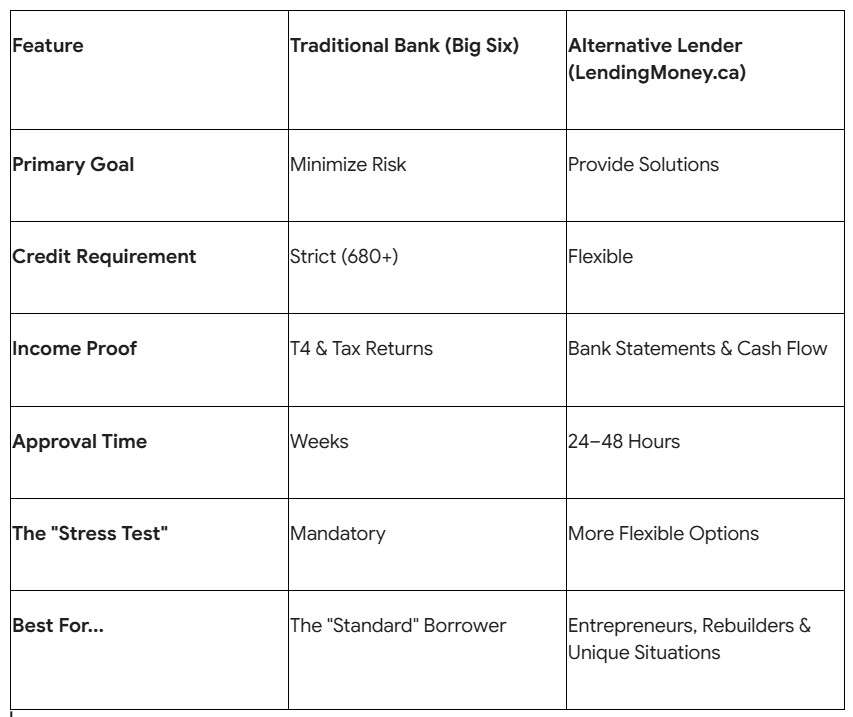
  • The Bank (Traditional): Banks are “Algorithm-First.” They use standardized underwriting templates. If your credit score is below a certain number (usually 680+) or if your income is fluctuating, the computer automatically triggers a decline. They rely on “T4 income” and stable 2-year employment histories.
  • The Alternative Lender: We are “Holistic-First.” While we still look at credit, we focus more on current cash flow, home equity, and future potential. We understand that a self-employed entrepreneur or someone recovering from a divorce is more than just a three-digit score.

2. 2026 Regulations and the Stress Test

In 2026, federal regulators (OSFI) have introduced even tighter rules for big banks, particularly regarding rental properties and debt-service ratios.

  • The Bank: Must apply the Mortgage Stress Test to every federally regulated product. They often “double-count” your debts but “single-count” your income, making it incredibly hard to qualify if you have existing loans.
  • The Alternative Lender: Many alternative lenders are provincially regulated, meaning they have more flexibility. We can often look at “global income” or “stated income” for business owners, providing a pathway to homeownership that simply doesn’t exist at a big bank in 2026.

3. Speed of Adjudication

If you are in a “bridge” situation – like needing to close on a house before your old one sells—time is your biggest enemy.

  • The Bank: Because of their massive size and layers of bureaucracy, a bank approval can take 3 to 8 weeks.
  • The Alternative Lender: We are built for speed. At LendingMoney.ca, we can often provide an approval in 24 to 48 hours. We don’t have layers of committees; we have Financial Heroes ready to make decisions.

4. Why the Rate Isn’t the Only Number That Matters

The most common argument for banks is that they offer the lowest interest rates. While this is often true, it comes with a hidden cost.

  • The Bank: Offers a “Prime” rate but requires “Prime” circumstances. If you don’t qualify, the rate is irrelevant.
  • The Alternative Lender: Our rates are slightly higher to reflect the customized risk we take. 
  • The Strategy: Think of an alternative lender as a bridge. You use us to secure your home or consolidate your debt now, and while you’re with us, we work on your Credit Rehabilitation. Once your score is back in the 700s, we help you “graduate” back to a traditional bank rate.

5. Flexibility for the Self-Employed and Gig Workers

In 2026, the Canadian workforce is changing. More people are freelancers, contractors, or small business owners.

  • The Bank: Prefers “stable” paychecks. If you write off expenses to save on taxes (as every smart business owner does), the bank sees a lower income and denies your loan.

The Alternative Lender: We look at your gross revenue and your bank statements. We understand how businesses actually work and don’t punish you for being your own boss.

Comparison at a Glance (2026)

Why Choice is Your Greatest Asset

Relying solely on a bank relationship can limit your growth. In 2026, the most successful Canadians treat financing as a strategy. They use alternative lenders when they need speed and flexibility, and they use traditional banks when they fit the “standard” mold.

At LendingMoney.ca, we are your partners in that strategy. We provide the capital when the bank says “no,” and we provide the roadmap to ensure they eventually say “yes.”

Tired of the bank’s “No”? [Connect with a Financial Hero] at LendingMoney.ca and let’s look at the big picture of your finances today.