
Blogs Mortgage Renewal

How a CRA Lien Affects Your Mortgage Renewal

A CRA lien is one of the most serious red flags a mortgage lender can encounter. In the 2026 lending environment, banks have become even more cautious about property titles, and a lien from the Canada Revenue Agency (CRA) can bring your mortgage renewal to a grinding halt.

If you are approaching your renewal date and have an outstanding tax debt, here is how a CRA lien changes the game and what you can do to save your home.

1. The Super Priority Problem

The reason banks fear a CRA lien is simple: The government usually gets paid first. In Canada, the CRA can exercise Super Priority for certain debts (like unremitted GST/HST or Payroll Source Deductions). Even if your bank registered their mortgage years ago, a CRA “Deemed Trust” claim can actually leapfrog the bank in the payout line.

  • The Impact on Renewal: When you renew, your bank performs a title search. If they see a CRA lien (Notice of Certification), they may refuse to renew your mortgage because their security is now at risk. They don’t want to be “second in line” behind the taxman.

2. You Lose Your Switching Power

In 2026, many homeowners shop around at renewal to find a lower interest rate.

  • The Trap: A new lender will never take on a mortgage if there is an existing CRA lien on the title. You are effectively “trapped” with your current lender, who may charge you a much higher “default” rate because they know you can’t leave.
  • The Result: You lose all your negotiating leverage. You are forced to accept whatever rate your current lender offers-if they offer one at all.

3. The Automatic Payout Requirement

If your current lender does agree to renew or if you are trying to refinance to get extra cash, the CRA lien must be dealt with as part of the legal process.

  • How it works: Your lawyer is legally required to use the mortgage funds to pay off the CRA lien before any money goes to you or your other debts.
  • The Risk: If the tax debt is large enough, it might eat up all your equity, leaving you with a larger mortgage but no actual cash in hand to fix your financial situation.

4. The 2026 Risk Premium

Lenders in 2026 use AI-driven risk modeling. A CRA lien is seen as a sign of “systemic financial distress.”

  • The Cost: Even if a lender agrees to renew with a lien on title, they may add a “Risk Premium” to your interest rate. You could end up paying 2% to 3% more than a neighbor with a clean title. Over a 5-year term, this can cost you tens of thousands of dollars.

How to Fix the Situation Before Renewal

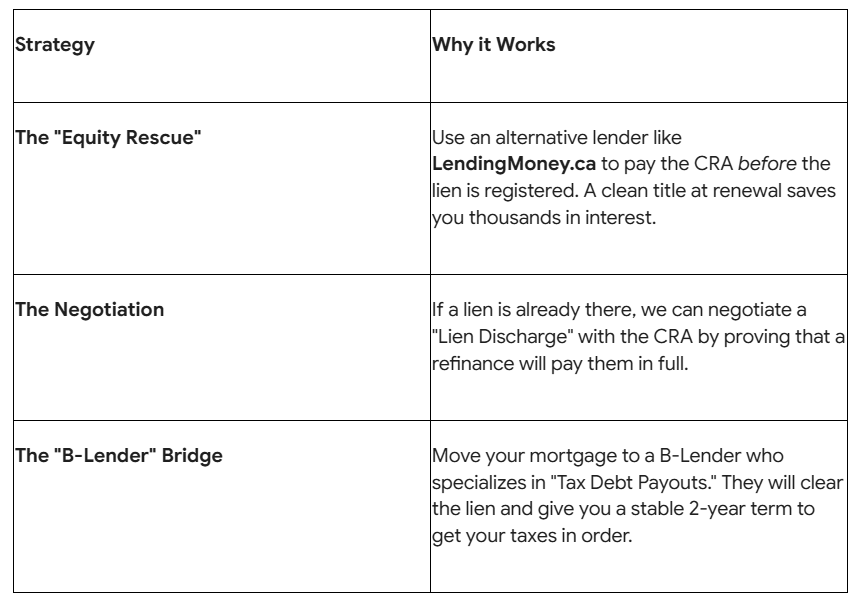
If you know you have a CRA debt but they haven’t placed a lien on your house yet, now is the time to act.
Don’t Let a Lien Steal Your Home

A CRA lien is a legal lock on your house, but LendingMoney.ca has the keys. We specialize in helping homeowners pay off the government so they can walk into their mortgage renewal with a clean title and a Financial Hero status.

Is your mortgage renewal coming up while you owe the CRA? [Connect with a Tax-Debt Specialist] at LendingMoney.ca today. We’ll help you clear the title and keep your home.

Reed More Blog – How to Fix Your Credit After a CRA Debt Settlement

Blogs Mortgage Tips Mortgages

The 2026 Mortgage Renewal Guide: How to Beat “Payment Shock”

If you bought or refinanced your home in 2021, you likely enjoyed some of the lowest interest rates in Canadian history—some as low as 1.5% to 2%. As you approach your 2026 renewal, the landscape has changed. With the Bank of Canada holding its policy rate at 2.25% and fixed rates averaging between 4% and 5%, most homeowners are facing a monthly payment increase of 15% to 25%.

At LendingMoney.ca, we don’t want you to just “sign and send” your renewal papers. We want you to use this moment to optimize your entire financial life. Here is the 2026 guide to winning your renewal.

1. The Reality of the “2026 Payment Jump”

For a typical $500,000 mortgage, jumping from a 1.99% rate to a 4.79% rate means your monthly payment will climb by roughly $700 per month.

  • The “Auto-Renewal” Trap: Your bank will send you a letter about 21 days before your term ends. It will likely offer you their “posted rate,” which is often 0.5% higher than what you could get by shopping around. Never sign the first offer.
  • The “Stress Test” Myth: If you stay with your current lender, you do not have to re-qualify or pass the stress test. However, if you want to switch lenders to find a better rate, you may need to pass the 7.25% stress test.

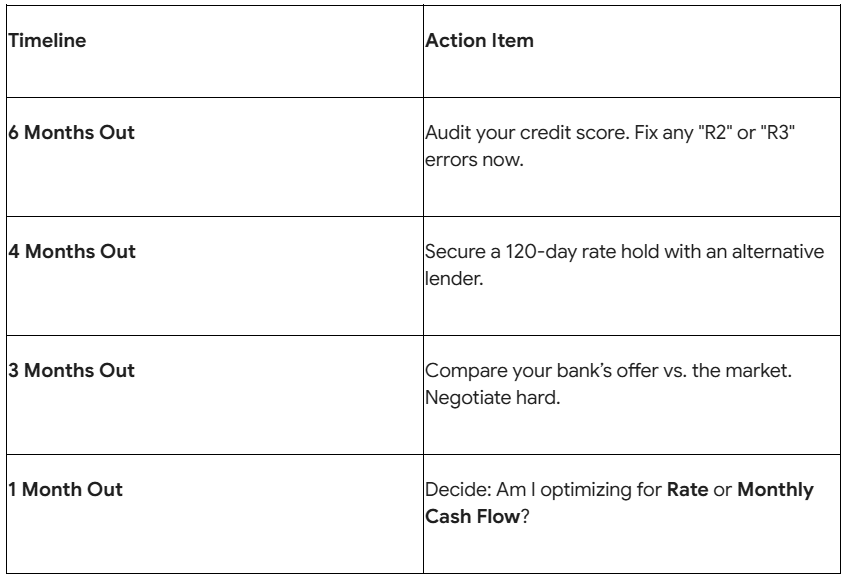
2. Strategy: The 120-Day “Rate Hold”

In 2026, volatility is the only constant.

  • The Move: Start shopping four months before your renewal date. Most lenders (and all Financial Heroes at LendingMoney.ca) can lock in a rate for you for 120 days.
  • The Win: If rates go up before your renewal, you are protected at the lower locked-in rate. If rates go down, you can simply take the new, lower market rate. It’s a “no-lose” strategy.

3. Extending Amortization: The Cash-Flow Lifesaver

If the new 2026 payments are going to break your household budget, you have a powerful lever: Amortization.

  • The Pivot: If you originally had a 25-year mortgage and you are 5 years in, your remaining amortization is 20 years. At renewal, you can often “stretch” that back out to 25 or even 30 years.
  • The Result: While this increases the total interest you pay over the life of the loan, it can drop your monthly payment by $300 to $500, giving your family the breathing room you need to stay stable.

4. The “Consolidation Renewal” (Credit Rehab Move)

This is the most popular strategy at LendingMoney.ca in 2026. If you are renewing your mortgage but also carrying $30,000 in credit card debt at 22%, you are fighting a losing battle.

  • The Move: Instead of a “Straight Renewal,” do a Refinance Renewal. Roll that high-interest debt into your new mortgage.
  • The Result: Even if your mortgage rate goes up to 5%, you are still “killing” 22% debt. Your total monthly outflow for all debts will likely decrease, and your credit score will skyrocket as your utilization drops to zero.

5. New 2026 Rules for Investors (OSFI Changes)

If you are renewing a mortgage on a rental property, be prepared for new scrutiny.

  • The “Independent Qualification” Rule: As of January 2026, OSFI requires that rental properties “stand on their own” for qualification if you switch lenders.

The Catch: If your rental isn’t generating enough cash flow to cover the new, higher interest rates, you may be “trapped” with your current lender. This makes it even more important to have a clean credit profile before your renewal date.

Your 2026 Renewal Checklist

Why Renew with LendingMoney.ca?

The big banks see renewal as an automated process. We see it as a financial reset. Whether you need to extend your amortization to save your budget or consolidate debt to save your credit, we are the alternative lending partnership to make it happen.

Is your renewal notice arriving soon? [Upload Your Renewal Offer] to LendingMoney.ca and let our Financial Heroes find you a better deal.