Mortgage & Lending Personal Finance Self-Employed Financing

Self-Employed Asset Verification: The Role of Bank Statements

For the self-employed entrepreneur in 2026, the traditional path to a loan is often blocked by a mountain of paperwork. While big banks are still obsessing over your Notice of Assessment (NOA) and “Net Income” after every possible deduction, LendingMoney.ca knows that your taxable income rarely tells your real story.

In the world of Credit Rehabilitation and alternative lending, your bank statement is no longer just a list of transactions-it is your most powerful financial asset. Here is why your cash flow is more important than your tax returns when it comes to securing an unsecured loan.

1. The Paperwork Gap: NOAs vs. Reality

Traditional lenders have a “9-to-5” mindset. They want a T4 slip or a “Line 15000” on an NOA that shows a high personal income.

  • The Problem: As a business owner, you likely use legal deductions to reduce your tax bill. While this is smart for your bottom line, it makes you look “broke” to a traditional bank.
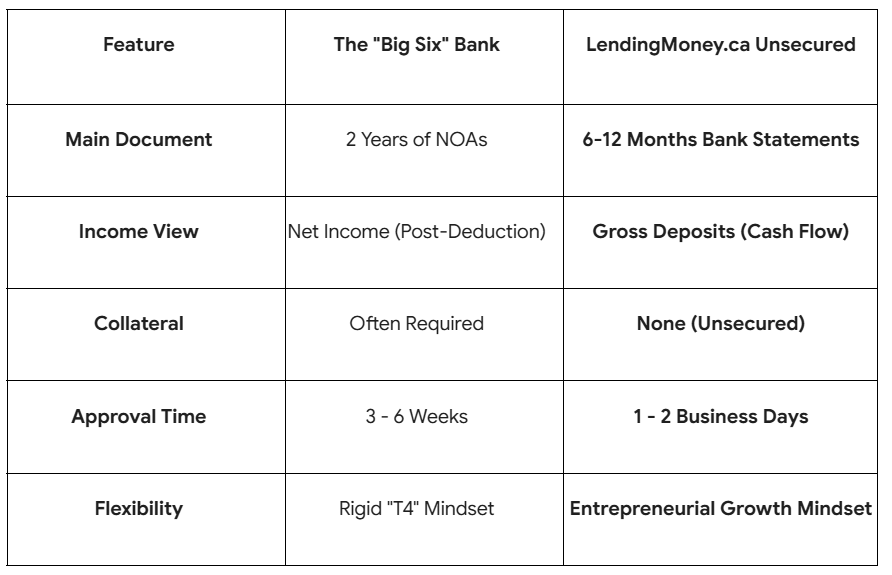
  • The 2026 Solution: At LendingMoney.ca, we don’t look at what you kept after taxes; we look at what you earned. By reviewing your 6 to 12 months of business bank statements, we see the true revenue your business generates. Your “Stated Income” backed by deposits is the key to unlocking an unsecured loan without the tax-man’s approval.

2. Cash Flow is Your Character

In 2026, the reliability of your deposits is a better indicator of your creditworthiness than a three-digit score.

  • The “Stability” Signal: Lenders love seeing consistent, regular deposits into your business account. Whether you are a consultant with three main clients or a contractor with dozens of smaller jobs, your bank statement proves that you have the velocity of money needed to handle a monthly installment.
  • The Hero Move: We use digital banking verification to “smooth out” your income. Even if your business is seasonal, your bank statements help us find an average that allows you to qualify for a loan that fits your lifestyle.

3. The Unsecured Freedom for Entrepreneurs

Most business loans in Canada require you to put up collateral – your equipment, your inventory, or even a lien against your personal home.

  • Why “Unsecured” Wins: With an unsecured loan from LendingMoney.ca, your business assets remain yours. You are borrowing based on the strength of your income, not the value of your tools.
  • The Strategy: This leaves your equipment “clean,” so if you need to lease a new truck or upgrade your tech later, those assets aren’t already tied up in a consolidation loan.

4. Speed: Funding at the Pace of Business

In 2026, opportunities move fast. If you need to buy inventory for a big contract or fix a critical piece of machinery, you can’t wait six weeks for a bank’s “Self-Employed Underwriting Department” to call you back.

  • The LendingMoney.ca Advantage: Because we prioritize bank statements over deep-dive tax audits, we can often fund an unsecured loan in 24 to 48 hours.
  • The Result: You get the capital you need to keep your business moving, using your own successful history as your primary reference.

Self-Employed Loan Comparison: 2026
5. Building Your B – Lender Bridge

Many of our self-employed clients use an unsecured loan as a stepping stone.

  • The Step: If you want to buy a home or refinance your mortgage next year, having a perfect 12-month payment history on an unsecured installment loan is powerful.
  • The Graduation: It proves to future “B-Lenders” (Trust Companies) that your business cash flow is stable and that you are a disciplined borrower.

Your Business, Your Rules

Don’t let a low “Net Income” on your tax return stop your growth. If your bank statements show a thriving business, you have all the collateral you need.

Ready to let your cash flow do the talking? [Apply for a Bank-Statement Loan] at LendingMoney.ca today. Let’s turn your business success into your next Financial Hero” moment.


Blogs Ontario Real Estate

The Bachelor Pad: Investing in Your First Condo

Being single gives you a unique advantage in the 2026 real estate market: Agility. You don’t need to worry about school zones or extra bedrooms for a growing family. You can focus entirely on location, appreciation, and resale value.

1. Location: The Walk Score ROI

In 2026, the value of a condo is tied directly to its proximity to transit and “lifestyle hubs.”

  • The Strategy: Look for “Transit-Oriented Communities” (TOCs) along the GO expansion lines or the Ontario Line.
  • The Hero Move: A smaller unit in a prime, walkable location will almost always appreciate faster and be easier to sell than a larger unit in a “sleeper” suburb. As a bachelor, you can sacrifice square footage for a 10-minute commute and better nightlife.

2. The Den Advantage: Future-Proofing for 2026

If your budget allows, prioritize a 1-bedroom plus den over a standard 1-bedroom.

  • Why? In the 2026 hybrid-work economy, a dedicated office space is a non-negotiable for most buyers.
  • The Resale Edge: When you’re ready to move on, that “den” makes your bachelor pad attractive to young couples who need a nursery or a remote workspace, doubling your pool of potential buyers.

3. High-Ratio Leverage: The 5% Entry

Many single men assume they need a 20% down payment to avoid “wasting money” on mortgage insurance.

  • The 2026 Reality: With home prices stabilizing, the cost of waiting to save another $50,000 often exceeds the cost of the CMHC premium.
  • The Strategy: Use the new 2026 $1.5M high-ratio ceiling to get in with as little as 5% down. This keeps your cash liquid for other investments or a “Safety Net” fund while you let the market do the heavy lifting for your net worth.

4. Understanding the Carry (Maintenance Fees)

The biggest threat to a bachelor’s budget isn’t the mortgage; it’s the Condo Fees.

  • The Red Flag: Avoid buildings with “luxury” amenities you won’t use (like bowling alleys or valet parking). These drive up fees without adding equal value to your resale price.
  • The Smart Buy: Look for “Boutique” buildings or well-managed older towers where the fees are stable and include utilities like heat and water.

The Bachelor’s Build vs. Buy 2026 Comparison

5. The Bachelor-to-Landlord Pipeline

The best part about a bachelor pad is that it’s the perfect first rental property.

  • The Exit Strategy: In 5 years, when you’re ready for a house with a yard, you don’t necessarily have to sell the condo.
  • The Move: At LendingMoney.ca, we can help you refinance your condo to pull out equity for your next down payment, keeping the condo as a cash-flowing rental asset. This is how you start your real estate empire.

Your First Move is the Most Important

In 2026, the “Bachelor Pad” isn’t a lifestyle choice-it’s a financial launchpad. Don’t wait for a partner or a “perfect” time. The best time to buy real estate was 10 years ago; the second best time is today.

Ready to stop paying your landlord’s mortgage? [Request a Bachelor Pad Feasibility Study] from LendingMoney.ca today. Let’s look at your income, your FHSA, and the best 2026 condo markets to get you started.

Credit Score & Reports Financial Education Personal Finance

Separating Fact from Fiction: 7 Common Credit Score Myths in Canada

In the world of personal finance, your credit score is often treated like a secret “grade” that determines your worthiness for a home, a car, or a loan. Because it’s so important, it’s also surrounded by myths and old wives’ tales that can actually end up hurting your financial progress.

At LendingMoney.ca, our goal is Credit Rehabilitation. We want to pull back the curtain on how credit really works so you can stop worrying and start building. Here are seven of the most common credit score myths debunked.

Myth #1: Checking my own credit score will lower it.

The Fact: Checking your own credit score is considered a Soft Inquiry (or a soft hit), and it has zero impact on your score.

In fact, we encourage you to check it regularly! Monitoring your score through services like Equifax, TransUnion, or third-party apps helps you spot errors or signs of identity theft early. The only checks that lower your score are “Hard Inquiries,” which happen when a lender pulls your report to approve you for a new credit card or loan.

Myth #2: Carrying a balance on my credit card helps my score.

The Fact: This is one of the most expensive myths out there. You do not need to pay interest to have a good credit score.

Lenders want to see that you use your credit and pay it off. Carrying a balance month-to-month doesn’t help your score; it just costs you money in high interest. The best strategy for your score is to pay your balance in full every month. This keeps your Credit Utilization Ratio low, which accounts for about 30% of your total score.

Myth #3: If I have a high income, I’ll have a high credit score.

The Fact: Your salary is not part of your credit score calculation.

You could earn $200,000 a year and have a poor credit score if you miss payments or max out your cards. Conversely, someone with a modest income can have a perfect 850 score by managing their debts responsibly. While your income is very important to lenders when they calculate your “Debt-to-Income” ratio for a mortgage, it doesn’t move the needle on your three-digit credit score.

Myth #4: I should close old credit cards I don’t use anymore.

The Fact: Closing an old account can actually lower your score.

There are two reasons for this:

  1. Length of History: 15% of your score is based on the age of your accounts. Closing your oldest card makes your credit history look shorter (and “younger”) than it actually is.
  2. Available Credit: Closing a card reduces your total available credit limit. If you have a balance on other cards, your utilization percentage will suddenly spike, which looks risky to lenders.

Myth #5: Paying off a debt removes it from my credit report.

The Fact: Negative information (like a late payment or a collection) usually stays on your report for 6 to 7 years.

Paying off a collection account is great – it changes the status to “Paid,” which looks much better to a human lender – but it doesn’t make the history of that collection disappear instantly. The key to “Credit Rehabilitation” is to start making on-time payments now so that the positive recent history outweighs the old mistakes.

Myth #6: Debit cards help build my credit score.

The Fact: Using a debit card has no impact on your credit.

When you use a debit card, you are spending your own money from a chequing account. Credit scores only track how you manage borrowed money. If you are trying to build credit from scratch or rebuild after a tough period, you need a “tradeline” like a secured credit card or a small installment loan that reports to the bureaus.

Myth #7: A divorce automatically separates our credit scores.

The Fact: Credit scores are always individual, but joint accounts stay joint until they are closed.

A divorce decree might say your ex-spouse is responsible for the joint car loan, but the bank doesn’t care. If your name is still on that loan and your ex-spouse misses a payment, your credit score will take the hit. When separating finances, it is crucial to pay off, close, or refinance joint accounts into single names.

Why Understanding the Truth Matters

At LendingMoney.ca, we see these myths every day. Clients often wait to apply for help because they are afraid of a “hit” to their score, not realizing that the high-interest debt they are carrying is doing far more damage every single month.

Our Credit Rehabilitation approach is about more than just money – it’s about education. When you understand the rules of the game, you can win.

Ready to stop guessing and start growing? [Apply with Ease] and let our Financial Heroes help you build a plan based on facts, not myths.

Read Blog – The Truth Behind the Curtain: Myths vs. Realities of Private Lending

Debt Management Personal Finance

Consumer Proposal vs. Debt Consolidation Loan: Which is Your Hero Move?

When you’re buried under high-interest debt, the goal is always the same: find a way out. In the Canadian financial landscape of 2026, two primary paths emerge: the Debt Consolidation Loan and the Consumer Proposal.

While they might sound similar – both result in one monthly payment – they are fundamentally different tools. Choosing the wrong one could cost you thousands of dollars or years of unnecessary stress. At LendingMoney.ca, we’re here to help you weigh the pros and cons so you can make an informed decision for your financial future.

The Debt Consolidation Loan: The Refinance Strategy

A debt consolidation loan is a new personal loan used to pay off all your smaller, high-interest debts (like credit cards). You are essentially moving your debt from several “expensive” places to one “cheaper” place.

The Pros:

  • Protects Your Credit Score: As long as you make your payments on time, your credit score usually stays stable or even improves as your credit utilization drops.
  • Total Control: You aren’t entering a legal process. You maintain your relationship with your bank and keep your current credit limits (though we recommend closing them to avoid re-spending!).
  • Simplified Life: One due date, one interest rate, and a clear “end date” for your debt.

The Cons:

  • Harder to Qualify: In 2026, lenders have tightened their belts. To get a rate low enough to make consolidation worth it, you typically need a credit score of 680 or higher.
  • No Debt Reduction: You still owe 100% of the principal. If you owe $40,000, you are still paying back $40,000 plus interest.
  • The “Debt Trap” Risk: If you don’t change your spending habits, you might end up with a consolidation loan plus new credit card balances.

The Consumer Proposal: The Settlement Strategy

A Consumer Proposal is a legal agreement where you offer to pay your creditors a percentage of what you owe, interest-free, over a period of up to five years.

The Pros:

  • Principal Reduction: You can often reduce your total debt by 50% to 80%. If you owe $40,000, you might only pay back $12,000.
  • Legal Protection: The moment you file, all interest stops, and creditors are legally forbidden from calling you or garnishing your wages.
  • No Interest: Every dollar you pay goes directly toward the principal.

The Cons:

  • Credit Impact: It carries an R7 rating on your credit report. This will make it difficult to get traditional low-interest loans for a few years.
  • Public Record: It is a formal insolvency proceeding.
  • The “R7” Footprint: It stays on your credit report for 3 years after you finish the payments (or 6 years after you start, whichever is sooner).

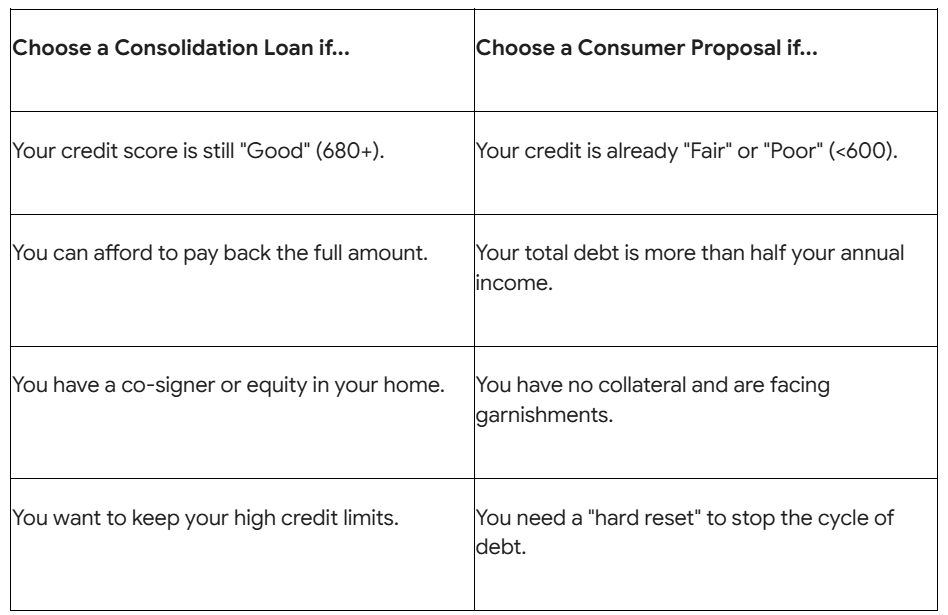
Which One is Right for You?

The LendingMoney.ca Verdict

At LendingMoney.ca, we don’t believe in a one-size-fits-all approach. If you have the credit to qualify, a Consolidation Loan is a fantastic way to save on interest while keeping your credit score pristine. However, if the math simply doesn’t add up and you’ll be in debt for the next 20 years, a Consumer Proposal is the more heroic choice for your long-term health.

Confused about which path to take? [Speak with a Financial Hero] today. We’ll run the numbers with you and find the strategy that fits your 2026 goals.