
Consumer Proposals Personal Finance

How to Navigate a Consumer Proposal and Keep Your Home

The most important thing to understand is that a Consumer Proposal is not bankruptcy. In a bankruptcy, certain assets may be sold to pay creditors. In a Consumer Proposal, you keep your assets (like your house) in exchange for a negotiated monthly payment to your creditors.

Here is the 2026 roadmap for protecting your home while settling your debt.

1. The Equity Math of a Proposal

Before you file, a Licensed Insolvency Trustee (LIT) will look at your home equity.

  • The Calculation: (Current Market Value) – (Mortgage Balance) = Equity.
  • The Rule: Creditors must receive more in a proposal than they would if you filed for bankruptcy. If you have significant equity, your monthly proposal payment may be higher because creditors know that equity exists.
  • The Hero Move: At LendingMoney.ca, we often help homeowners perform an Equity Rescue before or during a proposal. By using a second mortgage to pay off a lump-sum settlement, you can often finish your proposal in months instead of the standard five years.

2. Mortgages are Secured Debt

A Consumer Proposal only deals with unsecured debt (credit cards, lines of credit, tax debt). Your mortgage is a secured debt.

  • The Protection: As long as you keep your mortgage payments current, your bank cannot seize your home just because you filed a proposal.
  • The Risk: If you miss mortgage payments while in a proposal, the lender can still start “Power of Sale” proceedings. Protecting your mortgage payment is your #1 priority.

3. Navigating the Renewal Trap

This is where 2026 homeowners face the most stress. If your mortgage comes up for renewal while you are in an active Consumer Proposal, you have two paths:

  • The Path of Least Resistance: Renew with your existing lender. Most banks will offer an automatic renewal without a new credit check, provided you haven’t missed a mortgage payment.
  • The “Switch” Difficulty: Moving your mortgage to a new big bank while in a proposal is nearly impossible. Traditional banks will see the R7 rating on your credit report and decline the switch.
  • The Alternative Path: This is where LendingMoney.ca shines. We are an alternative lender who specializes in “Proposal Financing.” We can help you refinance to pay off your proposal early, which “cleans” your record much faster.

4. The R7 Rating: Rebuilding as You Go

When you file a proposal, your credit rating drops to an R7. In 2026, this stays on your report for 3 years after you finish your payments.

  • The Strategy: Don’t wait until the proposal is over to rebuild. Open a Secured Credit Card immediately. Making tiny payments on this card while paying your proposal proves to future mortgage lenders that you have learned a “Heroic” level of financial discipline.

Consumer Proposal vs. Home Equity Consolidation (2026)

FeatureConsumer ProposalLendingMoney.ca Equity Loan
Debt Reduced?Yes (often 50% – 70%)No (Total debt remains same)
Credit RatingR7 (Bruised)Maintains/Boosts Score
Asset RiskLow (Protected)None (Secured by Equity)
Lender AccessRestricted for 3-5 yearsAccess to Alternative Lenders
Interest0% (on settlement)9% – 15% (on loan)

5. Should You Refinance First?

At LendingMoney.ca, we always ask: Can we solve this without a proposal?

If you have enough equity in your home to consolidate your debts into a second mortgage, you can avoid the “R7” rating entirely.

  • The Benefit: Your credit remains “Bank Ready,” and you don’t have the legal stigma of insolvency on your record.
  • The Move: If your total unsecured debt is less than 50% of your home’s equity, a Second Mortgage is almost always the better choice than a Consumer Proposal.

Protect Your Sanctuary

Your home is more than an asset; it’s your security. Whether you choose a Consumer Proposal or an Equity-Based Consolidation, the goal is to stop the debt from threatening your roof.

Thinking about a Consumer Proposal? [Get an Equity Assessment] from LendingMoney.ca first. We’ll help you determine if you can use your home to pay off your debt without the long-term impact of insolvency.

Read Blog – Homeownership and Insolvency: How a Consumer Proposal Affects Your Mortgage

Debt Management Personal Finance

Homeownership and Insolvency: How a Consumer Proposal Affects Your Mortgage

One of the biggest fears homeowners face when considering debt relief is: “Will I lose my house? The short answer is no. In fact, a Consumer Proposal is often the very tool that saves a home by freeing up the cash flow needed to keep the mortgage current. However, while you keep the house, the “R7” rating on your credit report changes the rules of the game when it comes time to renew or refinance. Here is how a Consumer Proposal affects your mortgage in 2026.

1. Existing Mortgages: Business as Usual

A Consumer Proposal only deals with unsecured debt (credit cards, lines of credit, tax debt). Your mortgage is a secured debt. As long as you continue to make your mortgage payments on time, your lender generally cannot cancel your mortgage just because you filed a proposal.

2. The Renewal Reality

When your mortgage term ends, you have to renew. Here is where the impact of a Consumer Proposal is felt:

  • Renewing with Your Current Lender: If your mortgage is in good standing (no missed payments), most major banks will offer you an “automatic renewal” without a new credit check. However, you likely won’t be able to negotiate for their best “promotional” rates.
  • Switching Lenders: This is the challenge. If you try to move your mortgage to a new bank to find a better rate, they will pull your credit. If they see an active Consumer Proposal, they will likely decline the application unless you have significant equity or move to an Alternative (B) Lender.

3. Refinancing to Pay Off the Proposal

Many homeowners use their house as a “hero tool.” If your home has increased in value, you can often refinance your mortgage to pull out equity and pay off your Consumer Proposal in one lump sum.

  • The Benefit: This gets you a “Certificate of Full Performance” immediately, which starts the 3-year clock to clear your credit report much sooner.
  • The 2026 Rule: Most lenders will require you to have at least 20% equity remaining in the home after the refinance.

4. Buying a New Home After a Proposal

Can you buy a house after filing a proposal? Yes.

  • While in the Proposal: You will likely need a 20% down payment and an alternative lender with higher interest rates.
  • After Completion: Most “A” Lenders (Big Banks) want to see that your proposal has been completed for at least 2 years, and that you have rebuilt your credit with at least two new “tradelines” (like a secured card and a small installment loan).

5. The Equity Trap

If you have a massive amount of equity in your home (e.g., you owe $200k on a $800k home), your creditors might notice. They may demand a higher monthly payment in your proposal because they know you have assets. A Licensed Insolvency Trustee will help you structure the proposal so it is fair to creditors while still being affordable for you.

Final Thoughts: Protecting Your Largest Asset

A Consumer Proposal is not a threat to your home; it is a shield. By legally settling your credit card debt for cents on the dollar, you ensure that your mortgage – and your family’s roof – remains the top priority.

Worried about an upcoming mortgage renewal? [Talk to LendingMoney.ca]. We specialize in the “B-Lending” market and can help you navigate your mortgage options while in a Consumer Proposal.

Consumer Proposal Debt Management Personal Finance

The Reality Check: Life with an R7 Credit Rating and the Downsides of a Consumer Proposal

In our previous posts, we’ve discussed how a Consumer Proposal can be a financial “Hero Move,” cutting your debt by thousands and stopping the interest bleed. But as with any major financial decision, there is a flip side.

If you are considering this path in 2026, you need to understand the R7 credit rating – the scarlet letter that will sit on your credit report for several years. At LendingMoney.ca, we believe in “No Jargon, Just Truth.” Here is the reality of living with an R7 and the honest downsides of filing a Consumer Proposal.

1. Understanding the R7 “Scarlet Letter”

In the Canadian credit world, accounts are rated on a scale of 1 to 9. An R1 is a perfect, on-time payment. An R9 is a total default or bankruptcy.

An R7 is the code for a “settlement” or “orderly payment of debt.” It tells every future lender: “This person didn’t pay back what they originally promised, but they are making an effort to pay back a portion.”

How long does it last?

In 2026, the rules remain strict. An R7 rating stays on your credit report for:

  • 3 years after you make your final payment, OR
  • 6 years from the date you originally filed.
    (Whichever comes first.)

This means even if you pay off your proposal in month one, that R7 will likely haunt your report for at least another three years.

2. The Door-Slam Effect: Access to New Credit

The most immediate downside is that traditional “A-Lenders” (the big banks) will likely stop doing business with you the moment you file.

  • Credit Card Rejections: Most standard credit card companies will automatically decline your application if they see an active R7.
  • The “Blacklist” Reality: Many banks have internal “long memories.” If you include a specific bank (like RBC or TD) in your proposal, they may never give you a credit card again, even after the R7 falls off your public report.
  • Higher Interest Rates: You won’t be “frozen” out of credit entirely, but you will be pushed into the world of alternative lending. Expect interest rates on car loans or personal loans to be significantly higher – often 15% to 25% – because you are now viewed as a “High-Risk Hero.”

3. The Mortgage Renewal Stuck Period

If you already own a home, your R7 rating creates a specific type of gridlock.

  • You Can’t Shop Around: When your mortgage comes up for renewal, you are essentially “stuck” with your current lender. Because you have an R7, other banks won’t compete for your business. This means you have to accept whatever rate your current bank offers you, losing your power to negotiate for the best 2026 rates.

Refinancing Hurdles: Want to pull equity out of your home for a renovation? An R7 makes this nearly impossible through traditional channels unless you have at least 20-25% equity and work with an alternative lender like LendingMoney.ca.

4. Career and Housing Complications

The impact of an R7 can sometimes spill out of your wallet and into your life.

  • Employment Background Checks: If you work in finance, accounting, or a position that requires “bonding,” an R7 can be a red flag. Some employers see it as a sign of financial vulnerability.
  • Rental Applications: In a competitive 2026 rental market, landlords often run credit checks. An R7 rating can put you at the bottom of the pile behind applicants with “clean” R1 reports. You may be asked for a larger security deposit or a co-signer.

5. The Professional Licensing Disclosure

If you are a licensed professional (Real Estate Agent, Lawyer, Accountant, etc.), you may be legally required to disclose your Consumer Proposal to your regulatory body. While it rarely results in losing a license, it often involves extra paperwork and “rehabilitation” requirements to prove you are still fit to handle clients’ money.

6. Asset Limitations (The Equity Trap)

While you “keep your assets” in a proposal, they aren’t truly invisible. If you have significant equity in your home or own a high-value vehicle, your creditors will use that as leverage. They may demand that your monthly proposal payments be much higher to reflect the value of what you own. You “keep” the asset, but you pay for the privilege of doing so.

Is the R7 Worth It?

After reading the list above, you might be feeling discouraged. But here is the Financial Hero perspective:

Compare the R7 to the Alternative. If you don’t file, you might spend 15 years paying 29% interest on credit cards, never seeing the balance go down, and living in constant fear of a wage garnishment.

An R7 is a temporary set of handcuffs that leads to permanent freedom. It is a calculated trade-off. You accept a few years of limited credit access in exchange for a clean slate and a future where you don’t owe anyone a penny.

Why Partner with LendingMoney.ca During Your R7 Years?

We don’t see an R7 as a Do Not Help sign. We see it as a “Help Strategically” sign.

  • We help you get a loan specifically designed for people in proposals.
  • We provide mortgage solutions through alternative lenders when the big banks say no.
  • We give you the Credit Rehabilitation plan to ensure that the day your R7 disappears, your score is already at 700+.

Living with an R7 isn’t easy, but you don’t have to do it alone. [Talk to a Financial Hero] today and let’s plan your exit strategy from the world of R7.

Debt Management Personal Finance

Consumer Proposal vs. Debt Consolidation Loan: Which is Your Hero Move?

When you’re buried under high-interest debt, the goal is always the same: find a way out. In the Canadian financial landscape of 2026, two primary paths emerge: the Debt Consolidation Loan and the Consumer Proposal.

While they might sound similar – both result in one monthly payment – they are fundamentally different tools. Choosing the wrong one could cost you thousands of dollars or years of unnecessary stress. At LendingMoney.ca, we’re here to help you weigh the pros and cons so you can make an informed decision for your financial future.

The Debt Consolidation Loan: The Refinance Strategy

A debt consolidation loan is a new personal loan used to pay off all your smaller, high-interest debts (like credit cards). You are essentially moving your debt from several “expensive” places to one “cheaper” place.

The Pros:

  • Protects Your Credit Score: As long as you make your payments on time, your credit score usually stays stable or even improves as your credit utilization drops.
  • Total Control: You aren’t entering a legal process. You maintain your relationship with your bank and keep your current credit limits (though we recommend closing them to avoid re-spending!).
  • Simplified Life: One due date, one interest rate, and a clear “end date” for your debt.

The Cons:

  • Harder to Qualify: In 2026, lenders have tightened their belts. To get a rate low enough to make consolidation worth it, you typically need a credit score of 680 or higher.
  • No Debt Reduction: You still owe 100% of the principal. If you owe $40,000, you are still paying back $40,000 plus interest.
  • The “Debt Trap” Risk: If you don’t change your spending habits, you might end up with a consolidation loan plus new credit card balances.

The Consumer Proposal: The Settlement Strategy

A Consumer Proposal is a legal agreement where you offer to pay your creditors a percentage of what you owe, interest-free, over a period of up to five years.

The Pros:

  • Principal Reduction: You can often reduce your total debt by 50% to 80%. If you owe $40,000, you might only pay back $12,000.
  • Legal Protection: The moment you file, all interest stops, and creditors are legally forbidden from calling you or garnishing your wages.
  • No Interest: Every dollar you pay goes directly toward the principal.

The Cons:

  • Credit Impact: It carries an R7 rating on your credit report. This will make it difficult to get traditional low-interest loans for a few years.
  • Public Record: It is a formal insolvency proceeding.
  • The “R7” Footprint: It stays on your credit report for 3 years after you finish the payments (or 6 years after you start, whichever is sooner).

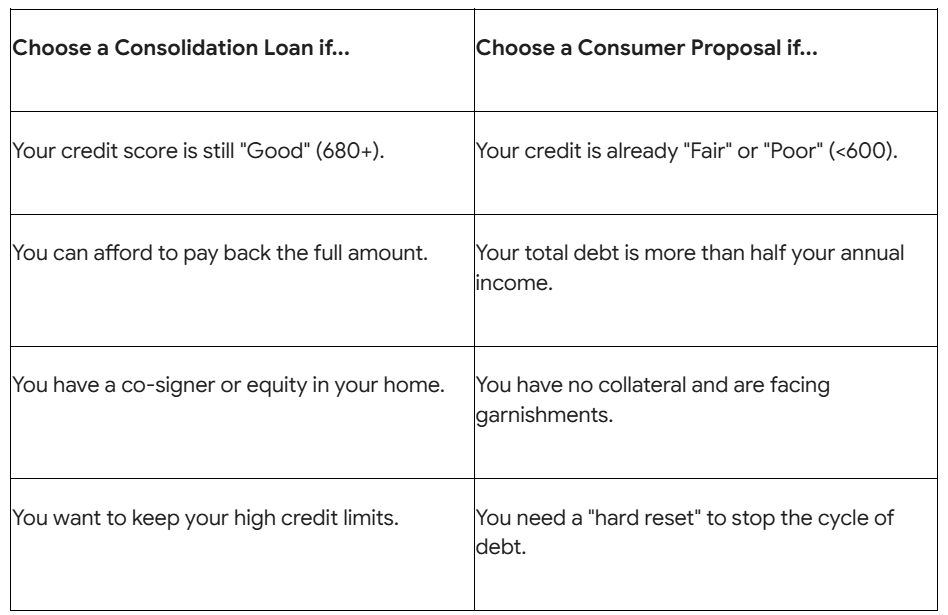
Which One is Right for You?

The LendingMoney.ca Verdict

At LendingMoney.ca, we don’t believe in a one-size-fits-all approach. If you have the credit to qualify, a Consolidation Loan is a fantastic way to save on interest while keeping your credit score pristine. However, if the math simply doesn’t add up and you’ll be in debt for the next 20 years, a Consumer Proposal is the more heroic choice for your long-term health.

Confused about which path to take? [Speak with a Financial Hero] today. We’ll run the numbers with you and find the strategy that fits your 2026 goals.