Blogs Mortgage Renewal

How a CRA Lien Affects Your Mortgage Renewal

A CRA lien is one of the most serious red flags a mortgage lender can encounter. In the 2026 lending environment, banks have become even more cautious about property titles, and a lien from the Canada Revenue Agency (CRA) can bring your mortgage renewal to a grinding halt.

If you are approaching your renewal date and have an outstanding tax debt, here is how a CRA lien changes the game and what you can do to save your home.

1. The Super Priority Problem

The reason banks fear a CRA lien is simple: The government usually gets paid first. In Canada, the CRA can exercise Super Priority for certain debts (like unremitted GST/HST or Payroll Source Deductions). Even if your bank registered their mortgage years ago, a CRA “Deemed Trust” claim can actually leapfrog the bank in the payout line.

  • The Impact on Renewal: When you renew, your bank performs a title search. If they see a CRA lien (Notice of Certification), they may refuse to renew your mortgage because their security is now at risk. They don’t want to be “second in line” behind the taxman.

2. You Lose Your Switching Power

In 2026, many homeowners shop around at renewal to find a lower interest rate.

  • The Trap: A new lender will never take on a mortgage if there is an existing CRA lien on the title. You are effectively “trapped” with your current lender, who may charge you a much higher “default” rate because they know you can’t leave.
  • The Result: You lose all your negotiating leverage. You are forced to accept whatever rate your current lender offers-if they offer one at all.

3. The Automatic Payout Requirement

If your current lender does agree to renew or if you are trying to refinance to get extra cash, the CRA lien must be dealt with as part of the legal process.

  • How it works: Your lawyer is legally required to use the mortgage funds to pay off the CRA lien before any money goes to you or your other debts.
  • The Risk: If the tax debt is large enough, it might eat up all your equity, leaving you with a larger mortgage but no actual cash in hand to fix your financial situation.

4. The 2026 Risk Premium

Lenders in 2026 use AI-driven risk modeling. A CRA lien is seen as a sign of “systemic financial distress.”

  • The Cost: Even if a lender agrees to renew with a lien on title, they may add a “Risk Premium” to your interest rate. You could end up paying 2% to 3% more than a neighbor with a clean title. Over a 5-year term, this can cost you tens of thousands of dollars.

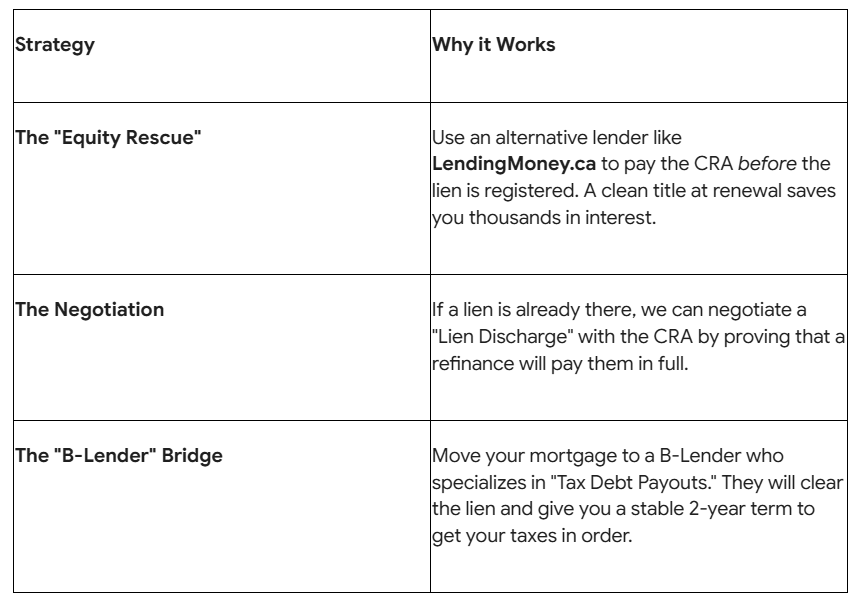
How to Fix the Situation Before Renewal

If you know you have a CRA debt but they haven’t placed a lien on your house yet, now is the time to act.

Don’t Let a Lien Steal Your Home

A CRA lien is a legal lock on your house, but LendingMoney.ca has the keys. We specialize in helping homeowners pay off the government so they can walk into their mortgage renewal with a clean title and a Financial Hero status.

Is your mortgage renewal coming up while you owe the CRA? [Connect with a Tax-Debt Specialist] at LendingMoney.ca today. We’ll help you clear the title and keep your home.

Reed More Blog – How to Fix Your Credit After a CRA Debt Settlement

Blogs Education Financial Recovery Mortgage Renewal Personal Finance

Payday vs. Installment Loan Costs

In 2026, the marketing around “fast cash” has become incredibly sophisticated. Big-name lenders like Money Mart are no longer just “payday” shops; they have aggressively pivoted into High-Cost Installment Loans.

While these might look like a better deal than a 14-day payday loan, the “Real Cost” over 12 to 36 months can be devastating to your long-term wealth. At LendingMoney.ca, we believe in Credit Rehabilitation, which means using the lowest cost of capital available to you-your home equity-to kill high-interest debt forever.

Here is the breakdown of the real cost between high-interest installments and an alternative equity-backed loan.

Payday vs. Installments vs. Equity: What’s the Real Cost?

When you’re in a financial pinch, lenders know you are focused on one number: the monthly payment. But the monthly payment is a mask. To see the true cost of a loan, you have to look at the Total Cost of Borrowing.

In 2026, the federal government has capped the criminal interest rate at 35% APR. While this sounds like a win for consumers, high-cost lenders have responded by adding “optional” insurance, administration fees, and longer terms to keep their profits high.

1. The Money Mart Installment Loan (35% APR + Fees)

If you borrow $10,000 from a high-cost installment lender in 2026 to consolidate your debts, your contract might look like this:

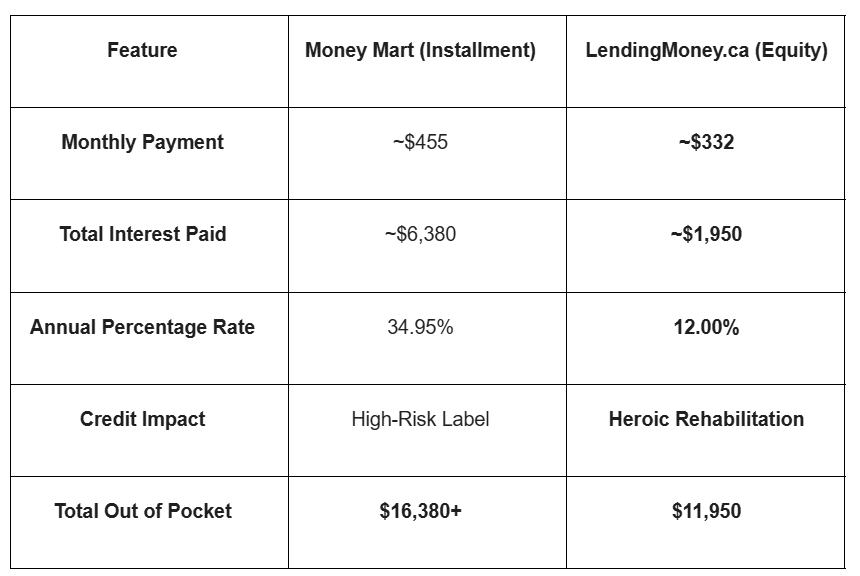
  • Interest Rate: ~34.95% APR
  • Term: 36 Months
  • Monthly Payment: ~$455.00
  • Optional Insurance: ~$92.00/month (often “highly recommended” for approval)

The Real Cost: After 3 years, you haven’t just paid back $10,000. You’ve paid back roughly $16,380 (or over $19,000 with insurance). You have effectively paid for your debt nearly twice.

2. The Payday Loan Treadmill (The 365% Trap)

If you skip the installment loan and go for a classic $500 payday loan:

  • The Fee: $14 per $100 borrowed ($70 fee).
  • The Cycle: Because you have to pay the full $570 back in 14 days, you likely have to borrow again to pay rent.
  • The Real Cost: If you “roll over” this debt for just six months, you will have paid over $900 in fees while still owing the original $500.

3. The LendingMoney.ca Alternative (9% – 15% APR)

Now, let’s look at using a Second Mortgage or Equity Loan to solve the same $10,000 problem:

  • Interest Rate: ~12% APR
  • Term: 36 Months (Amortized)
  • Monthly Payment: ~$332.00
  • Insurance/Hidden Fees: $0 (We focus on the equity in your home, not selling you add-ons).

The Real Cost: After 3 years, you’ve paid back $11,950.

2026 Cost Comparison: Borrowing $10,000

Why the Alternative Path Wins Every Time

The reason Money Mart’s costs are so high is that they are lending to thousands of people with no collateral. They expect many of them to fail, so you (the person who pays) have to cover the cost of those who don’t.

At LendingMoney.ca, we use your Home Equity as your “Financial Hero.” Because the loan is secured by your home, the risk is lower, which allows us to provide a rate that is one-third the cost of an unsecured installment loan.

The Hidden Danger of High-Interest Installments

In 2026, many banks see a “High-Interest Installment Loan” on a credit bureau as a sign of financial instability. Even if you pay it on time, it can actually make it harder to graduate to a traditional bank mortgage later. An equity-backed loan from LendingMoney.ca, however, shows you are a savvy homeowner using your assets strategically.

Stop Overpaying for Your Own Money

Every dollar you pay in 35% interest is a dollar taken away from your retirement, your children’s education, or your next home. If you own your home, you have already earned the right to lower interest rates.

Comparing a loan offer from Money Mart or another high-cost lender? [Upload Your Quote] to LendingMoney.ca for a “Real Cost Analysis.” Let us show you how much of your own money you can keep.

Read blog – Navigating Your Options: A Guide to Professional Debt Consolidation Services in Canada

Blogs Mortgage Renewal Mortgages Private Lending

Fixing Your Credit While in a Private Mortgage

A private mortgage is often described as a “bridge.” But a bridge is only useful if it leads somewhere. If you are in a private mortgage in 2026, your primary goal is to use this 12-month window to rehabilitate your credit so you can “graduate” to a lower-interest bank or B-lender.

At LendingMoney.ca, we don’t want you to stay in a private loan forever. We want to help you fix the issues that put you there in the first place. Here is your month-by-month guide to Credit Rehabilitation while using a private mortgage.

1. The Private Mortgage Reporting Reality

In 2026, most individual private lenders do not report to Equifax or TransUnion.

  • The Problem: Even if you make every payment on time for a year, your credit score might not go up because the bureaus don’t see the “good behavior.”
  • The Hero Move: You must focus on your other tradelines. Since the mortgage isn’t helping your score, your credit cards, car loans, and phone bills have to do the heavy lifting.
  • The Catch: While private lenders don’t report the “good,” they will certainly report the “bad” if they have to take legal action (Power of Sale). On-time payments are mandatory to protect your equity.

2. Eliminate “R9” and “R7” Ghost Debts

If you took a private mortgage to consolidate debt, you likely have old collections (R9) or settled accounts (R7) on your report.

  • The Strategy: Use a small portion of your mortgage “holdback” or savings to pay off any remaining small collections.
  • The 2026 Rule: A “Paid Collection” is significantly better than an “Active Collection” when applying for a B-Lender. It shows the underwriter that you have cleared the wreckage of the past.

3. The 10% Utilization Rule

The fastest way to jump your score while in a private mortgage is to change how you use your credit cards.

  • The Math: If you have a $5,000 limit, never let the balance exceed $500 (10%) on the day the statement is produced.
  • The Hero Move: In 2026, many apps allow “Real-Time Reporting.” Pay your credit card balance every time you get paid (bi-weekly) rather than once a month. This keeps your “average utilization” extremely low, which is the #1 “Point Booster” in the Equifax algorithm.

4. Add Two “Fresh” Tradelines

To get back to a traditional bank, you usually need a “2-2-2” profile: 2 years of history on 2 lines of credit with at least $2,000 limits.

  • The Strategy: If your old cards were closed during a Consumer Proposal or bankruptcy, open two new Secured Credit Cards immediately.
  • The Timeline: By the time your 12-month private mortgage is up, these cards will have 12 months of perfect history, making you an ideal candidate for a B-Lender (Trust Company).

5. Diversify with a “Credit Builder” Loan

In 2026, lenders like seeing a mix of credit types. If you only have credit cards, your score will plateau.

  • The Move: Open a small Installment Credit-Builder Loan (like those offered by Nyble or KOHO).
  • How it works: You pay a small amount monthly ($20–$50), and they report it as a “Personal Loan” payment. This adds “Credit Mix” to your profile, which accounts for 10% of your total score.

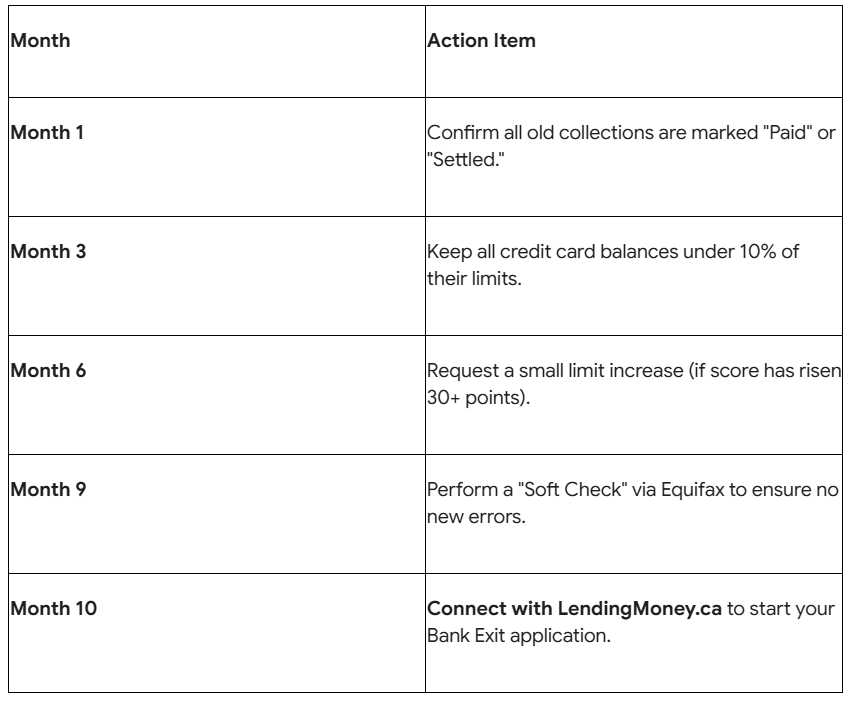
Your 12-Month Credit Rehab Calendar

The Goal: Graduation Day

Fixing your credit while in a private mortgage requires discipline. You are paying a higher interest rate now so that you never have to pay it again. At LendingMoney.ca, we provide the tools and the coaching to ensure that when your private term ends, you are ready for a prime-rate mortgage.

Currently in a private mortgage and want to see your “Graduation Date”? [Get a Free Credit Rehabilitation Roadmap] from LendingMoney.ca today and let’s start moving you back to the bank.

Read blog – Breaking the Cycle: A Guide to Loans for Debt Consolidation with Poor Credit

Alternative Lending Blogs Mortgage Renewal Private Mortgages

The Silent Equity Killer: How to Avoid Private Mortgage Renewal Fees

If you have a private mortgage, you probably remember the “Lender Fee and Broker Fee you paid to get it. What many homeowners don’t realize is that most private lenders charge those fees every single year you stay with them.

In 2026, with private interest rates already sitting between 10% and 15%, adding a 2% renewal fee means you are effectively paying an APR of nearly 17%. If you have a $500,000 mortgage, that’s $10,000 vanished in a single signature. Here is how to stop the bleed.

1. The 120-Day Rule (Start Before They Do)

Private lenders count on you being “trapped.” They often send your renewal notice just 21 to 30 days before the term ends, leaving you with no time to find an alternative.

  • The Hero Move: Start your search 4 months (120 days) before your maturity date.
  • The LendingMoney.ca Advantage: We track your maturity date from day one. At the 4-month mark, we perform a “Financial Health Check” to see if your Credit Rehabilitation is far enough along to move you to a B-Lender or a Credit Union where there are zero renewal fees.

2. Leverage Your Improved Story

A private lender charges a renewal fee because they claim the “risk” is still high. You need to prove them wrong.

  • Show the Progress: Since you took the private loan, have you paid off a collection? Has your income increased? Have you made every private mortgage payment on time?
  • The Negotiation: At LendingMoney.ca, we use these “wins” to negotiate. We tell the lender: “Our client’s credit score has jumped 60 points. They are now eligible for a B-Lender. If you want to keep this loan, you must waive the renewal fee.”

3. The B-Lender Pivot (The Fee-Free Zone)

The best way to avoid private renewal fees is to stop being a private borrower. In 2026, the jump from “Private” (C-Lender) to “Alternative” (B-Lender) is the most important step in your journey.

  • B-Lenders (Trust Companies): Unlike private individuals, B-Lenders are regulated institutions. They generally do not charge renewal fees. Once you are in, you simply renew at the current market rate.
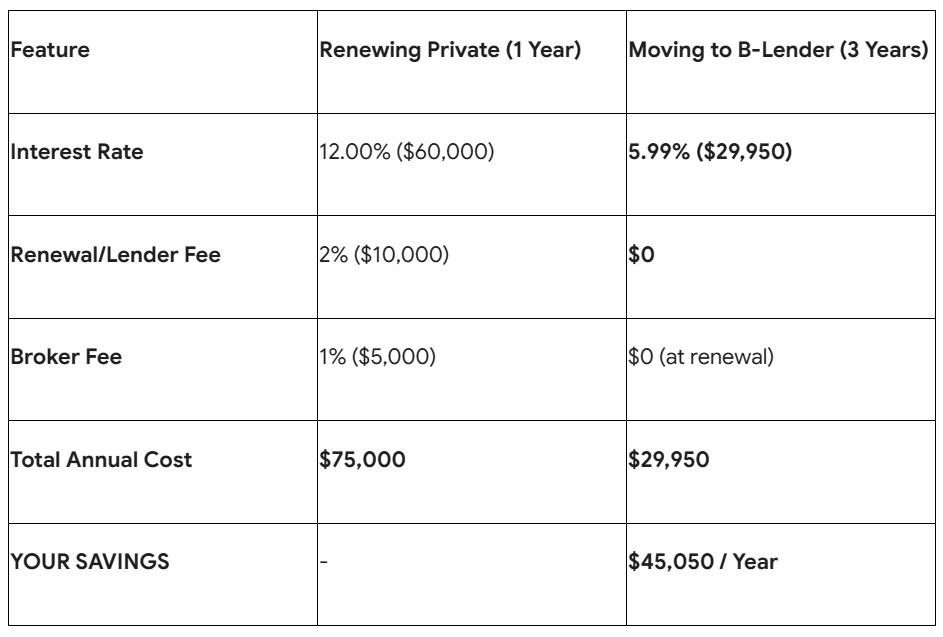
  • The Savings: Moving to a B-Lender doesn’t just lower your interest rate; it saves you that 1%–2% annual fee forever.

4. Don’t Auto-Renew by Silence

Many private mortgage contracts have a clause that says if you don’t respond, the mortgage “auto-renews” for another year, including the fees.

  • The Action Step: Read your original commitment letter. Look for the “Renewal” section.
  • The 2026 Reality: Some lenders are now charging “Exit Fees” if you leave. We review your contract to ensure the cost of leaving is smaller than the cost of staying. Usually, paying a small discharge fee is much cheaper than paying a massive renewal fee.

5. Use a Bridge-to-Bank Strategy

If your credit isn’t quite ready for a bank yet, we can sometimes find a “Semi-Private” institution. These are lenders that sit between a private individual and a bank.

  • The Benefit: They offer 2-year or 3-year terms.
  • Why this works: By taking a 3-year term, you only pay a fee once instead of paying a renewal fee every 12 months. This gives you three years of stable payments to finish your Credit Rehabilitation.

Comparison: The Cost of Staying vs. The Cost of Moving (2026)

Based on a $500,000 Mortgage

Your Equity Belongs to You, Not the Lender

At LendingMoney.ca, we believe private mortgages should be short, sharp, and successful. If you are entering your second or third year in a private loan, you are no longer using a “bridge”, you are living on it.

Is your private mortgage renewal coming up in the next 120 days? [Upload Your Current Statement] for a free Exit Analysis. Let’s stop the fees and start your graduation back to the bank.

Alternative Lending Blogs Mortgage Renewal

The Graduation Guide: How to Move from Alternative to B Lending

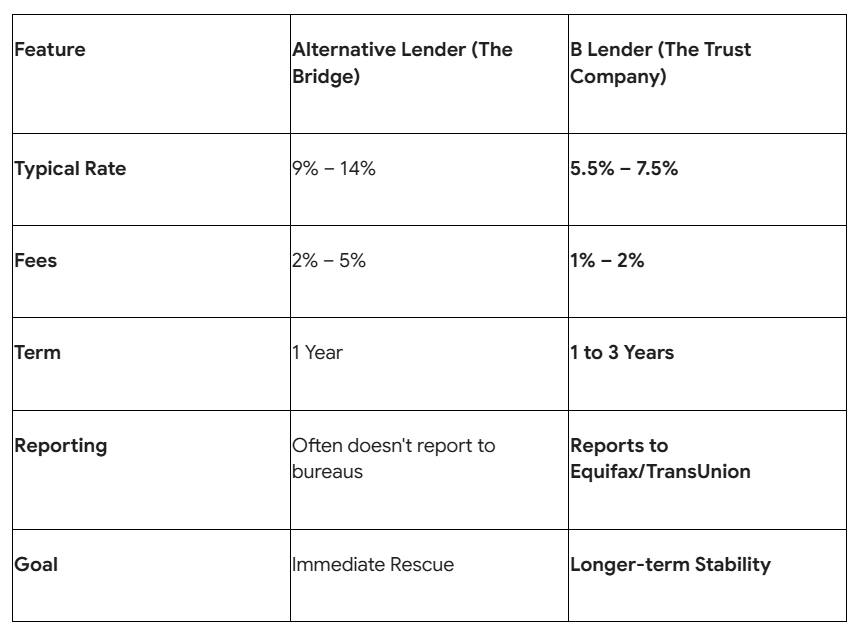
An alternative mortgage is a high-performance bridge, but it isn’t meant to be your forever home. B Lenders offer lower interest rates (often 3% to 5% lower than alternative rates) and longer terms, but they require a higher level of “financial hygiene.”

To make the jump, you need to prove to a Trust Company that the issues that led you to an alternative lender are firmly in the past.

1. The “600 Score” Benchmark

While LendingMoney.ca can work with almost any credit score by focusing on equity, B Lenders (Trust Companies) generally want to see a score of at least 550 to 600.

  • The Strategy: Use the 12-month term of your alternative mortgage to aggressively rebuild. If you used your alternative loan to pay off collections, ensure those are now marked as “Paid” on your Equifax report.
  • The Requirement: B Lenders look for “Re-established Credit.” This typically means having two new credit cards with at least a $2,000 limit, used responsibly for at least 6–12 months.

2. Clean Up the “Paper Trail”

B Lenders are regulated institutions, which means their underwriters are more detail-oriented than alternative lenders.

  • The “No-Lates” Rule: To qualify for a Trust Company, you must show 12 months of perfect payments on your alternative mortgage. One single missed payment on your current mortgage can disqualify you from a B Lender for another year.
  • The CRA Factor: If you had tax debt, the B Lender will require a Notice of Assessment (NOA) showing a $0 balance. They won’t “graduate” you until they see the government is fully out of the picture.

3. Shifting from “Equity” to “Income”

Alternative lenders often look at the value of your home first. B Lenders, however, care deeply about your Debt Service Ratios (GDS/TDS).

  • The Math: A B Lender wants to see that your total housing costs and debts don’t exceed roughly 50% of your gross income.
  • Self-Employed Hero Move: In 2026, B Lenders are very friendly to business owners. They will often use a “Stated Income” approach, where they look at your business bank statements to see your true cash flow rather than just the “Net Income” on your tax return.

4. The 20% Equity Requirement

To move into the B-Lending space, you almost always need to have at least 20% equity in your home (an 80% Loan-to-Value ratio).

  • The Appraisal: Since 2026 property values have stabilized, your home may be worth more than when you started your alternative loan. A new, professional appraisal will prove to the Trust Company that their investment is safe.

The “Graduation” Comparison (2026)

5. Timing Your Exit

The best time to move is 3 to 4 months before your alternative mortgage matures.

  • Avoid the Renewal: If you wait until the last minute, your alternative lender may charge you a renewal fee (1%–3%) just to stay for another year.
  • The LendingMoney.ca Process: At the 9-month mark of your alternative loan, your Financial Hero will reach out to review your credit score. If you’ve hit the 600 mark, we will encourage you to start the application with the Trust Companies immediately to ensure a seamless “hand-off.”

You’ve Earned the Upgrade

Moving from an alternative lender to a B Lender is proof that your Credit Rehabilitation plan is working. It’s the moment your monthly housing costs drop and your financial future becomes more predictable.

Ready to see if you’re ready to “graduate” to a Trust Company? [Request a Graduation Audit] from LendingMoney.ca today. We’ll review your progress and find the B Lender that’s ready to welcome you back to institutional banking.