
Consumer Proposals Personal Finance

How to Navigate a Consumer Proposal and Keep Your Home

The most important thing to understand is that a Consumer Proposal is not bankruptcy. In a bankruptcy, certain assets may be sold to pay creditors. In a Consumer Proposal, you keep your assets (like your house) in exchange for a negotiated monthly payment to your creditors.

Here is the 2026 roadmap for protecting your home while settling your debt.

1. The Equity Math of a Proposal

Before you file, a Licensed Insolvency Trustee (LIT) will look at your home equity.

  • The Calculation: (Current Market Value) – (Mortgage Balance) = Equity.
  • The Rule: Creditors must receive more in a proposal than they would if you filed for bankruptcy. If you have significant equity, your monthly proposal payment may be higher because creditors know that equity exists.
  • The Hero Move: At LendingMoney.ca, we often help homeowners perform an Equity Rescue before or during a proposal. By using a second mortgage to pay off a lump-sum settlement, you can often finish your proposal in months instead of the standard five years.

2. Mortgages are Secured Debt

A Consumer Proposal only deals with unsecured debt (credit cards, lines of credit, tax debt). Your mortgage is a secured debt.

  • The Protection: As long as you keep your mortgage payments current, your bank cannot seize your home just because you filed a proposal.
  • The Risk: If you miss mortgage payments while in a proposal, the lender can still start “Power of Sale” proceedings. Protecting your mortgage payment is your #1 priority.

3. Navigating the Renewal Trap

This is where 2026 homeowners face the most stress. If your mortgage comes up for renewal while you are in an active Consumer Proposal, you have two paths:

  • The Path of Least Resistance: Renew with your existing lender. Most banks will offer an automatic renewal without a new credit check, provided you haven’t missed a mortgage payment.
  • The “Switch” Difficulty: Moving your mortgage to a new big bank while in a proposal is nearly impossible. Traditional banks will see the R7 rating on your credit report and decline the switch.
  • The Alternative Path: This is where LendingMoney.ca shines. We are an alternative lender who specializes in “Proposal Financing.” We can help you refinance to pay off your proposal early, which “cleans” your record much faster.

4. The R7 Rating: Rebuilding as You Go

When you file a proposal, your credit rating drops to an R7. In 2026, this stays on your report for 3 years after you finish your payments.

  • The Strategy: Don’t wait until the proposal is over to rebuild. Open a Secured Credit Card immediately. Making tiny payments on this card while paying your proposal proves to future mortgage lenders that you have learned a “Heroic” level of financial discipline.

Consumer Proposal vs. Home Equity Consolidation (2026)

FeatureConsumer ProposalLendingMoney.ca Equity Loan
Debt Reduced?Yes (often 50% – 70%)No (Total debt remains same)
Credit RatingR7 (Bruised)Maintains/Boosts Score
Asset RiskLow (Protected)None (Secured by Equity)
Lender AccessRestricted for 3-5 yearsAccess to Alternative Lenders
Interest0% (on settlement)9% – 15% (on loan)

5. Should You Refinance First?

At LendingMoney.ca, we always ask: Can we solve this without a proposal?

If you have enough equity in your home to consolidate your debts into a second mortgage, you can avoid the “R7” rating entirely.

  • The Benefit: Your credit remains “Bank Ready,” and you don’t have the legal stigma of insolvency on your record.
  • The Move: If your total unsecured debt is less than 50% of your home’s equity, a Second Mortgage is almost always the better choice than a Consumer Proposal.

Protect Your Sanctuary

Your home is more than an asset; it’s your security. Whether you choose a Consumer Proposal or an Equity-Based Consolidation, the goal is to stop the debt from threatening your roof.

Thinking about a Consumer Proposal? [Get an Equity Assessment] from LendingMoney.ca first. We’ll help you determine if you can use your home to pay off your debt without the long-term impact of insolvency.

Read Blog – Homeownership and Insolvency: How a Consumer Proposal Affects Your Mortgage
Blogs Credit Score Debt Relief Personal Finance

The Road Back: How to Rebuild Your Credit After Bankruptcy in Canada

Receiving your bankruptcy discharge is a major milestone. It’s the moment the legal weight of your past debts is lifted, giving you a clean slate to build upon. However, many Canadians feel a sense of “credit paralysis” after discharge, worried that their score will never recover or that they are permanently “blacklisted” from borrowing.

At LendingMoney.ca, we see bankruptcy as a reset button, not a life sentence. While the record of your bankruptcy will stay on your credit report for 6 to 7 years, your credit rehabilitation can—and should—begin the very same day you receive your discharge.

Here is your step-by-step roadmap to rebuilding a strong, healthy credit score in Canada.

1. Audit Your Post-Discharge Credit Report

The first thing you must do is ensure your “clean slate” is actually clean. Sometimes, creditors fail to update their records, and debts that were legally discharged still appear as “active” or “delinquent.”

  • Action Step: Request your free credit reports from Equifax Canada and TransUnion Canada.
  • What to Look For: Ensure every debt included in your bankruptcy is marked as “Discharged in Bankruptcy” and shows a $0 balance. If you see errors, dispute them immediately through the bureau’s website.

2. Start Small with a Secured Credit Card

You cannot build a credit score without active credit. Since traditional unsecured cards may be out of reach initially, a Secured Credit Card is the “Hero” tool of credit rebuilding.

  • How it Works: You provide a small security deposit (typically $500) to the lender, and they give you a credit card with a limit equal to that deposit.
  • The Strategy: Use this card only for small, fixed expenses—like your monthly phone bill or one grocery trip. Pay the balance in full and on time every month.
  • Why it Matters: These lenders report your on-time payments to the credit bureaus just like a regular card, proving to the system that you can manage credit responsibly again.

3. Layer in a Credit Builder Loan

Lenders like to see a “credit mix.” Having both a credit card (revolving credit) and an installment loan (fixed payments) shows a higher level of financial discipline.

  • The Credit Builder Model: Many specialized lenders in Canada offer “Credit Builder Loans.” Unlike a traditional loan where you get the money upfront, the lender holds the loan amount in a locked savings account while you make monthly payments.
  • The Reward: Once the loan is paid off, the money is released to you. More importantly, every single one of those payments was reported to the bureaus, significantly padding your positive payment history.

4. Master the "30% Rule" (Utilization)

Even if you have a low credit limit (like $500), you should never max it out. Your Credit Utilization Ratio—how much of your available credit you use—is a huge factor in your score.

  • The Goal: Keep your balance below 30% of your limit at all times. On a $500 card, that means never owing more than $150.
  • Pro Tip: Pay your card off multiple times a month. This ensures that when the credit bureau “snaps a photo” of your account, your balance looks low and controlled.

5. Automate Everything

After bankruptcy, a single missed payment can be devastating to your recovery. Your payment history is the single most important part of your score (35%).

  • Action Step: Set up pre-authorized debits for your cell phone, utilities, and your new secured credit card.
  • The Safety Net: Treat your “Due Date” as a hard deadline. Even if you only pay the minimum (though paying in full is better), an on-time payment keeps your momentum moving forward.

6. Avoid "Credit Repair" Scams

You may see ads promising to “erase bankruptcy” or “fix credit overnight” for a high fee.

  • The Truth: No one can legally remove accurate information from your credit report. Only time and consistent, positive behavior can rebuild your score.
  • Our Approach: At LendingMoney.ca, we don’t believe in “quick fixes.” We believe in Credit Rehabilitation—providing you with the real tools (loans and advice) that actually move the needle.

Your Rebuild Timeline: What to Expect

  • 0–6 Months: Focus on getting your first secured card and auditing your report.
  • 6–12 Months: Your score should begin to stabilize. This is a good time to add a second “tradeline” (like a small installment loan).
  • 12–24 Months: With a clean post-discharge history, you may begin qualifying for competitive car loans or even store-brand unsecured credit cards.

Final Thoughts: The Journey is Worth It

Rebuilding after bankruptcy is a marathon, not a sprint. Every on-time payment is a brick in the foundation of your new financial life. By being intentional and using the right tools, you can reach a 700+ credit score much faster than you think.

Are you ready to stop looking back and start building your future? [Apply for a Credit Rebuilding Plan] with LendingMoney.ca and let’s get your journey started.

Debt Management Personal Finance

Consumer Proposal vs. Debt Consolidation Loan: Which is Your Hero Move?

When you’re buried under high-interest debt, the goal is always the same: find a way out. In the Canadian financial landscape of 2026, two primary paths emerge: the Debt Consolidation Loan and the Consumer Proposal.

While they might sound similar – both result in one monthly payment – they are fundamentally different tools. Choosing the wrong one could cost you thousands of dollars or years of unnecessary stress. At LendingMoney.ca, we’re here to help you weigh the pros and cons so you can make an informed decision for your financial future.

The Debt Consolidation Loan: The Refinance Strategy

A debt consolidation loan is a new personal loan used to pay off all your smaller, high-interest debts (like credit cards). You are essentially moving your debt from several “expensive” places to one “cheaper” place.

The Pros:

  • Protects Your Credit Score: As long as you make your payments on time, your credit score usually stays stable or even improves as your credit utilization drops.
  • Total Control: You aren’t entering a legal process. You maintain your relationship with your bank and keep your current credit limits (though we recommend closing them to avoid re-spending!).
  • Simplified Life: One due date, one interest rate, and a clear “end date” for your debt.

The Cons:

  • Harder to Qualify: In 2026, lenders have tightened their belts. To get a rate low enough to make consolidation worth it, you typically need a credit score of 680 or higher.
  • No Debt Reduction: You still owe 100% of the principal. If you owe $40,000, you are still paying back $40,000 plus interest.
  • The “Debt Trap” Risk: If you don’t change your spending habits, you might end up with a consolidation loan plus new credit card balances.

The Consumer Proposal: The Settlement Strategy

A Consumer Proposal is a legal agreement where you offer to pay your creditors a percentage of what you owe, interest-free, over a period of up to five years.

The Pros:

  • Principal Reduction: You can often reduce your total debt by 50% to 80%. If you owe $40,000, you might only pay back $12,000.
  • Legal Protection: The moment you file, all interest stops, and creditors are legally forbidden from calling you or garnishing your wages.
  • No Interest: Every dollar you pay goes directly toward the principal.

The Cons:

  • Credit Impact: It carries an R7 rating on your credit report. This will make it difficult to get traditional low-interest loans for a few years.
  • Public Record: It is a formal insolvency proceeding.
  • The “R7” Footprint: It stays on your credit report for 3 years after you finish the payments (or 6 years after you start, whichever is sooner).

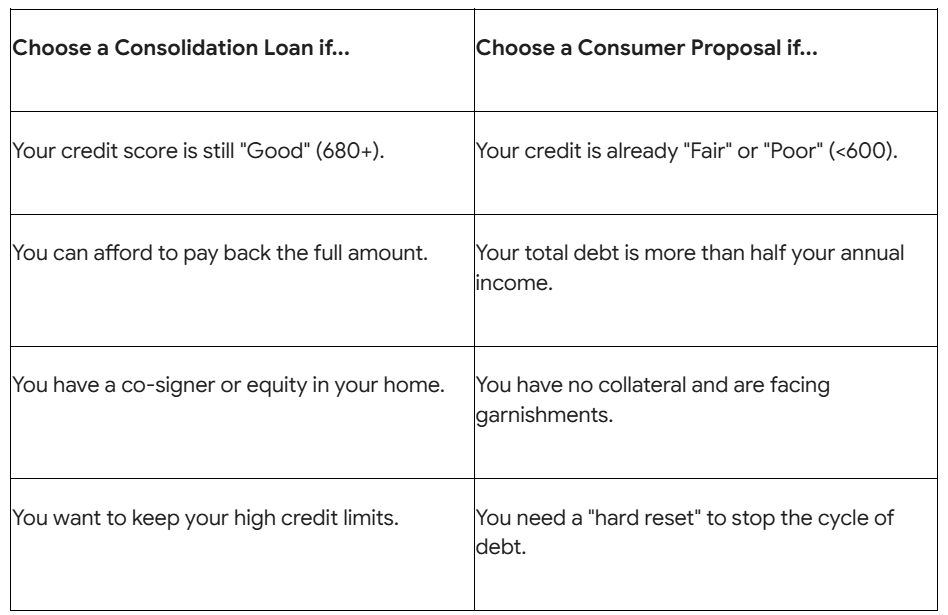
Which One is Right for You?

The LendingMoney.ca Verdict

At LendingMoney.ca, we don’t believe in a one-size-fits-all approach. If you have the credit to qualify, a Consolidation Loan is a fantastic way to save on interest while keeping your credit score pristine. However, if the math simply doesn’t add up and you’ll be in debt for the next 20 years, a Consumer Proposal is the more heroic choice for your long-term health.

Confused about which path to take? [Speak with a Financial Hero] today. We’ll run the numbers with you and find the strategy that fits your 2026 goals.