Blogs Mortgage Renewal Mortgages Private Lending

Fixing Your Credit While in a Private Mortgage

A private mortgage is often described as a “bridge.” But a bridge is only useful if it leads somewhere. If you are in a private mortgage in 2026, your primary goal is to use this 12-month window to rehabilitate your credit so you can “graduate” to a lower-interest bank or B-lender.

At LendingMoney.ca, we don’t want you to stay in a private loan forever. We want to help you fix the issues that put you there in the first place. Here is your month-by-month guide to Credit Rehabilitation while using a private mortgage.

1. The Private Mortgage Reporting Reality

In 2026, most individual private lenders do not report to Equifax or TransUnion.

  • The Problem: Even if you make every payment on time for a year, your credit score might not go up because the bureaus don’t see the “good behavior.”
  • The Hero Move: You must focus on your other tradelines. Since the mortgage isn’t helping your score, your credit cards, car loans, and phone bills have to do the heavy lifting.
  • The Catch: While private lenders don’t report the “good,” they will certainly report the “bad” if they have to take legal action (Power of Sale). On-time payments are mandatory to protect your equity.

2. Eliminate “R9” and “R7” Ghost Debts

If you took a private mortgage to consolidate debt, you likely have old collections (R9) or settled accounts (R7) on your report.

  • The Strategy: Use a small portion of your mortgage “holdback” or savings to pay off any remaining small collections.
  • The 2026 Rule: A “Paid Collection” is significantly better than an “Active Collection” when applying for a B-Lender. It shows the underwriter that you have cleared the wreckage of the past.

3. The 10% Utilization Rule

The fastest way to jump your score while in a private mortgage is to change how you use your credit cards.

  • The Math: If you have a $5,000 limit, never let the balance exceed $500 (10%) on the day the statement is produced.
  • The Hero Move: In 2026, many apps allow “Real-Time Reporting.” Pay your credit card balance every time you get paid (bi-weekly) rather than once a month. This keeps your “average utilization” extremely low, which is the #1 “Point Booster” in the Equifax algorithm.

4. Add Two “Fresh” Tradelines

To get back to a traditional bank, you usually need a “2-2-2” profile: 2 years of history on 2 lines of credit with at least $2,000 limits.

  • The Strategy: If your old cards were closed during a Consumer Proposal or bankruptcy, open two new Secured Credit Cards immediately.
  • The Timeline: By the time your 12-month private mortgage is up, these cards will have 12 months of perfect history, making you an ideal candidate for a B-Lender (Trust Company).

5. Diversify with a “Credit Builder” Loan

In 2026, lenders like seeing a mix of credit types. If you only have credit cards, your score will plateau.

  • The Move: Open a small Installment Credit-Builder Loan (like those offered by Nyble or KOHO).
  • How it works: You pay a small amount monthly ($20–$50), and they report it as a “Personal Loan” payment. This adds “Credit Mix” to your profile, which accounts for 10% of your total score.

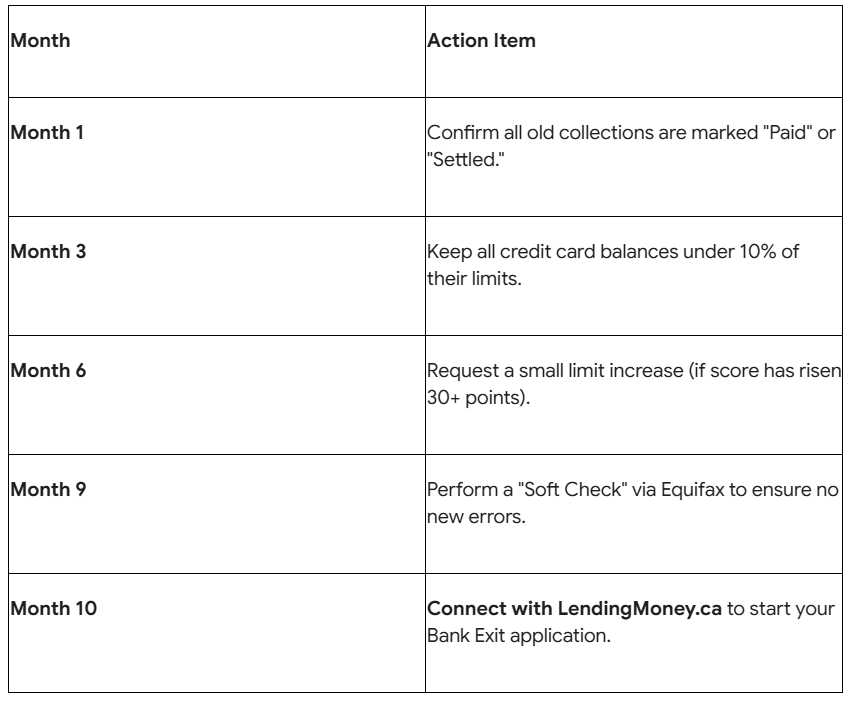
Your 12-Month Credit Rehab Calendar
The Goal: Graduation Day

Fixing your credit while in a private mortgage requires discipline. You are paying a higher interest rate now so that you never have to pay it again. At LendingMoney.ca, we provide the tools and the coaching to ensure that when your private term ends, you are ready for a prime-rate mortgage.

Currently in a private mortgage and want to see your “Graduation Date”? [Get a Free Credit Rehabilitation Roadmap] from LendingMoney.ca today and let’s start moving you back to the bank.

Read blog – Breaking the Cycle: A Guide to Loans for Debt Consolidation with Poor Credit

Alternative Lending Blogs Credit Score Personal Finance

The Final Leap: Moving from Alternative Lending back to the Bank

Alternative mortgages and B-Lenders are fantastic “stabilization” tools. They gave you the cash to pay the CRA, consolidate debt, or bridge a gap in your self-employment income. But now that the dust has settled, you likely want the lowest possible interest rate and the prestige of a traditional bank mortgage.

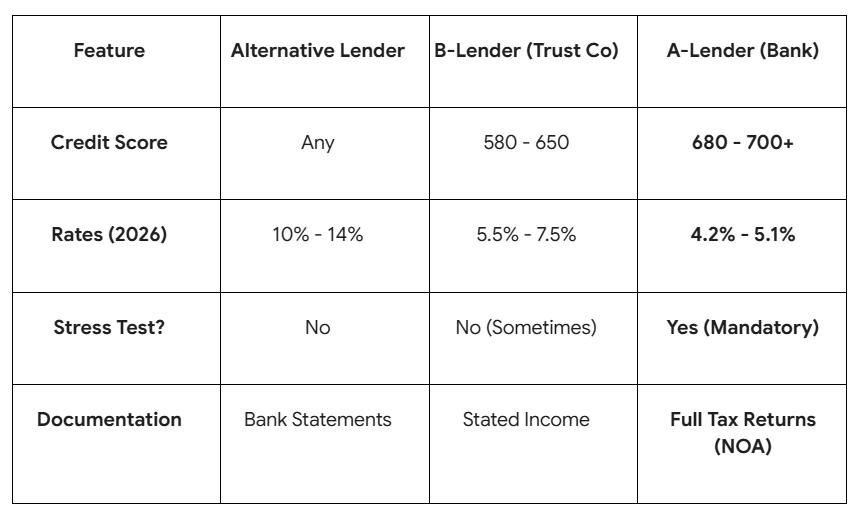
Moving back to an A-Lender requires more than just a good score; it requires a “clean” financial story. Here are the five benchmarks you must hit to graduate in 2026.

1. The 700 Club: Your New Credit Target

While you can get a B-Lender mortgage with a 600 score, the “Big Banks” in 2026 generally look for a minimum of 680, with 700+ being the “Golden Ticket” for the best advertised rates.

  • The Requirement: You need a “clean” credit bureau for the last 24 months. This means zero late payments on any credit card, car loan, or phone bill since you started your alternative mortgage.
  • The “Tradeline” Rule: Banks want to see at least two active credit cards with limits over $2,000, both with a history of at least two years.

2. The NOA Standard: Tax Transparence

This is often the biggest hurdle for entrepreneurs and those who previously owed the CRA.

  • The Rule: An A-Lender will require your two most recent Notices of Assessment (NOAs). They must show that you owe $0.00 to the government.
  • The 2026 Shift: Banks are now using digital verification. They may ask for a “Proof of Income” statement directly from the CRA portal. If there is any hint of a payment plan or outstanding balance, the bank will decline the application immediately.

3. The Federal Stress Test (Guideline B-20)

When you are with an alternative lender or a private lender, you often don’t have to pass the federal stress test. To move back to a bank, you must pass it.

  • The Math: In 2026, with the Bank of Canada policy rate near 2.25%, the “Benchmark” stress test is typically around 7.25%.
  • The Goal: Your total housing costs (mortgage + taxes + heat) must not exceed 39% of your gross income, and your total debt (including car loans) must not exceed 44%.

4. Stability of Income

Banks love “T4” employees (salaried workers). If you are self-employed, graduating back to a bank is harder but not impossible.

  • The 2-Year Average: The bank will take your “Line 15000” income from your last two years of tax returns and average them.
  • The Hero Move: If your business has grown significantly, we at LendingMoney.ca advise you to package your corporate financial statements to show “add-backs”-proving your true earning power is higher than what you show the taxman.

5. Property Appraisal & Marketability

A-Lenders are the most conservative when it comes to the “collateral” (your house).

  • The Inspection: If you used your alternative mortgage to fund renovations, the bank will want to see that those renovations are 100% complete. They will not take over a mortgage on a “construction zone.”
  • Location: Banks prioritize properties in major urban centers. If your home is in a very remote area, graduating back to a Big Six bank may require a higher credit score or a lower Loan-to-Value (LTV) ratio.

The Graduation Roadmap (Alternative → B → A)

Why Use LendingMoney.ca for Your Final Leap?

Most people think they can just walk into their local bank branch once their credit is fixed. However, if that bank sees a history of a private mortgage on your title, they may still be hesitant.

At LendingMoney.ca, we know which A-Lender underwriters are the most flexible with “recovered” borrowers. We tell your story in a way that highlights your successful rehabilitation, ensuring the bank sees you as a low-risk, high-value client.

Are you ready to stop paying “alternative” rates and start paying “bank” rates? [Request a Bank-Ready Audit] from LendingMoney.ca today. We’ll verify your score, your ratios, and your NOAs to see if today is your Graduation Day.

Read blog- How to Pay CRA Debt With Home Equity

Blogs Mortgages in Canada Personal Finance Second Mortgages

Falling Behind? How to Catch Up on Your Mortgage and Stop Foreclosure

Life in 2026 is expensive. Between groceries, utilities, and the new reality of higher mortgage rates, it only takes one unexpected event, a job transition, a medical emergency, or a major home repair, to fall behind on your mortgage.

If you’ve missed a payment, you might be avoiding your bank’s calls out of fear. But in Canada, lenders actually prefer helping you catch up over the long, expensive process of a “Power of Sale.” Here is your step-by-step Credit Rehabilitation plan to get back on track.

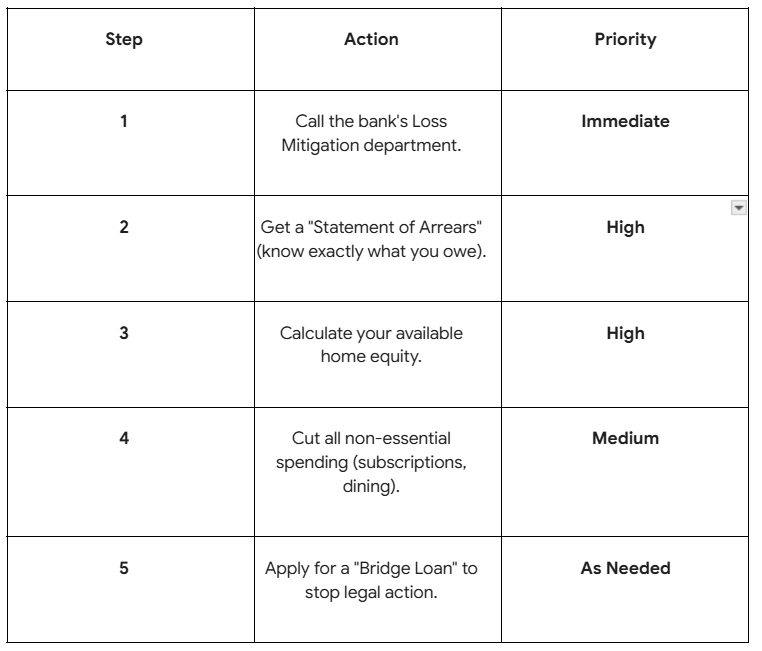
1. The First Strike Rule: Call Your Lender

The moment you know a payment is going to bounce, or if you’ve already missed one, pick up the phone.

  • What to Ask For: Ask to speak to the Loss Mitigation Department.
  • The 2026 Options: Most “Big Six” banks and credit unions have structured relief programs, including:
  • Capitalizing the Arrears: The lender takes the missed payments and adds them back into your total mortgage balance, spreading the cost over the remaining years.
  • Payment Deferral: Some lenders may allow a “pause” for up to 4 months if you can prove the hardship is temporary.

Interest-Only Payments: A temporary shift where you only pay the interest, giving you a 3–6 month window to stabilize your income.

2. Leverage Your Hero Tool: Home Equity

If your bank isn’t willing to work with you, or if you owe more than three months of payments, the “institutional” door may close. This is where your home’s value becomes your lifesaver.

  • The Equity Bailout: If you have at least 20% equity in your home, you can use a Second Mortgage or an Alternative Equity Loan from LendingMoney.ca to “clear the slate.”
  • Why this works: We provide the lump sum needed to pay the bank the full amount of your arrears (including their legal fees). This stops the foreclosure process instantly. You then have a manageable monthly payment with us while you get back on your feet.

3. The Amortization Stretch

If the reason you fell behind is that your monthly payment is simply too high for your current income, a “catch-up” payment is only a temporary fix. You need a structural change.

  • The Move: Re-amortize your mortgage. If you have 15 years left, ask to move back to a 25 or 30-year schedule.
  • The Result: This lowers your monthly obligation, making it much harder to fall behind again in the future.

4. Watch Out for the Legal Fee Trap

In 2026, once a mortgage goes into “Default,” lenders move quickly.

  • The Danger: After 2 or 3 missed payments, the bank’s lawyer will issue a “Statement of Claim.” The moment this happens, thousands of dollars in legal fees are added to your debt.
  • The Strategy: The faster you act, the less you pay. Settling your arrears in month two might cost you $200 in fees; waiting until month four could cost you $5,000.

5. The CRA Connection

Check your tax status. In 2026, many mortgage arrears are actually caused by the CRA freezing a homeowner’s bank account due to unpaid taxes.

  • The Fix: If your mortgage is bouncing because your accounts are frozen, you must resolve the CRA issue simultaneously. Using home equity to pay off both the CRA and the mortgage arrears is the ultimate “Double-Hero” move.

Your “Catch-Up” Checklist (2026)

You Don’t Have to Lose Your Home

At LendingMoney.ca, we specialize in the “Second Chance.” We know that being behind on your mortgage is a heavy burden, but we have the alternative lending tools to lift it. We help you pay the arrears, stop the legal fees, and build a plan to return to a traditional lender when your Credit Rehabilitation is complete.

Are the calls from the bank getting louder? [Get an Arrears Rescue Quote] from LendingMoney.ca today. Let’s protect your equity and keep your family in their home.

Blogs Debt Consolidation Debt Management Personal Finance

The Ultimate Guide to Consumer Proposals in Canada: Your Path to Debt Forgiveness

If you’ve been struggling with unmanageable debt, you’ve likely heard the term Consumer Proposal. In 2026, more Canadians than ever are choosing this legal pathway over bankruptcy to find relief from high-interest credit cards, tax debt, and unsecured loans.

But what exactly is a Consumer Proposal, and is it the right “hero move” for your financial journey? At LendingMoney.ca, we believe that understanding your options is the first step toward Credit Rehabilitation. Here is everything you need to know about this powerful debt-settlement tool.

What is a Consumer Proposal?

A Consumer Proposal is a formal, legally binding agreement between you and your unsecured creditors. Regulated under the Bankruptcy and Insolvency Act, it allows you to pay back a portion of what you owe- often as little as 20% to 50% – in exchange for full debt forgiveness on the remaining balance.

Unlike informal debt settlement schemes, a Consumer Proposal is a federal process administered by a Licensed Insolvency Trustee (LIT). It is designed to be a “win-win”: you get a monthly payment you can actually afford, and your creditors receive more money than they would if you filed for bankruptcy.

How Does a Consumer Proposal Work? (The 5-Step Process)

The process is structured to give you immediate relief while providing a clear exit strategy from debt.

  1. The Consultation: You meet with a Licensed Insolvency Trustee to review your finances. They determine if you are “insolvent” (unable to pay your debts as they come due) and if a proposal is your best option.
  2. The Filing: Your Trustee files the proposal with the government. The moment this happens, a Stay of Proceedings kicks in. This is your legal shield—it immediately stops all collection calls, interest charges, lawsuits, and wage garnishments.
  3. The 45-Day Voting Period: Your creditors have 45 days to review your offer. For the proposal to be accepted, a simple majority (51%) of your creditors (based on the dollar value of the debt) must vote “Yes.” Once the majority agrees, all your unsecured creditors are legally bound by the deal.
  4. The Repayment Phase: You make one fixed, interest-free monthly payment to your Trustee for a term of up to 5 years (60 months).

The Certificate of Full Performance: Once your payments are complete and you’ve attended two mandatory financial counseling sessions, you receive a certificate that legally discharges you from all debts included in the proposal.

What Debts Can You Include?

A Consumer Proposal is incredibly versatile. It covers almost all forms of unsecured debt, including:

  • Credit Cards: Visa, Mastercard, Amex, and retail store cards.
  • Lines of Credit: Both bank-issued and private unsecured lines.
  • CRA Debt: Income tax arrears, GST/HST, and even CERB/CRB overpayments.
  • Personal Loans: Including high-interest installment loans and payday loans.
  • Student Loans: Provided you have been out of school for at least seven years.

Note: Secured debts, such as your mortgage or your car loan, stay outside the proposal. As long as you keep making those specific payments, you keep the assets.

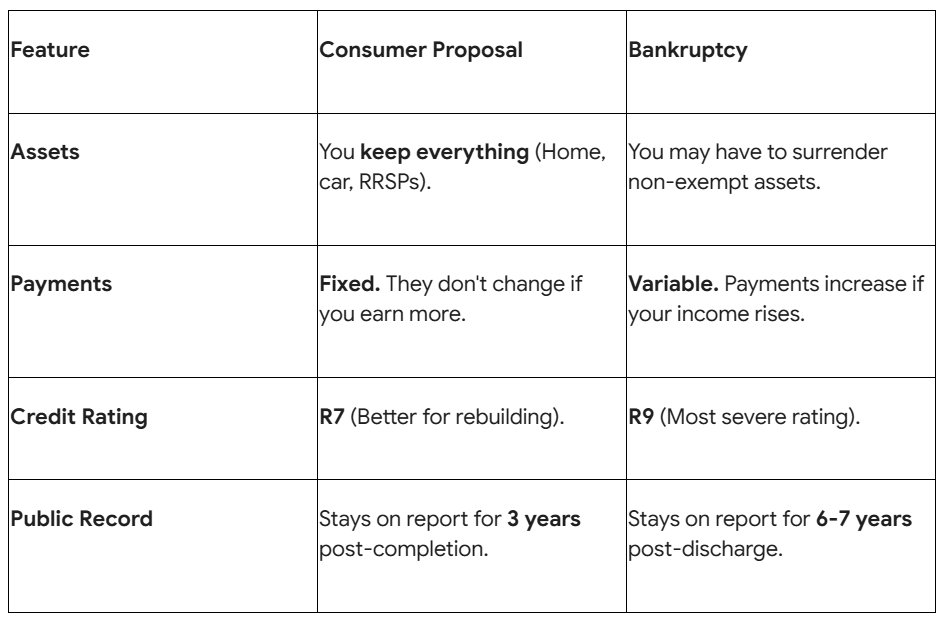
Why Choose a Consumer Proposal Over Bankruptcy?

In 2026, the “stigma” of insolvency is fading as more people realize that a Consumer Proposal is a proactive, responsible choice. Here is why it often beats bankruptcy:

Who Qualifies for a Consumer Proposal in Canada?

To file a Consumer Proposal in 2026, you must meet four main criteria:

  1. Insolvency: You owe more than you own, or you can no longer meet your monthly minimum payments.
  2. Debt Limit: Your total unsecured debt must be between $1,000 and $250,000 (excluding your mortgage). If you are filing as a couple, your joint limit is $500,000.
  3. Residency: You must live in Canada or own property here.

Ability to Pay: You must have a stable source of income (employment, pension, or self-employment) to support the monthly payments.

The Catch: What are the Drawbacks?

While a Consumer Proposal is a powerful tool, it isn’t a “get out of debt free” card. There are a few things to consider:

  • Credit Impact: Your credit will be rated as an R7. While this is better than a bankruptcy’s R9, it will make it difficult to get traditional low-interest credit while the proposal is active.
  • Public Record: Like all insolvency filings, it is a matter of public record, though it is rarely “advertised” outside of specific credit-search databases.
  • Missed Payments: If you miss three monthly payments, your proposal is “annulled,” meaning the legal protection disappears and your creditors can come after you for the full original amount plus interest.

The LendingMoney Advantage: Post-Proposal Recovery

Filing a Consumer Proposal is only half the battle. The real goal is Credit Rehabilitation.

At LendingMoney.ca, we work with clients who are currently in or have recently completed a Consumer Proposal. While big banks might turn you away, we understand the 2026 lending landscape. We help you navigate the “rebuilding phase” with:

  • Consolidation Strategies: Helping you manage your proposal payments more effectively.
  • Rebuilding Tools: Introducing you to credit-building loans that report to the bureaus while your proposal is active.
  • Bridge Financing: Providing the “hero” support you need to reach that Certificate of Full Performance faster.

Final Thoughts: Is It Time to Act?

If you are only making minimum payments and your total debt isn’t going down, you are essentially on a “treadmill” that is going nowhere. A Consumer Proposal allows you to step off that treadmill and start walking toward a debt-free life.

Ready to see if a Consumer Proposal is the “Hero Move” your family needs? [Connect with LendingMoney.ca] today for a no-judgment consultation and start your journey to a 700+ credit score.

Read blog – How to get a Second Mortgage With Bruised Credit

Blogs Financial Recovery Personal Finance Private Lending

The Strategic Second: Why Canadians are Turning to Second Mortgages in 2026

For many, the term “second mortgage” once carried a certain stigma. It was something whispered about in times of crisis. However, as we move through 2026, the narrative has shifted. Today’s homeowners are using second mortgages to protect their low-rate first mortgages, fuel business growth, and navigate a complex tax environment.

A second mortgage is a loan secured against your property that sits behind your primary mortgage on the title. Because the lender is in “second position,” they take on more risk (if the home is sold, the first lender is paid first), which results in higher interest rates. But despite the cost, the benefits often far outweigh the price of the interest.

Here are the primary reasons why second mortgages have become the “Hero Move” for Ontario homeowners this year.

1. Protecting a Low-Rate First Mortgage

This is the #1 reason for a second mortgage in 2026. Many homeowners locked into 5-year fixed rates in 2021 or 2022 at rates between 1.5% and 2.5%.

If you need $50,000 today, you have two choices:

  • Refinance: Break your entire mortgage and move the whole balance to today’s rate (likely 4.5% – 5.5%). This triggers massive prepayment penalties and increases the cost of your entire debt.
  • The Second Mortgage: You leave your 2% mortgage exactly where it is. You only pay a higher rate on the new $50,000.

By keeping your “A-Lender” rate untouched, you save thousands in interest over the remaining years of your term.

2. High-Interest Debt Consolidation

In 2026, credit card interest rates have climbed to 21% – 24%, and personal lines of credit aren’t far behind. For a homeowner carrying $40,000 in consumer debt, the monthly interest alone can be “choking” their cash flow.

A second mortgage allows you to:

  • Replace 22% interest with 9% – 12% interest.
  • Collapse five or six monthly payments into one.
  • The Credit Rehab Win: By paying off your credit cards in full, your credit utilization drops to zero, often causing your credit score to jump 50 to 100 points in a single 90-day cycle.

3. Resolving CRA Tax Arrears

As we’ve discussed in our tax series, the CRA is the only creditor in Canada with “Super Priority.” They don’t need a court order to freeze your bank account or garnish your wages.

Traditional banks will almost never give you money to pay off the CRA. They view tax debt as a sign of instability. A private second mortgage lender, however, is happy to lend you the funds to “kill” the tax debt.

  • The Goal: Pay the CRA today to stop the 7% daily compounding interest and prevent a lien from being registered on your title.

4. Funding Value-Add Renovations

In 2026, many Canadians have decided to “Love It, Don’t List It.” With the costs of moving (land transfer taxes, real estate commissions, and legal fees) reaching $50,000+, many families prefer to renovate their existing space.

A second mortgage is perfect for:

  • ADUs (Additional Dwelling Units): Converting a basement or garage into a rental suite to generate extra income.
  • Major Overhauls: Kitchens and bathrooms that add more value to the home than the cost of the loan.
  • Speed: Unlike a bank-led “Improvement Mortgage,” which requires multiple inspections and draws, a second mortgage provides the cash upfront so you can pay your contractors and get the job done.

5. Business Capital and Entrepreneurial Growth

Banks are notoriously difficult for small business owners. If you are self-employed or starting a new venture in 2026, a bank will likely want to see two years of perfect tax returns before they lend you a dime.

Entrepreneurs use second mortgages as working capital:

  • To buy inventory in bulk at a discount.
  • To fund a marketing push or hire a key employee.
  • To bridge the gap while waiting for large invoices to be paid.
    Since the loan is based on equity, not your business’s current P&L statement, it is the fastest way to inject cash into a growing company.

6. Helping the Next Generation (The Bank of Mom and Dad)

With the 2026 real estate market still challenging for young buyers, many parents are using second mortgages to “gift” a down payment to their children.

  • By taking out a $100,000 second mortgage, parents can help their child enter the market today rather than waiting 10 years to save. This allows the family to build wealth across two properties simultaneously.

7. Emergency and Life Events

Life doesn’t always follow a budget. Unexpected medical expenses, a sudden divorce settlement, or helping a family member in a crisis can require a large amount of liquidity instantly.
A second mortgage can be funded in as little as 3 to 5 business days, making it the “Emergency Fund” for homeowners who are asset-rich but cash-poor.

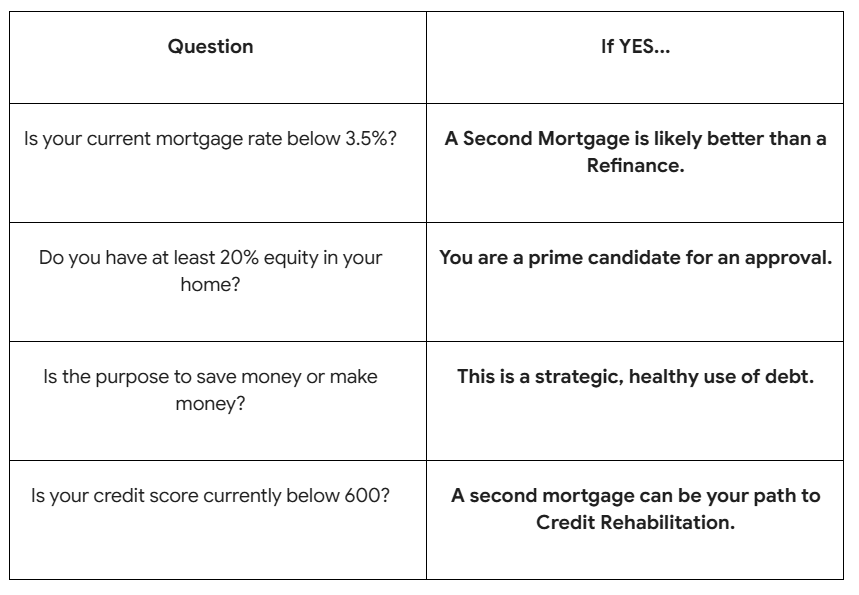
Is a Second Mortgage Right for You? (The 2026 Checklist)

Your Home, Your Future

At LendingMoney.ca, we don’t just see a second mortgage as a loan; we see it as a pivotal financial moment. Whether you are consolidating debt to save your credit or investing in your business to save your future, we match you with the lenders who value your equity and your story.

Ready to see how much equity you can unlock? [Get a Second Mortgage Quote] from a Financial Hero at LendingMoney.ca today. We’ll help you do the math and find the smartest path forward.

Alternative Lending Blogs Education Personal Finance Tax Debt Solutions

Breaking the Cycle: Why Payday Loans are a Financial Trap in 2026

We’ve all been there: an unexpected car repair, a dental emergency, or a utility bill that’s higher than usual. When you need cash today and the bank has already said no, a neon sign for a payday loan can look like a beacon of hope.

In Ontario, names like Money Mart are everywhere, promising “instant cash” with “no credit check.” But in 2026, the price of that speed has reached a breaking point for many Canadian families. At LendingMoney.ca, we believe that true Credit Rehabilitation starts with understanding why payday loans are designed to keep you in debt-and how alternative lending can set you free.

1. The 365% Reality Check

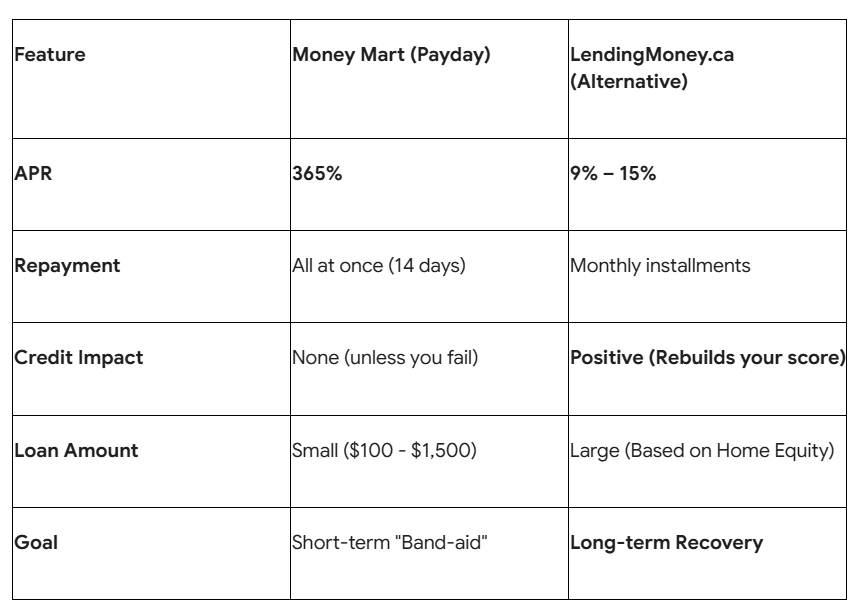
In Ontario, the law limits payday lenders to charging $14 per $100 borrowed. On the surface, $14 doesn’t sound like much. But payday loans are designed to be paid back in just 14 days.

  • The Math: If you borrow $500 for two weeks, you pay $70 in fees. If you were to carry that same debt for a full year, the Annual Percentage Rate (APR) is a staggering 365%.
  • The Comparison: At LendingMoney.ca, an alternative equity loan or second mortgage typically carries an APR between 9% and 15%. That is a difference of over 350%.

2. The Vicious Cycle of Re-Borrowing

The biggest pitfall of a payday loan isn’t the first one—it’s the second one.

  • The Trap: When your next paycheck arrives, the payday lender takes their $570 (principal + fees) directly from your account. This leaves you with $570 less to pay your rent and buy groceries for the next two weeks.
  • The Result: Most borrowers find themselves short again within days, forcing them to take out a new payday loan to cover the gap left by the first one.
  • The 2026 Data: Statistics Canada reports that the average payday loan user in 2026 takes out 8 to 10 loans per year. This isn’t a “bridge”-it’s a treadmill.

3. The No Credit Check Illusion

Payday lenders often advertise “No Credit Check” as a benefit. While this makes it easy to get the money, it has a hidden sting: Payday loans almost never help your credit score.

  • The Logic: Because they don’t report your on-time payments to Equifax or TransUnion, you get zero “points” for paying them back.
  • The Sting: However, if you miss a payment, they will send the debt to a collection agency immediately, which will tank your score. It is a “no-win” scenario for your Credit Rehabilitation.

4. The Balloon Payment vs. Installments

A payday loan is a “balloon” payment—the whole amount is due at once. This is the hardest way to pay back debt.

  • The LendingMoney.ca Difference: We offer Installment-Based alternative loans. Instead of losing $500 of your next paycheck, you might pay $50 a month over a longer term. This protects your daily cash flow and allows you to breathe.

5. Aggressive Collection Tactics in 2026

With the 2026 digital banking updates, payday lenders use “Pre-Authorized Debit” agreements that are notoriously difficult to stop. If you try to block the payment to buy food, they may charge you NSF fees of $20–$50 on top of the 30% default interest they are legally allowed to charge.

Payday Loan vs. LendingMoney.ca Alternative Loan

Stop Digging. Start Building.

If you are currently using payday loans to stay afloat, you aren’t alone-but there is a better way. If you own your home, your equity is a “Financial Hero” waiting to be used.

At LendingMoney.ca, we use your home equity to provide a low-interest alternative to the payday trap. We pay off the high-interest lenders, lower your monthly payments, and start the process of moving you back to a traditional bank.

Ready to break the cycle? [Get a Payday Loan Exit Quote] from LendingMoney.ca today. Let’s trade your 365% debt for a plan that actually works.

Read blog – Breaking the Cycle: A Guide to Loans for Debt Consolidation with Poor Credit
Alternative Lending Blogs Financial Education Financial Recovery Personal Finance

The Big Six vs. The Alternatives: Which Lender is Your Best Financial Partner?

If you’ve ever walked into a major Canadian bank to apply for a loan or a mortgage only to be told you don’t “fit the box,” you aren’t alone. In 2026, Canada’s “Big Six” banks have some of the strictest lending criteria in the world. But a “no” from a bank isn’t the end of your financial journey – it’s often just a sign that you need an alternative lender.

At LendingMoney.ca, we operate in the “Alternative” space. But what does that actually mean for your wallet? Let’s break down the fundamental differences between traditional banks and alternative lenders so you can choose the partner that actually fits your life.

1. The Box vs. The Big Picture

The most significant difference lies in how a lender views you.

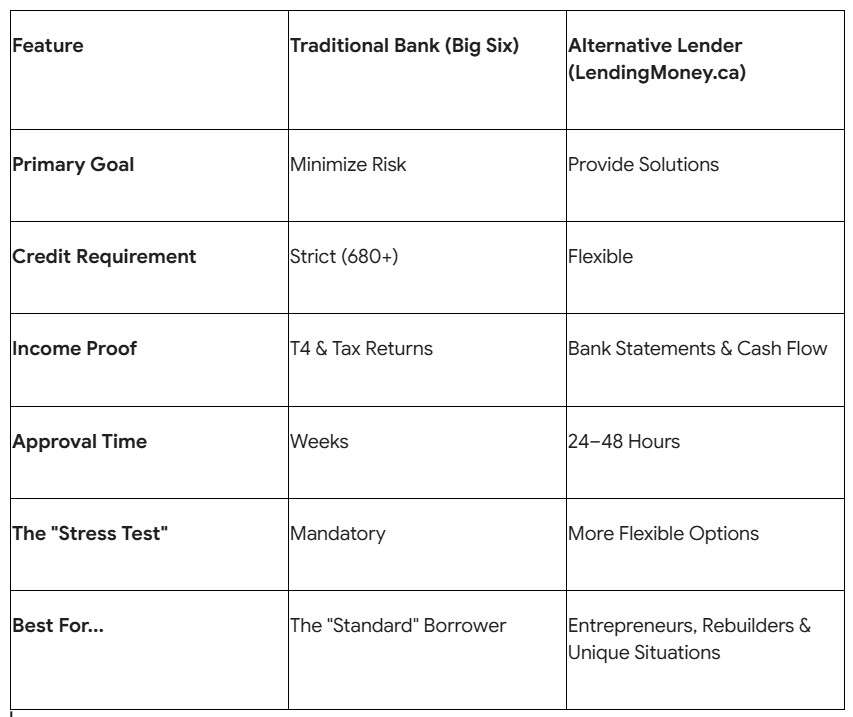
  • The Bank (Traditional): Banks are “Algorithm-First.” They use standardized underwriting templates. If your credit score is below a certain number (usually 680+) or if your income is fluctuating, the computer automatically triggers a decline. They rely on “T4 income” and stable 2-year employment histories.
  • The Alternative Lender: We are “Holistic-First.” While we still look at credit, we focus more on current cash flow, home equity, and future potential. We understand that a self-employed entrepreneur or someone recovering from a divorce is more than just a three-digit score.

2. 2026 Regulations and the Stress Test

In 2026, federal regulators (OSFI) have introduced even tighter rules for big banks, particularly regarding rental properties and debt-service ratios.

  • The Bank: Must apply the Mortgage Stress Test to every federally regulated product. They often “double-count” your debts but “single-count” your income, making it incredibly hard to qualify if you have existing loans.
  • The Alternative Lender: Many alternative lenders are provincially regulated, meaning they have more flexibility. We can often look at “global income” or “stated income” for business owners, providing a pathway to homeownership that simply doesn’t exist at a big bank in 2026.

3. Speed of Adjudication

If you are in a “bridge” situation – like needing to close on a house before your old one sells—time is your biggest enemy.

  • The Bank: Because of their massive size and layers of bureaucracy, a bank approval can take 3 to 8 weeks.
  • The Alternative Lender: We are built for speed. At LendingMoney.ca, we can often provide an approval in 24 to 48 hours. We don’t have layers of committees; we have Financial Heroes ready to make decisions.

4. Why the Rate Isn’t the Only Number That Matters

The most common argument for banks is that they offer the lowest interest rates. While this is often true, it comes with a hidden cost.

  • The Bank: Offers a “Prime” rate but requires “Prime” circumstances. If you don’t qualify, the rate is irrelevant.
  • The Alternative Lender: Our rates are slightly higher to reflect the customized risk we take. 
  • The Strategy: Think of an alternative lender as a bridge. You use us to secure your home or consolidate your debt now, and while you’re with us, we work on your Credit Rehabilitation. Once your score is back in the 700s, we help you “graduate” back to a traditional bank rate.

5. Flexibility for the Self-Employed and Gig Workers

In 2026, the Canadian workforce is changing. More people are freelancers, contractors, or small business owners.

  • The Bank: Prefers “stable” paychecks. If you write off expenses to save on taxes (as every smart business owner does), the bank sees a lower income and denies your loan.

The Alternative Lender: We look at your gross revenue and your bank statements. We understand how businesses actually work and don’t punish you for being your own boss.

Comparison at a Glance (2026)

Why Choice is Your Greatest Asset

Relying solely on a bank relationship can limit your growth. In 2026, the most successful Canadians treat financing as a strategy. They use alternative lenders when they need speed and flexibility, and they use traditional banks when they fit the “standard” mold.

At LendingMoney.ca, we are your partners in that strategy. We provide the capital when the bank says “no,” and we provide the roadmap to ensure they eventually say “yes.”

Tired of the bank’s “No”? [Connect with a Financial Hero] at LendingMoney.ca and let’s look at the big picture of your finances today.

Alternative Lending Blogs Debt Consolidation Private Mortgages

If you have received a Notice of Sale Under Mortgage, the most important thing to know is that you still own your home. In Ontario, the “Power of Sale” is a legal process, and like any process, it can be stopped, but the clock is ticking.

In 2026, lenders are moving faster to protect their capital, often initiating the process after just two missed payments. Here are the top five ways to pull the emergency brake and stop a Power of Sale today.

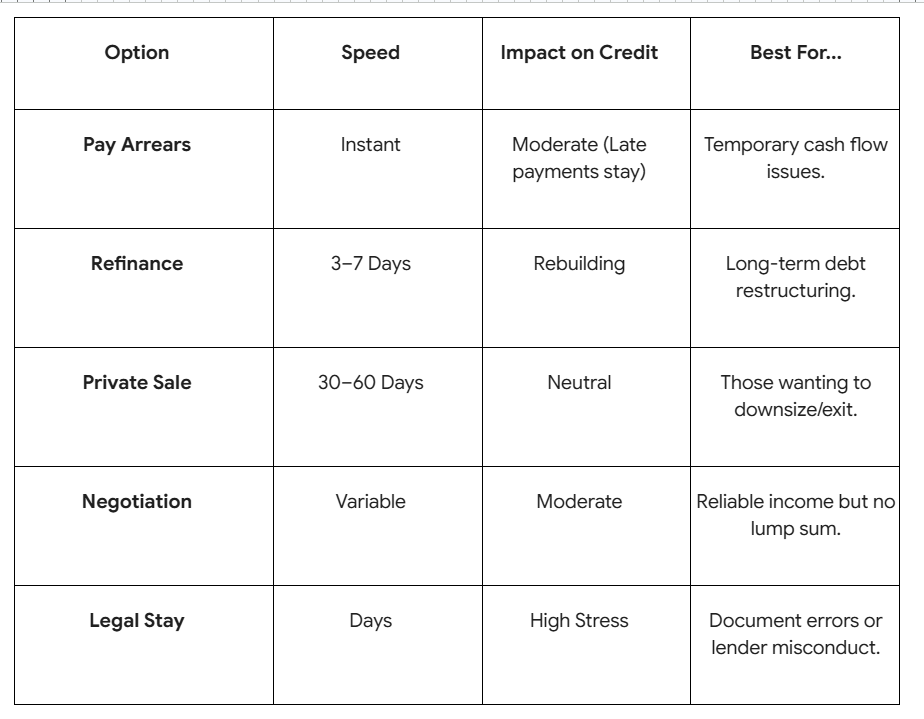
1. Pay the Arrears and Reinstate (The Cleanest Break)

The most direct way to stop a Power of Sale is to “cure” the default. Under Section 22 of the Mortgages Act, you have the right to bring the mortgage back into good standing by paying exactly what is owed.

  • What you pay: You must pay the total of all missed payments, any late penalties, and the lender’s actual legal costs incurred to date.
  • The Result: Once paid, the Power of Sale is legally voided, and your mortgage continues as if the default never happened.
  • Hero Tip: If you’ve recently returned to work or received an inheritance, this is your best move. Always get a written “Statement of Arrears” from the lender’s lawyer to ensure you are paying the correct amount.

2. Refinance with an Alternative or Private Lender

If you cannot come up with the cash to pay the arrears, you can replace the entire mortgage. Traditional banks will not touch a file in Power of Sale, but Alternative Lenders (like LendingMoney.ca) specialize in this.

  • How it works: A new lender pays off your old bank in full (including all legal fees and penalties). The Power of Sale is cancelled because the debt no longer exists.
  • The 2026 Strategy: This is a “Bridge” strategy. You take a 1-year term with an alternative lender to save your home today, then use that year for Credit Rehabilitation so you can switch back to a lower-rate bank later.

3. Sell the Property Privately (Protect Your Equity)

If you know you cannot afford the mortgage long-term, you should sell the home yourself before the lender does.

  • The Math: When a lender sells your house under Power of Sale, they often sell it “as-is” and may not push for the highest price, they just want their money back. By listing it yourself, you control the marketing and the price.
  • The Legal Window: You can list and sell your home even after a Notice of Sale is issued, provided the sale closes before the lender completes their own transaction. This ensures that the surplus equity (the profit) stays in your pocket, not the bank’s legal fees.

4. Negotiate a Forbearance or Repayment Plan

Believe it or not, most lenders do not actually want your house; they want their money. In 2026, many institutions have “loss mitigation” departments.

  • The Ask: Request a formal Forbearance Agreement. This is a legal document where the lender agrees to “pause” the Power of Sale if you agree to a strict schedule to pay back the arrears over 3–6 months.
  • The Hero Move: You are more likely to get a “Yes” if you can pay a small “good faith” lump sum immediately.

5. Challenge the Process (The Legal Defense)

If the lender has made a mistake in the paperwork, a judge can stay (stop) the Power of Sale.

  • Common Errors: Failing to wait the mandatory 15-day default period before sending the notice, or failing to serve the notice to all registered owners (including ex-spouses).

The Catch: This requires a specialized real estate lawyer and can be expensive. It is usually a “delay tactic” to buy you more time to execute Option 2 or Option 3.

Comparison of Your “Rescue” Options

The 35-Day Redemption Clock

In Ontario, once you receive the Notice of Sale Under Mortgage, you have a 35-day redemption period (40 days if it’s a matrimonial home). During this window, the lender cannot sell the property. This is your “Golden Window” to act. Once this period expires, the lender can list the property on the MLS, and your options become much more expensive.

Warning: Do not wait until Day 34. Appraisals and alternative mortgage funding take time.

Is the clock ticking on your Notice of Sale? [Connect with a Financial Hero] at LendingMoney.ca immediately. We can often secure an equity-based approval in 24 hours to stop the sale and save your home.

Read blog – What is a Power of Sale in Ontario? Your 2026 Emergency Guide

Alternative Lending Blogs Business Finance Credit Rehabilitation Financial Recovery

Starting Over: How to Rebuild Your Credit After a Business Failure

In the entrepreneurial world, failure is often just a prerequisite for future success. However, while your spirit might be ready for the next venture, your credit report usually tells a different story. Between personally guaranteed business loans, maxed-out credit cards used to keep the doors open, and potential CRA arrears, a business closure can leave your credit score in the 400s or 500s.

At LendingMoney.ca, we don’t define you by your last business – we help you fund your next one. Here is your 2026 roadmap for financial recovery and credit rehabilitation after a business failure.

1. Inventory the Personal Guarantee Damage

The first step in recovery is separating what you owe personally from what the business owed.

  • The “PG” Audit: Go through your business contracts. Which loans did you personally guarantee (PG)? These will follow you even after the corporation is dissolved.
  • The “Silent” Hit: If you had a business credit card that you were a Co-Applicant on, that balance is now 100% your personal responsibility.
  • The Action Step: Get your Equifax and TransUnion reports immediately. Ensure no business debts are being “double-counted” as personal debts unless there was a legal guarantee in place.

2. Address the CRA Director Liability

This is the biggest “Hero” move you can make. If your business owed GST/HST or Payroll Deductions, the CRA can hold you personally liable as a Director.

  • The 2026 Risk: The CRA has become more aggressive this year in pursuing directors for unpaid corporate taxes.
  • The Solution: If you have home equity, use an Alternative Equity Loan from LendingMoney.ca to settle these government debts first. The CRA is the only creditor that can “leapfrog” other lenders to freeze your personal assets.

3. The Strategic Settlement Phase

If you have five different credit cards with balances from the failed business, don’t try to pay them all at once.

  • The “Lump Sum” Strategy: It is often better to save a lump sum and offer a settlement to one creditor at a time (e.g., offering $0.40 on the dollar).
  • The Credit Code: A settled debt will be marked as an R7. While not perfect, an R7 is infinitely better than an “R9” (Collection/Charge-off) because it shows the account is closed and settled.

4. Re-Establish Your Personal Tradelines

After a business failure, your Credit Mix is usually a mess of high-interest loans. You need to re-introduce “Normal” credit.

  • The Two-Card Rule: Secure two small Secured Credit Cards. Do not use them for business. Use them for your personal groceries and pay them off every single Friday.

The “Activity” Signal: You need to show the bureaus that you are back to a “stable personal lifestyle.” Consistent, small, weekly payments are the fastest way to signal a turnaround in 2026.

5. Wait, Don’t Rush the New Business Credit

It’s tempting to start a new corporation and apply for credit immediately.

  • The Warning: In 2026, lenders are using AI-driven “Identity Linking.” If you start a new business but your personal score is still 520, you will be declined for everything.
  • The Goal: Focus 100% on your personal Credit Rehabilitation for 6–12 months. Once your personal score crosses the 650 mark, your “Director” status becomes an asset again rather than a liability.

6. Use an Alternative Bridge Loan

If the business failure left you with high-interest personal debt that is “choking” your cash flow, an installment loan from LendingMoney.ca can act as your bridge.

  • Consolidate the “Failure”: Move the high-interest cards into one manageable payment.
  • The Result: Your credit utilization drops, your score rises, and you stop the emotional stress of multiple collections calls.

You Are Not Your Business Failure

A business failure is a masterclass in experience, but it shouldn’t be a life sentence of bad credit. By taking a structured approach to your Credit Rehabilitation, you can be back in a “Mortgage-Ready” position sooner than you think.

Ready to leave the stress of your past business behind? [Talk to a Financial Hero] at LendingMoney.ca today. We’ll help you clean up the debris and build a foundation for your next success.

Read blog –The Head Start: How to Rebuild Your Credit During a Consumer Proposal