
Alternative Lending Blogs Credit Rehabilitation Mortgage Tips Personal Finance

Top 5 Private Lender Questions to ask to Avoid Traps

When you take out a private mortgage, you aren’t just signing a loan; you are entering a high-stakes business partnership. In the 2026 lending environment, private mortgages (often called “C-Lending”) are more common than ever, but they are also more complex.

At LendingMoney.ca, we believe that a “Financial Hero” is an informed borrower. Before you sign that commitment letter, you need to look past the interest rate and ask these five critical questions. The answers will determine whether your mortgage is a helpful bridge or a permanent trap.

1. What is the Total ‘Cost of Borrowing’ (APR)?

The interest rate is only one part of the story. Private lenders often layer on multiple fees that aren’t immediately obvious.

  • The Reality: You might see a rate of 9.99%, but once you add the Lender Fee (2%), the Broker Fee (2%), and the Legal Fees ($3,000), your actual Annual Percentage Rate (APR) could be closer to 15%.
  • The Hero Move: Ask for a full disclosure of all one-time and recurring fees. If the lender is hesitant to give you a “Truth in Lending” summary, that’s a red flag.

2. Is There a ‘Renewal Fee’ After 12 Months?

Most private mortgages in Ontario are one-year terms. The biggest “Equity Killer” is the surprise fee that hits you when that year is up.

  • The Trap: Some private lenders charge the same 2% fee to renew the loan for another year. If you have a $500,000 mortgage, you are paying $10,000 just to stay in the loan.
  • The Hero Move: Ask if the renewal fee can be waived or capped if you make all your payments on time.

3. What are the Pre-Payment Penalties?

A private mortgage is meant to be a short-term fix. You want the freedom to leave as soon as your credit score improves or you sell your home.

  • The Reality: Many private lenders “lock” you in for the full term. If you try to pay off the mortgage at month 6, they may charge you the remaining 6 months of interest as a penalty.
  • The Hero Move: Look for a “3-month interest” penalty or, better yet, a “Fully Open” mortgage. This allows you to “graduate” to a bank-rate mortgage the moment your Credit Rehabilitation is complete without paying a fortune to leave.

4. Is This an ‘Interest-Only’ or ‘Amortized’ Loan?

Most private mortgages are “Interest-Only,” meaning your monthly payment doesn’t reduce the amount you owe.

  • The Risk: If you borrow $400,000, you will still owe exactly $400,000 a year from now. If the housing market dips, you could end up owing more than the house is worth.
  • The Hero Move: Confirm exactly where your money is going. If it’s interest-only, you must have a separate plan to save for a principal reduction or a plan to refinance into an amortized “B-Lender” loan as soon as possible.

5. What Happens if I Miss a Single Payment?

Private lenders don’t have the same “Loss Mitigation” departments as big banks. Their tolerance for late payments is much lower.

  • The Trap: Some contracts include “Default Interest Rates” that can jump to 24% or higher the moment a payment is missed. They may also initiate Power of Sale proceedings after just 15 days of default.
  • The Hero Move: Ask about the “Grace Period” and the “NSF Fees.” You need to know exactly how much time you have to fix a mistake before legal action begins.

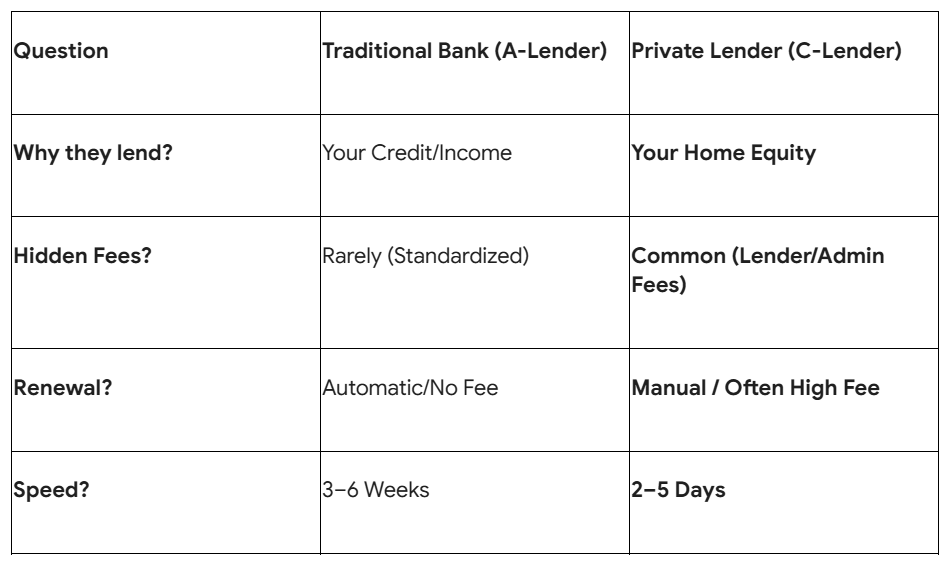
Comparison: Standard Bank vs. Private Lender Questions
Don’t Sign Until You’re Certain

At LendingMoney.ca, we act as your protective shield. We vet every private lender in our network to ensure their terms are fair and their “Exit Strategy” is clear. We don’t just want you to get the money; we want you to keep your equity.

Considering a private mortgage offer? [Upload Your Commitment Letter] for a “Second Opinion” from a Financial Hero at LendingMoney.ca. We’ll help you spot the traps before you sign.
Alternative Lending Blogs Credit Rehabilitation Personal Finance

The Payday Trap: The Hidden Costs That Keep You in Debt

When you’re a few days away from your next paycheck and an unexpected expense hits—a car repair, a dental bill, or a late utility notice – the “Instant Cash” sign at a payday lender can look like a lifesaver. It’s fast, there’s no credit check, and the fee seems small: “Just $14 per $100 borrowed.”

But in the world of Canadian finance, that $14 is a wolf in sheep’s clothing. At LendingMoney.ca, we specialize in Credit Rehabilitation, and the first step in that journey is stopping the “payday cycle.” Here is the reality of what those loans actually cost you and why they are the most expensive way to borrow money in 2026.

1. The APR Shock: 365% vs. 10.95%

Payday lenders often talk in “fees” rather than “interest rates” to hide the true cost of the loan. Under 2026 Canadian regulations, the maximum a lender can charge in most provinces is $14 for every $100 borrowed for a 14-day term.

While $14 sounds manageable, let’s look at the Annual Percentage Rate (APR):

  • A typical credit card has an APR of 19.99%.
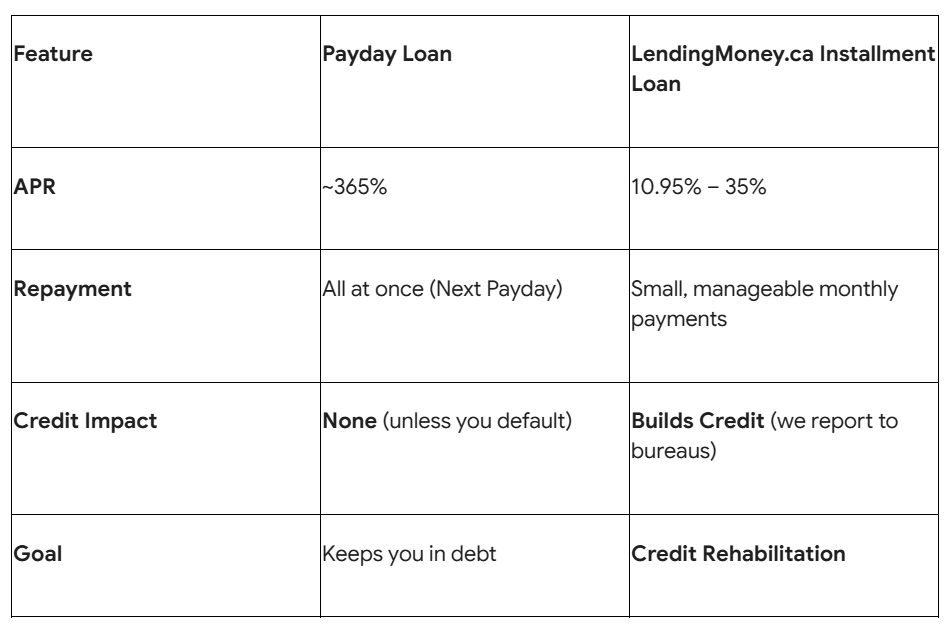
  • A personal installment loan from a lender like LendingMoney.ca might range from 10.95% to 35%.
  • A payday loan has an APR of 365%.

If you borrowed that same $100 for a full year at payday rates, you wouldn’t owe $114 – you would owe hundreds in compounding fees. You are essentially paying “VIP prices” for a “budget” service.

2. The “Invisible” Fees: NSFs and Bounced Cheques

The $14 fee is only the beginning. The real “hidden” costs kick in if anything goes wrong:

  • The Bank Hit: If the payday lender tries to withdraw the repayment and you don’t have the funds, your bank will charge you an NSF (Non-Sufficient Funds) fee, which in 2026 averages $45 to $50.
  • The Lender Hit: On top of your bank’s fee, the payday lender can charge a “Dishonoured Payment” fee (capped at $20 in most provinces).
  • The Result: A simple $300 loan can suddenly cost you an extra $70 in fees in a single day – all before you’ve even touched the principal.

3. The Silent Credit Killer

One of the biggest myths is that paying back a payday loan helps your credit score. It does not.

  • No Upside: Most payday lenders do not report your on-time payments to Equifax or TransUnion. You can pay back 50 loans perfectly and your credit score won’t move an inch.
  • Massive Downside: If you miss a payment, they will sell your debt to a collection agency. That agency does report to the bureaus, resulting in an R9 rating (the same as bankruptcy) that can haunt your report for six years.

4. The Debt Spiral (The Rollover Trap)

The most devastating hidden cost of a payday loan is the loss of your future income. Because the loan is due in full on your next payday, many borrowers find themselves short on cash for rent or groceries the very next day.

This leads to the “Cycle of Debt”:

  1. You take a loan to pay a bill.
  2. Your next paycheck goes entirely to the lender.
  3. You immediately take another loan to survive the month.
  4. You are now paying a “subscription fee” of $14 per $100 just to access your own salary.

[Image: The Payday Cycle – A hamster wheel of debt]

5. New 2026 Protections: What You Need to Know

As of 2025 and 2026, the Canadian government has significantly tightened the rules to protect you:

  • Criminal Interest Rate: The federal criminal interest rate has been lowered to 35% APR for most personal loans. While payday loans have a specific exemption, the “net” is closing in on predatory lenders.
  • Cooling-Off Periods: In provinces like Ontario and BC, you have two business days to cancel a payday loan contract without any penalty. If you realize you’ve made a mistake, you can give the money back and walk away for free.

The Hero Alternative: The Installment Loan

At LendingMoney.ca, we offer a different path. Instead of a 14-day “trap,” we provide Installment Loans with terms from 9 to 60 months.

Final Thoughts: Stop Feeding the Machine

Payday loans are designed to be easy to get into and impossible to get out of. If you are caught in the cycle, the best “Hero Move” you can make is to consolidate those high-interest “fires” into one structured, lower-interest loan that actually helps your credit score.

Are you ready to break the cycle? [Apply for an Installment Loan] today and let’s get you on the path to true financial freedom.

Read Blog –Breaking the Cycle: A Guide to Loans for Debt Consolidation with Poor Credit

Credit Score Debt Relief Financial Recovery Personal Finance

The Head Start: How to Rebuild Your Credit During a Consumer Proposal

A common misconception in Canada is that you have to wait until you receive your “Certificate of Full Performance” to start fixing your credit score. Many people believe they are in a financial penalty boxfor the entire duration of their 5-year proposal.

The truth is much more exciting.

At LendingMoney.ca, we specialize in the “early rebuild.” While your Consumer Proposal is active and coded as an R7, you can – and should—begin layering in new, positive credit history. By the time you make your final proposal payment, you could already have 2–3 years of perfect “rehabilitated” history ready to show a mortgage lender.

Here is your 2026 playbook for rebuilding credit while still in a proposal.

1. The Clean Slate Audit

Before adding new credit, you must ensure the old “ghosts” aren’t haunting your report incorrectly.

  • Check the Coding: Ensure the debts included in your proposal are marked as “Included in Proposal” or “Settled” with an R7 rating. If a creditor is still reporting a debt as “Delinquent” or “R9” after your proposal was accepted, it’s a reporting error that is dragging your score down.
  • Dispute Errors Early: Don’t wait. Use the online dispute tools at Equifax and TransUnion to fix these clerical errors immediately.

2. Secure Your First Hero Tool: The Secured Card

Since your old credit cards were cancelled when you filed, you need a new “tradeline” to prove you can handle credit again.

  • Instant Approval Options: In 2026, cards like the Secured Neo Mastercard or the Capital One Guaranteed Mastercard are the gold standard for people in active proposals. They often require as little as a $50 deposit and don’t require a hard credit check.
  • The Strategy: Use the card for one small, recurring monthly bill (like your internet or a streaming service) and set up an auto-payment to pay it in full every month.
  • The Goal: You want the credit bureau to see 12 consecutive months of “Paid as Agreed” status while your proposal is still running.

3. Layer in a Credit Builder Loan

Lenders love Credit Mix. If you only have a credit card, your score will plateau. Adding a Credit Builder Loan is the perfect secondary move.

  • How it works: You make a small monthly payment (e.g., $50) into a locked savings account. The lender reports this as a “loan payment” to the bureaus. At the end of the term, you get the cash back.
  • The “Double Win”: Not only are you rebuilding your score, but you are also building an emergency fund that you can use to pay off your Consumer Proposal early (see Step 5).

4. Master the 10/30 Rule

During a proposal, your total available credit will be low (likely just your $500 secured card). This makes it very easy to accidentally “max out” your utilization.

  • The Rule: Never let your balance exceed 30% of your limit. However, if you want “Hero” results, keep it under 10%.
  • Example: On a $500 card, keep your reported balance under $50. This tells the credit bureau’s algorithm that you have access to credit but don’t need it to survive.

5. The Accelerator Strategy: Finishing Early

The 3-year clock for a Consumer Proposal to drop off your credit report only starts after your final payment.

  • Lump-Sum Power: If you receive a tax refund, a bonus, or use the savings from your Credit Builder Loan (Step 3), you can pay off the remainder of your proposal at any time with no penalty.
  • Why this matters: If you finish a 5-year proposal in 2 years, the “R7” mark will disappear from your record 3 years sooner. This is the fastest way to get back to “A-Lender” mortgage rates.

6. Don’t Let the Small Stuff Slip

While you are hyper-focused on your proposal payments, don’t forget the bills that don’t usually show up on your credit report—until they go wrong.

  • Cell Phones & Utilities: In Ontario, a missed Rogers or Bell bill can be sent to collections, creating a brand new “R9” hit that will reset your progress.
  • Parking Tickets & Fines: These can eventually trigger “Government Collections” which look terrible to mortgage lenders. Stay current on everything.

Why Start Now?

At LendingMoney.ca, we see the difference between clients who wait and clients who rebuild. A client who starts rebuilding during their proposal is often “Mortgage Ready” the very day they get their completion certificate. A client who waits has to start that 2-year rebuilding process from scratch.

Don’t spend 5 years in a financial shadow. You’ve already taken the brave step of filing a proposal—now take the smart step of rehabilitating your future.

Ready to find the right credit-building tools for your specific situation? [Connect with a Financial Hero] at LendingMoney.ca today.