Blogs Debt Consolidation Personal Finance

Breaking the Cycle: How to Move from Payday Loans to Home Equity

If you are currently juggling multiple payday loans from lenders like Money Mart, you aren’t just paying high interest-you are losing your cash flow. To stop the cycle, you need to replace “emergency” money with equity money. Here is the 2026 step-by-step roadmap to making the transition.

1. Stop the Re-Borrowing Reflex

The hardest part of the transition is the first 14 days. When your paycheck hits and the payday lender takes their share, your first instinct will be to walk back into the store and borrow it again.

  • The Transition Move: Before your next payday, [connect with LendingMoney. We can often secure an alternative equity loan in as little as 3 to 5 business days. Having the approval in place before your paycheck disappears gives you the confidence to break the re-borrowing habit.

2. Calculate the Freedom Number

List every single payday loan, high-interest installment loan, and “cash advance” app balance you currently have.

  • The 2026 Reality: In Ontario, even with new caps, a $500 payday loan costs $70 in fees every two weeks. If you have three of these, you are losing $140 per week just to stay in debt.
  • The Strategy: Your “Freedom Number” is the total amount needed to pay every one of these lenders to zero. This is the amount we will target with your home equity loan.

3. Leverage Your Quiet Equity

You don’t need a perfect credit score to use your home equity. In 2026, alternative lenders focus on the LTV (Loan-to-Value) ratio.

  • The Math: If your home is worth $700,000 and you owe $400,000, you have $300,000 in equity. We can use a small slice of that (e.g., $15,000) to pay off all your payday loans.
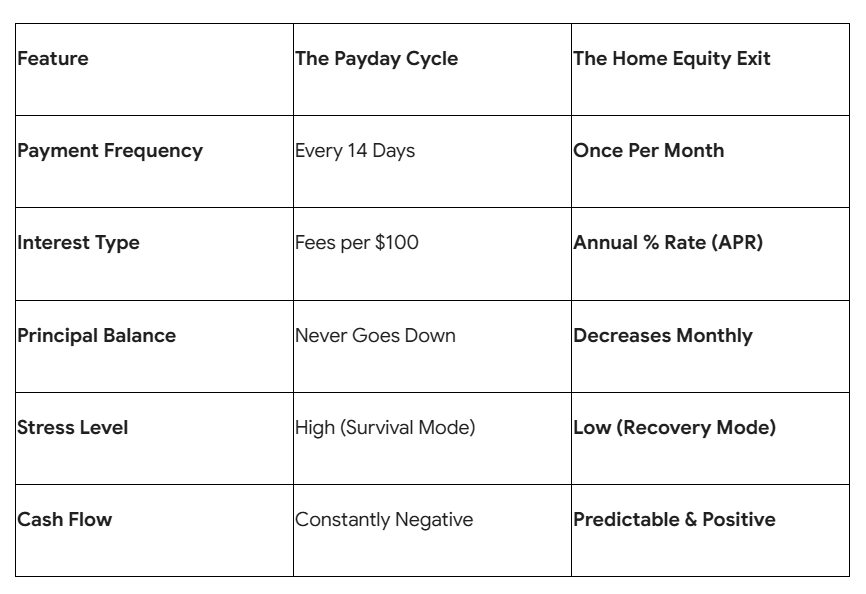
  • The Comparison: * Payday Loan: ~365% APR (due in 14 days).
  • Equity Loan: ~10% – 12% APR (due over 12–24 months).

4. The Direct Payout Method

To ensure you successfully break the cycle, LendingMoney.ca will facilitate a direct payout.

  • How it works: Instead of putting the money in your bank account (where a payday lender might try to grab it via a pre-authorized debit), the funds can be used to pay the lenders directly.
  • The Result: You wake up the next morning with zero payday debt. Your “Requirement to Pay” agreements are cancelled, and your paycheck is finally yours again.

5. Rebuild Your inancial Hero Score

Payday loans are “invisible” to your credit score when you pay them, but “poison” when you don’t. An equity loan from an alternative lender is different.

  • The Rehabilitation: By paying off the high-interest debt, your “Debt-to-Income” ratio improves instantly.
  • The Next Step: Once the payday “noise” is gone from your bank statements, you become a candidate for B-Lending and eventually A-Lending at much lower rates.

Transition Comparison (2026)
Your Home is Your Way Out

If you own a home in Ontario, you have a “Financial Hero” sitting in your driveway. There is no reason to pay 365% interest to a payday lender when you have equity available at a fraction of the cost.

Are you ready to stop the payday treadmill? [Request an Equity Rescue Analysis] from LendingMoney.ca today. Let’s use your home to buy back your paycheck.
Blogs Education Financial Recovery Mortgage Renewal Personal Finance

Payday vs. Installment Loan Costs

In 2026, the marketing around “fast cash” has become incredibly sophisticated. Big-name lenders like Money Mart are no longer just “payday” shops; they have aggressively pivoted into High-Cost Installment Loans.

While these might look like a better deal than a 14-day payday loan, the “Real Cost” over 12 to 36 months can be devastating to your long-term wealth. At LendingMoney.ca, we believe in Credit Rehabilitation, which means using the lowest cost of capital available to you-your home equity-to kill high-interest debt forever.

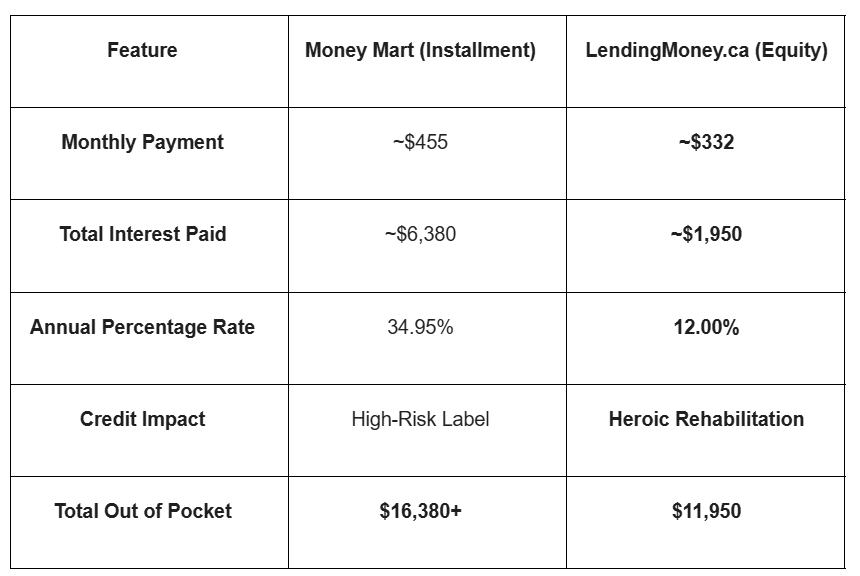
Here is the breakdown of the real cost between high-interest installments and an alternative equity-backed loan.

Payday vs. Installments vs. Equity: What’s the Real Cost?

When you’re in a financial pinch, lenders know you are focused on one number: the monthly payment. But the monthly payment is a mask. To see the true cost of a loan, you have to look at the Total Cost of Borrowing.

In 2026, the federal government has capped the criminal interest rate at 35% APR. While this sounds like a win for consumers, high-cost lenders have responded by adding “optional” insurance, administration fees, and longer terms to keep their profits high.

1. The Money Mart Installment Loan (35% APR + Fees)

If you borrow $10,000 from a high-cost installment lender in 2026 to consolidate your debts, your contract might look like this:

  • Interest Rate: ~34.95% APR
  • Term: 36 Months
  • Monthly Payment: ~$455.00
  • Optional Insurance: ~$92.00/month (often “highly recommended” for approval)

The Real Cost: After 3 years, you haven’t just paid back $10,000. You’ve paid back roughly $16,380 (or over $19,000 with insurance). You have effectively paid for your debt nearly twice.

2. The Payday Loan Treadmill (The 365% Trap)

If you skip the installment loan and go for a classic $500 payday loan:

  • The Fee: $14 per $100 borrowed ($70 fee).
  • The Cycle: Because you have to pay the full $570 back in 14 days, you likely have to borrow again to pay rent.
  • The Real Cost: If you “roll over” this debt for just six months, you will have paid over $900 in fees while still owing the original $500.

3. The LendingMoney.ca Alternative (9% – 15% APR)

Now, let’s look at using a Second Mortgage or Equity Loan to solve the same $10,000 problem:

  • Interest Rate: ~12% APR
  • Term: 36 Months (Amortized)
  • Monthly Payment: ~$332.00
  • Insurance/Hidden Fees: $0 (We focus on the equity in your home, not selling you add-ons).

The Real Cost: After 3 years, you’ve paid back $11,950.

2026 Cost Comparison: Borrowing $10,000

Why the Alternative Path Wins Every Time

The reason Money Mart’s costs are so high is that they are lending to thousands of people with no collateral. They expect many of them to fail, so you (the person who pays) have to cover the cost of those who don’t.

At LendingMoney.ca, we use your Home Equity as your “Financial Hero.” Because the loan is secured by your home, the risk is lower, which allows us to provide a rate that is one-third the cost of an unsecured installment loan.

The Hidden Danger of High-Interest Installments

In 2026, many banks see a “High-Interest Installment Loan” on a credit bureau as a sign of financial instability. Even if you pay it on time, it can actually make it harder to graduate to a traditional bank mortgage later. An equity-backed loan from LendingMoney.ca, however, shows you are a savvy homeowner using your assets strategically.

Stop Overpaying for Your Own Money

Every dollar you pay in 35% interest is a dollar taken away from your retirement, your children’s education, or your next home. If you own your home, you have already earned the right to lower interest rates.

Comparing a loan offer from Money Mart or another high-cost lender? [Upload Your Quote] to LendingMoney.ca for a “Real Cost Analysis.” Let us show you how much of your own money you can keep.

Read blog – Navigating Your Options: A Guide to Professional Debt Consolidation Services in Canada

Blogs Home Buying Mortgages Personal Finance

Strength in Numbers: How to Qualify for a Mortgage as a Single Parent in Canada (2026 Guide)

The dream of homeownership shouldn’t disappear just because you are a single parent. Whether you are starting over after a divorce or raising a family on your own, the path to a mortgage is often clearer than you think. While the “single income” challenge is real, Canada’s 2026 mortgage rules include several “boosters” specifically designed to help families succeed.

At LendingMoney.ca, we believe every family deserves a stable place to call home. Our “Hero” approach means we help you find the hidden income and special programs that traditional banks might overlook. Here is how to qualify for a mortgage as a single parent in 2026.

1. Unlock "Hidden" Qualifying Income

When a bank looks at your mortgage application, they calculate your Debt-to-Income (DTI) ratio. For a single parent, your salary is only one part of the equation. In 2026, lenders are more flexible than ever about what counts as “qualifying income.”

  • Canada Child Benefit (CCB): Most lenders now accept 100% of your CCB payments as qualifying income for children under the age of 15. This monthly “lifeline” can add thousands of dollars to your annual qualifying total.
  • Child Support & Spousal Support: If you have a written separation agreement or a court order, this support is considered stable income. Most lenders allow support payments to make up to 30–50% of your total qualifying income, provided you can show a history of consistent payments.
  • Boarder or Rental Income: If you are buying a home with a “mortgage helper” (a legal basement suite), you can often use 50–100% of the projected rental income to help you qualify for a larger mortgage.

2. Leverage New 2026 Government Incentives

The Canadian government has introduced several landmark measures in the Making Life More Affordable for Canadians Act (Bill C-4) that directly benefit single-parent households.

  • The First-Time Home Buyer GST Rebate: As of 2026, the GST is fully eliminated on new homes priced up to $1 million for first-time buyers. This can save you up to $50,000 on the purchase price of a new build—money that stays in your pocket for furniture or emergency savings.30-
  • Year Amortization: Single parents buying newly constructed homes can now qualify for 30-year mortgages (up from the traditional 25). This lower monthly payment makes it much easier to pass the “Stress Test” on a single income.
  • The “Second Chance” First-Time Buyer Rule: Even if you owned a home with your ex-spouse, you can qualify as a “first-time buyer” again if you have been living separate and apart for at least 90 days due to a relationship breakdown. This unlocks the Home Buyers’ Plan (HBP), allowing you to withdraw up to $60,000 tax-free from your RRSP.

3. The Power of "Home Start" and Low Down Payments

You don’t need a 20% down payment to buy a home. Through CMHC-insured mortgages, you can enter the market with as little as 5% down.

  • CMHC Home Start: This program is specifically designed to help families with a minimum credit score of 600. If your score took a dip during a separation, this program provides a realistic pathway back into homeownership without requiring a “perfect” 700+ score.
  • Flex Down Options: Some lenders allow you to use “non-traditional” sources for your down payment, such as a gift from a family member or even a personal loan, provided your credit and income are stable.

4. Tackle the "Stress Test" with Credit Rehabilitation

The biggest hurdle for single parents is the “Mortgage Stress Test,” which requires you to prove you could handle payments if interest rates were higher.

  • Consolidate Before You Apply: If you are carrying high-interest car loans or credit card debt, it eats into your “Total Debt Service” ratio. Using a LendingMoney.ca consolidation loan to pay off these small debts before applying for a mortgage can drastically increase the amount a mortgage lender will give you.
  • The “Hero” Strategy: By clearing $400/month in credit card payments through consolidation, you could potentially qualify for an additional $50,000 to $70,000 in mortgage principal.

5. Build Your "Professional Team"

Qualifying as a single parent requires a more nuanced approach than a standard application. You need experts who understand family law and alternative lending.

  • Mortgage Brokers: They have access to “B-Lenders” who are more flexible with child support and CCB income than the major banks.
  • Financial Heroes: At LendingMoney.ca, we help you bridge the gap by cleaning up your credit and consolidating debt so your mortgage application is “bank-ready.”

Final Thoughts: Your Family's New Chapter

Being a single parent takes incredible strength, and that same strength can build a financial foundation for your children. By combining government rebates, child-related tax benefits, and a smart credit rehabilitation strategy, the keys to your own front door are within reach.

Ready to see how much home you can actually afford? [Connect with a Financial Hero] at LendingMoney.ca and let’s build your path to homeownership today.

Blogs Credit & Debt Management Debt Consolidation Personal Finance

Navigating Your Options: A Guide to Professional Debt Consolidation Services in Canada

If you feel like you are drowning in monthly bills, you aren’t alone. Between rising living costs and high-interest credit card rates, many Canadians find themselves making only minimum payments that barely scratch the surface of their principal balance. When “doing it yourself” is no longer working, it’s time to look into professional debt consolidation services.

But what exactly are these services, and how do you choose the right one? At LendingMoney.ca, we provide a personalized approach to debt management that goes beyond just handing over a loan. We act as your financial partners, guiding you through the process of “Credit Rehabilitation.”

What are Debt Consolidation Services?

Debt consolidation services are professional programs designed to help you combine multiple high-interest debts – such as credit cards, retail store cards, and payday loans—into a single, more manageable monthly payment.

The goal is simple: lower your interest rates, simplify your life, and create a clear timeline to become debt-free.

Professional Help vs. DIY Consolidation

While you can try to consolidate on your own by applying for a new credit card or bank loan, professional services offer several key advantages:

  • Expert Adjudication: We look at your whole financial story, not just a computer-generated score.
  • Strategic Planning: We determine which debts are hurting your credit the most and prioritize them.
  • Direct Negotiation: We can often work directly with your creditors to ensure your transition is seamless.

The Different Paths to Consolidation

Not all debt consolidation services are the same. Depending on your credit score and the amount of debt you owe, a professional advisor might recommend one of the following paths:

1. Debt Consolidation Loans

This is a standard installment loan where a lump sum is used to pay off all your other creditors. You then pay back that one loan over a fixed term (usually 12 to 60 months). This is ideal if you have a stable income and want a predictable, no-surprise schedule.

2. Direct Creditor Payment Services

At LendingMoney.ca, we specialize in this. To take the stress off your shoulders, we can take the loan amount and pay your high-interest credit cards or collection accounts directly. This ensures the debt is cleared immediately without you having to manage the logistics.

3. Home Equity Consolidation

For homeowners, your house is your greatest financial tool. Professional services can help you tap into your home’s equity to secure a much lower interest rate than any personal loan could offer. This is often the most cost-effective way to handle large amounts of debt.

Why Use a Debt Consolidation Service Instead of a Bank?

Many Canadians head to their local bank first, only to be met with a “no” because of a past bankruptcy or a lower-than-average credit score.

Banks focus on your past; debt consolidation services focus on your future.

Professional alternative lenders like LendingMoney.ca use a proprietary “Credit Risk Model.” This means we look at your current cash flow and your commitment to a rehabilitation plan. We specialize in helping the “unbankable” get back into the good graces of the financial system.

How Our Debt Consolidation Service Rebuilds Your Credit

One of the biggest misconceptions is that debt consolidation services hurt your credit. In reality, a properly managed program is a powerful credit rehabilitation tool:

  • Lowering Credit Utilization: By paying off “maxed-out” credit cards, your utilization ratio drops instantly. This is the fastest way to see a “point jump” in your score.
  • On-Time Payment History: Payment history is the most influential factor in your credit score. Our service ensures you have one affordable payment that you can consistently make on time.
  • Bureau Reporting: We report your consistent payments to the major credit bureaus, proving to future lenders that you are a responsible borrower.

Is a Debt Consolidation Service Right for You?

Ask yourself these three questions:

  1. Are you paying more than 19% interest on your current debts?
  2. Are you struggling to keep track of multiple due dates and creditors?
  3. Is your credit score preventing you from qualifying for traditional bank products?

If you answered “yes” to any of these, a professional debt consolidation service can provide the “Hero” intervention you need.

The LendingMoney.ca Difference: No Jargon, Just Results

We know that talking about debt is stressful. That’s why we’ve designed our service to be as approachable as possible.

  • No Confusing Jargon: We speak your language. We explain the “why” behind every step.
  • Speed: Our application takes minutes, and we can often fund your loan or pay your creditors within 24 to 48 hours.
  • Human Support: You aren’t just a file number. Our team- including your “Financial Heroes” Alex and Hari – is here to guide your journey.

Stop the Stress and Start Your Journey Today

You don’t have to fight the debt battle alone. Professional debt consolidation services are designed to give you the breathing room you need to finally get ahead. By moving high-interest debt into a structured, lower-rate plan, you are making a permanent change to your financial health.

Ready to see what you qualify for? [Apply Now] and let LendingMoney.ca take the weight off your shoulders.

Read blog –

Blogs Credit Score Debt Relief Personal Finance

The Road Back: How to Rebuild Your Credit After Bankruptcy in Canada

Receiving your bankruptcy discharge is a major milestone. It’s the moment the legal weight of your past debts is lifted, giving you a clean slate to build upon. However, many Canadians feel a sense of “credit paralysis” after discharge, worried that their score will never recover or that they are permanently “blacklisted” from borrowing.

At LendingMoney.ca, we see bankruptcy as a reset button, not a life sentence. While the record of your bankruptcy will stay on your credit report for 6 to 7 years, your credit rehabilitation can—and should—begin the very same day you receive your discharge.

Here is your step-by-step roadmap to rebuilding a strong, healthy credit score in Canada.

1. Audit Your Post-Discharge Credit Report

The first thing you must do is ensure your “clean slate” is actually clean. Sometimes, creditors fail to update their records, and debts that were legally discharged still appear as “active” or “delinquent.”

  • Action Step: Request your free credit reports from Equifax Canada and TransUnion Canada.
  • What to Look For: Ensure every debt included in your bankruptcy is marked as “Discharged in Bankruptcy” and shows a $0 balance. If you see errors, dispute them immediately through the bureau’s website.

2. Start Small with a Secured Credit Card

You cannot build a credit score without active credit. Since traditional unsecured cards may be out of reach initially, a Secured Credit Card is the “Hero” tool of credit rebuilding.

  • How it Works: You provide a small security deposit (typically $500) to the lender, and they give you a credit card with a limit equal to that deposit.
  • The Strategy: Use this card only for small, fixed expenses—like your monthly phone bill or one grocery trip. Pay the balance in full and on time every month.
  • Why it Matters: These lenders report your on-time payments to the credit bureaus just like a regular card, proving to the system that you can manage credit responsibly again.

3. Layer in a Credit Builder Loan

Lenders like to see a “credit mix.” Having both a credit card (revolving credit) and an installment loan (fixed payments) shows a higher level of financial discipline.

  • The Credit Builder Model: Many specialized lenders in Canada offer “Credit Builder Loans.” Unlike a traditional loan where you get the money upfront, the lender holds the loan amount in a locked savings account while you make monthly payments.
  • The Reward: Once the loan is paid off, the money is released to you. More importantly, every single one of those payments was reported to the bureaus, significantly padding your positive payment history.

4. Master the "30% Rule" (Utilization)

Even if you have a low credit limit (like $500), you should never max it out. Your Credit Utilization Ratio—how much of your available credit you use—is a huge factor in your score.

  • The Goal: Keep your balance below 30% of your limit at all times. On a $500 card, that means never owing more than $150.
  • Pro Tip: Pay your card off multiple times a month. This ensures that when the credit bureau “snaps a photo” of your account, your balance looks low and controlled.

5. Automate Everything

After bankruptcy, a single missed payment can be devastating to your recovery. Your payment history is the single most important part of your score (35%).

  • Action Step: Set up pre-authorized debits for your cell phone, utilities, and your new secured credit card.
  • The Safety Net: Treat your “Due Date” as a hard deadline. Even if you only pay the minimum (though paying in full is better), an on-time payment keeps your momentum moving forward.

6. Avoid "Credit Repair" Scams

You may see ads promising to “erase bankruptcy” or “fix credit overnight” for a high fee.

  • The Truth: No one can legally remove accurate information from your credit report. Only time and consistent, positive behavior can rebuild your score.
  • Our Approach: At LendingMoney.ca, we don’t believe in “quick fixes.” We believe in Credit Rehabilitation—providing you with the real tools (loans and advice) that actually move the needle.

Your Rebuild Timeline: What to Expect

  • 0–6 Months: Focus on getting your first secured card and auditing your report.
  • 6–12 Months: Your score should begin to stabilize. This is a good time to add a second “tradeline” (like a small installment loan).
  • 12–24 Months: With a clean post-discharge history, you may begin qualifying for competitive car loans or even store-brand unsecured credit cards.

Final Thoughts: The Journey is Worth It

Rebuilding after bankruptcy is a marathon, not a sprint. Every on-time payment is a brick in the foundation of your new financial life. By being intentional and using the right tools, you can reach a 700+ credit score much faster than you think.

Are you ready to stop looking back and start building your future? [Apply for a Credit Rebuilding Plan] with LendingMoney.ca and let’s get your journey started.

Alternative Lending Solutions Blogs Ontario Real Estate Personal Finance

Ontario Newcomer Cost of Living 2026

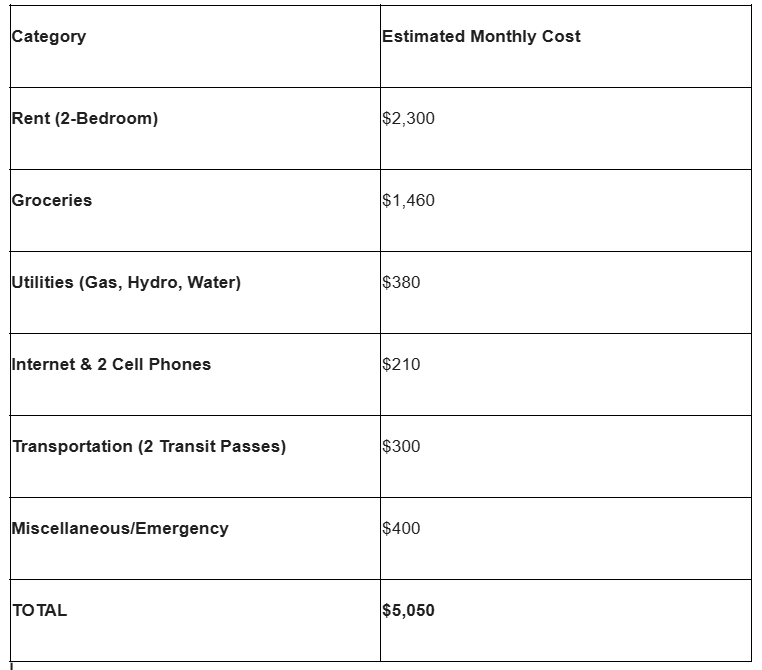
The dream of moving to Ontario is exciting, but in 2026, the Price of Admission requires a solid plan. While inflation has stabilized compared to the early 2020s, newcomers need to account for a new baseline in housing, groceries, and services.

At LendingMoney.ca, we believe that transparency is the best form of Credit Rehabilitation. If you know the numbers, you can build a budget that protects your credit score from day one. Here is the 2026 breakdown of what it costs to live in Ontario.

1. Housing: The Largest Piece of the Pie

In 2026, Ontario’s rental market has become slightly more balanced as new supply hits the market, but the GTA (Greater Toronto Area) remains a high-cost zone.

  • Average Rents (March 2026):
  • One-Bedroom Apartment: ~$1,850 – $1,900/month
  • Two-Bedroom Apartment: ~$2,250 – $2,350/month
  • The “Regional Hack”: Cities like St. Catharines or London offer one-bedroom units closer to $1,600, while Mississauga and Toronto often exceed $2,100 for the same space.
  • The Hero Move: Always factor in Tenant Insurance ($20–$30/month). Most landlords in 2026 require this before handing over the keys.

2. Groceries: The “Family of Four” Benchmark

Food prices in 2026 have seen a 4–6% increase over last year, driven by higher logistics and labor costs.

  • Monthly Grocery Bill:
  • Single Adult: ~$350 – $400/month
  • Family of Four: ~$1,460 – $1,500/month
  • 2026 Tip: Beef and fresh proteins have seen the highest jumps. Many newcomers find significant savings by shopping at “discount” banners like No Frills, FreshCo, or Food Basics rather than premium grocers.

3. Utilities & Connectivity

In 2026, your “Digital Life” is just as important as your physical one. Ontario utility costs are structured around “Time-of-Use” rates.

The Basic Bundle:

  • Electricity (Hydro): ~$90 – $110/month (varies by home size)
  • Heating (Natural Gas): ~$150 – $220/month (averaged across the year)
  • Water/Sewage: ~$90/month
  • High-Speed Internet: ~$65 – $80/month
  • The Hero Move: Use Ultra-Low Overnight (ULO) rates for laundry and dishwashing (after 11 PM) to drop your hydro bill by up to 20%.

4. Transportation: Moving Around the Province

If you live in a transit-hub like Toronto or Mississauga, you may not need a car immediately.

  • Public Transit: A monthly pass (TTC/MiWay) averages $140 – $160.
  • GO Transit: Shorter trips under 10km are now a flat $3.70 with a Presto card in 2026, a huge win for local commuters.
  • Car Ownership: If you buy a car, expect Insurance to be your biggest hurdle. Newcomers often pay $250 – $400/month for insurance until they build a Canadian driving record.

5. Childcare: The 2026 Ten Dollar Goal

One of the biggest financial reliefs for families arriving in 2026 is the progress of the National Child Care Plan.

  • The Goal: As of early 2026, the Ontario government has reached the target of $10-a-day average for licensed childcare spaces.
  • The Catch: Availability is the challenge. Licensed spots have long waiting lists. If you use unlicensed home daycare, you could still be looking at $40 – $60 per day.

Monthly Budget Estimate: Family of Four (2026)

Why Your Budget is Your Credit’s Best Friend

At LendingMoney.ca, we see it all the time: newcomers who didn’t account for the “winter gas bill” or the “car insurance premium” and end up using high-interest credit cards to fill the gap. This is the start of a debt cycle that hurts your credit score.

By understanding the true cost of living, you can set aside an emergency fund and ensure your Canadian credit journey is a success from the very first month.

Planning your move and need a financial roadmap? [Download our Newcomer Budget Planner] or connect with a Financial Hero at LendingMoney.ca today.

Read blog – Ontario’s Top 5 Newcomer Neighborhoods

Debt Management Debt Relief Personal Finance

The R7 Survival Guide: Navigating Travel Hotels and Rentals Without a Traditional Credit Card

When you file a Consumer Proposal, the immediate relief from debt is life-changing. But shortly after, the “R7 reality” sets in. In Canada, an R7 rating usually means you’ve surrendered your traditional credit cards.

Suddenly, the world feels a lot less “convenient.” You go to book a weekend getaway or rent a car for a business trip, and you hit a wall. “We require a major credit card for security,” the clerk says.

Does an R7 mean you’re grounded for the next few years? Not at all. At LendingMoney.ca, we help our clients navigate these exact “speed bumps.” Here is the reality of living with an R7 and the workarounds you need to stay mobile.

1. The Hotel Hard Line: Why Debit No Longer Cuts It

In years past, you might have found a hotel willing to take a cash or debit deposit. In 2026, those days are virtually over. Most major Canadian hotel brands (Marriott, Hilton, Delta, etc.) have moved to “Credit Only” policies for check-in.

The R7 Reality: Even if you have $5,000 in your bank account, the front desk computer is programmed to require a pre-authorization on a credit card.

  • The “No-Go” Scenario: You arrive after a long flight, show your ID and your Visa Debit card, and the clerk tells you they cannot “open the room” without a credit card on file. Without a card, you are literally locked out of your reservation, often with no refund.
  • Why they do it: A debit card is “real money,” but a credit card is a “guarantee.” Hotels need the ability to charge for damages discovered after you’ve checked out. Their systems are built to verify a credit line, not a bank balance.
  • The Survival Tip: This is where the Secured Credit Card becomes your most essential piece of luggage. Because it is a genuine Mastercard or Visa (not a “Prepaid” or “Debit” card), the hotel system recognizes it as a valid credit instrument. Without this tool, your R7 rating can turn a business trip into a travel nightmare.

2. Car Rentals: The Credit Card Gatekeeper

If you think hotels are strict, car rental agencies are the ultimate gatekeepers. To a rental company, you aren’t just a guest; you are a person driving away with a $40,000 piece of machinery.

The R7 Reality: While some local “off-brand” agencies might entertain a massive cash deposit, every major airport rental counter in Canada now mandates a major credit card in the driver’s name.

  • The “Denied” Rental: You can book and pay for a car online using a debit card, but when you stand at the counter to get the keys, they will ask for a credit card for the security hold. No credit card? No car. They will cancel your booking on the spot.
  • The Survival Tip: Don’t rely on “Visa Debit.” In 2026, rental systems are more sophisticated and can instantly detect that a card is linked to a bank account rather than a credit line. You must have a Secured Credit Card with an embossed name that matches your driver’s license.

3. The Prepaid Trap: Why It’s Not a Solution

Many people in a Consumer Proposal try to use “Prepaid” cards (like those you buy at a grocery store or a gas station).

The R7 Reality: These are almost universally rejected by hotels and car rentals.

  • The Reason: These cards lack a “Name” field and aren’t tied to a person’s identity. Since the hotel can’t “verify” the person holding the card, they won’t accept it for security.
  • The Hero Solution: At LendingMoney.ca, we emphasize getting a Named Secured Card. It looks, feels, and “swipes” exactly like a high-limit bank card. It bridges the gap between your R7 reality and the requirements of the modern world.

4. Why the Hold Still Matters (Even on Credit)

Even when you have a secured card, you have to be strategic.

  • The Math: If your secured card has a $500 limit and you use it to check into a hotel, they might put a $400 hold on it for the stay plus incidentals.
  • The Result: You now only have $100 left of “spendable” credit until you check out and that hold is released (which can take 3–5 days).
  • The Survival Tip: Always “over-fund” your secured card before a trip. If you know you’re traveling, increase your security deposit to $1,000 or $1,500 so you don’t find your card “Maxed Out” by a simple hotel hold.

5. The Hero Tool: The Branded Secured Credit Card

This is why we advocate for Credit Rehabilitation starting immediately after you file your proposal.

The R7 Reality: A “Prepaid” card (like a vanilla Visa gift card) will not work for hotels or car rentals because it doesn’t have your name embossed on it.

  • The Solution: You need a Secured Credit Card (like Neo or Capital One). Because these are technically “Real” Mastercards or Visas, they are accepted by 99% of hotels and car rental agencies.
  • The Benefit: Since you provide the deposit upfront, the bank isn’t taking a risk, but the merchant sees a “Major Credit Card.” It solves the “no-card” problem while simultaneously rebuilding your score.

6. Online Shopping and “Hidden” Fees

Living with an R7 in 2026 means becoming a master of the Visa Debit.

  • The Reality: Most online retailers (Amazon, Uber, SkipTheDishes) treat Visa/Mastercard Debit exactly like a credit card.
  • The Risk: Subscriptions. If you have an R7, you don’t have a “credit cushion.” If an automated subscription (like Netflix or a gym membership) hits your account when you’re low on funds, you’ll be hit with an NSF (Non-Sufficient Funds) fee from your bank—often $45 or more.
  • The Survival Tip: Use a separate “Bills” account. Keep your “Spending” money on your debit card and keep your “Bill” money in a secondary account that isn’t attached to your tap-to-pay.

7. Travel Insurance: The Missing Safety Net

Most people don’t realize that their old “Gold” or “Infinite” credit cards provided free travel and rental car insurance.

The R7 Reality: When you lose those cards, you lose the insurance. If you decline the “Loss Damage Waiver” at the car rental counter because you think your card covers it, you are uninsured.

  • The Survival Tip: You must buy the insurance at the counter or through a third-party provider like CAA. It adds $20–$30 a day to your trip, but with an R7, you cannot afford a $20,000 bill for a fender bender.

Why Survival is Only Temporary

Living with an R7 requires more planning, more cash-on-hand, and a bit more patience at the checkout counter. But remember: this is a phase of Credit Rehabilitation.

At LendingMoney.ca, we don’t just want you to “survive” your R7 years; we want you to use them to build a foundation. By using a secured card correctly and managing your debit account perfectly, you are proving to the world that you are ready for an R1 rating again.

Tired of the “No Credit Card” struggle? [Talk to a Financial Hero] at LendingMoney.ca. We’ll help you find the right secured tools to make your day-to-day life feel “normal” again.

Personal Finance

The Credit Shield: How to Protect Your Score During a Separation

In the middle of a separation, your focus is likely on legal fees, living arrangements, and your family’s well-being. However, there is a silent observer watching every move: the credit bureaus.

In 2026, the financial ties between couples are more digital and integrated than ever before. A single missed payment by an ex-partner on a joint card can drop your score by 100 points overnight, potentially locking you out of a new home or car exactly when you need them most.

At LendingMoney.ca, we believe that Credit Rehabilitation starts with a strong defense. Here is your step-by-step playbook to shielding your credit score during a separation.

1. The Audit Phase: Know What’s Joint

You cannot protect what you don’t know exists. Many couples have “ghost” accounts – store cards or old lines of credit they haven’t used in years.

  • Action Step: Download your free reports from both Equifax and TransUnion.
  • The Hunt: Look specifically for accounts labeled as “Joint,” “Co-Applicant,” or “Secondary Cardholder.”
  • The “Authorized User” Trap: Even if you aren’t a joint owner, being an “Authorized User” on your ex’s card can impact your score. If they max out the card, your Utilization Ratio will skyrocket.

2. Freeze and Close (The Clean Break)

A separation agreement is a contract between you and your spouse – it is not a contract between you and the bank.

  • The Reality: If your name is on a $20,000 Line of Credit, you are 100% liable for that debt, regardless of what your lawyer says.
  • The Move: Contact your lenders immediately to “freeze” joint lines of credit and credit cards so no new charges can be made.
  • The Goal: Work toward closing these accounts. If there is a balance, it must be paid off or moved to an Individual Consolidation Loan in one person’s name.

3. The Stay in Touch Strategy (For the Mortgage)

The biggest threat to your credit during separation is the mortgage.

  • The Problem: If your ex stays in the house and “forgets” to pay the mortgage for two months, your credit is ruined.
  • The Solution: Set up Account Alerts. Most Canadian banks in 2026 allow you to receive a text or email the moment a payment is made (or missed).
  • The Hero Move: If you see a payment is about to be missed, pay it yourself. It feels unfair to pay for a house you don’t live in, but it is much cheaper than trying to rebuild your credit after a foreclosure or “Notice of Default” hits your report.

4. Establish Solo Tradelines Immediately

If all your credit history was tied to your spouse, you might find yourself with a “Thin File” once the joint accounts are closed.

  • The Strategy: Apply for a small Individual Credit Card or a Secured Card in your name only.
  • Why it Matters: You need to show the bureaus that you are a stable, independent entity. Having your own history helps “dilute” the impact of any old joint accounts that might be dragging you down.

5. Add a Notice of Change to Your File

In Canada, you have the right to add a 100-word “Consumer Statement” to your Equifax and TransUnion reports.

  • The Statement: “I am currently going through a legal separation. All joint accounts are being addressed via a Separation Agreement. Please contact me directly for any new credit applications.”
  • The Benefit: While this doesn’t stop your score from dropping if a payment is missed, it alerts future lenders (like a car dealership or a landlord) that any recent “bruising” on your credit is due to a temporary life transition rather than chronic irresponsibility.

6. Update Your Address Everywhere

“I didn’t get the bill” is not a legal excuse for a late payment.

  • The Risk: Utility bills (hydro, water, internet) are often in one name but tied to the “family home.” If your ex moves out and stops paying the gas bill that’s in your name, you won’t know until a collection agency calls you at your new place.
  • The Move: Redirect your mail through Canada Post for at least 12 months and ensure every utility account is either closed or transferred to the person actually living in the property.

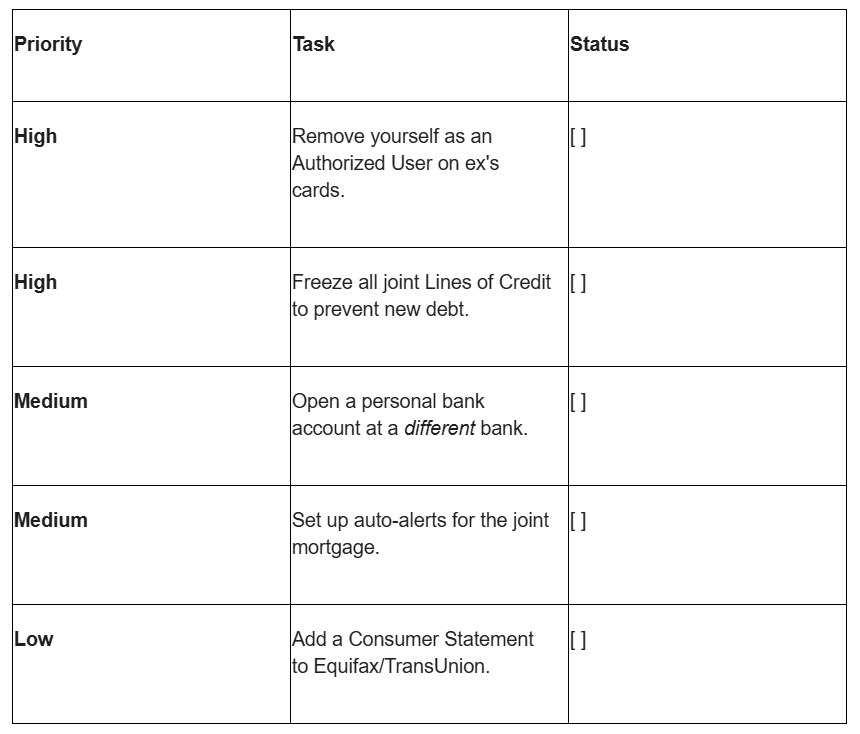
Separation Credit Checklist (2026)

Protecting Your Future

A separation is a transition, not a destination. By being proactive today, you ensure that when the dust settles, you have the credit score you need to buy a new home, start a business, or simply enjoy your financial independence.

Going through a transition and need to consolidate joint debt? [Talk to a Financial Hero] at LendingMoney.ca. We’ll help you untangle your finances and protect your score for the next chapter of your life.

Debt Management Personal Finance

Homeownership and Insolvency: How a Consumer Proposal Affects Your Mortgage

One of the biggest fears homeowners face when considering debt relief is: “Will I lose my house? The short answer is no. In fact, a Consumer Proposal is often the very tool that saves a home by freeing up the cash flow needed to keep the mortgage current. However, while you keep the house, the “R7” rating on your credit report changes the rules of the game when it comes time to renew or refinance. Here is how a Consumer Proposal affects your mortgage in 2026.

1. Existing Mortgages: Business as Usual

A Consumer Proposal only deals with unsecured debt (credit cards, lines of credit, tax debt). Your mortgage is a secured debt. As long as you continue to make your mortgage payments on time, your lender generally cannot cancel your mortgage just because you filed a proposal.

2. The Renewal Reality

When your mortgage term ends, you have to renew. Here is where the impact of a Consumer Proposal is felt:

  • Renewing with Your Current Lender: If your mortgage is in good standing (no missed payments), most major banks will offer you an “automatic renewal” without a new credit check. However, you likely won’t be able to negotiate for their best “promotional” rates.
  • Switching Lenders: This is the challenge. If you try to move your mortgage to a new bank to find a better rate, they will pull your credit. If they see an active Consumer Proposal, they will likely decline the application unless you have significant equity or move to an Alternative (B) Lender.

3. Refinancing to Pay Off the Proposal

Many homeowners use their house as a “hero tool.” If your home has increased in value, you can often refinance your mortgage to pull out equity and pay off your Consumer Proposal in one lump sum.

  • The Benefit: This gets you a “Certificate of Full Performance” immediately, which starts the 3-year clock to clear your credit report much sooner.
  • The 2026 Rule: Most lenders will require you to have at least 20% equity remaining in the home after the refinance.

4. Buying a New Home After a Proposal

Can you buy a house after filing a proposal? Yes.

  • While in the Proposal: You will likely need a 20% down payment and an alternative lender with higher interest rates.
  • After Completion: Most “A” Lenders (Big Banks) want to see that your proposal has been completed for at least 2 years, and that you have rebuilt your credit with at least two new “tradelines” (like a secured card and a small installment loan).

5. The Equity Trap

If you have a massive amount of equity in your home (e.g., you owe $200k on a $800k home), your creditors might notice. They may demand a higher monthly payment in your proposal because they know you have assets. A Licensed Insolvency Trustee will help you structure the proposal so it is fair to creditors while still being affordable for you.

Final Thoughts: Protecting Your Largest Asset

A Consumer Proposal is not a threat to your home; it is a shield. By legally settling your credit card debt for cents on the dollar, you ensure that your mortgage – and your family’s roof – remains the top priority.

Worried about an upcoming mortgage renewal? [Talk to LendingMoney.ca]. We specialize in the “B-Lending” market and can help you navigate your mortgage options while in a Consumer Proposal.