Blogs

What is a Power of Sale in Ontario? Your 2026 Emergency Guide

In Ontario, if you miss a mortgage payment, your lender doesn’t usually go to court to take your house (that’s foreclosure). Instead, they use a legal “shortcut” called Power of Sale.

This process allows the lender to sell your home to recover their money without needing a judge’s permission for the sale itself. Because it is faster and cheaper for the bank, it is the dominant way mortgages are enforced in Ontario. If you’ve received a “Notice of Sale,” the clock is already ticking. Here is the breakdown of the process.

1. The Timeline: How Fast Does It Move?

In 2026, lenders are moving quicker than ever to protect their capital. The transition from a “missed payment” to “losing the house” can happen in as little as 3 to 4 months.

  • Day 15 of Default: Once you are 15 days behind, the lender has the legal right to issue a Notice of Sale.
  • The 35-Day “Redemption Period”: This is your most critical window. By law, the lender must give you 35 days (40 if mailed) to “redeem” the mortgage.

Day 80+: If the redemption period ends and you haven’t paid, the lender can apply for a Writ of Possession. This is the document that allows the Sheriff to physically evict you and change the locks.

2. Power of Sale vs. Foreclosure: The Key Difference

Many people use these terms interchangeably, but they have a massive impact on your wallet.
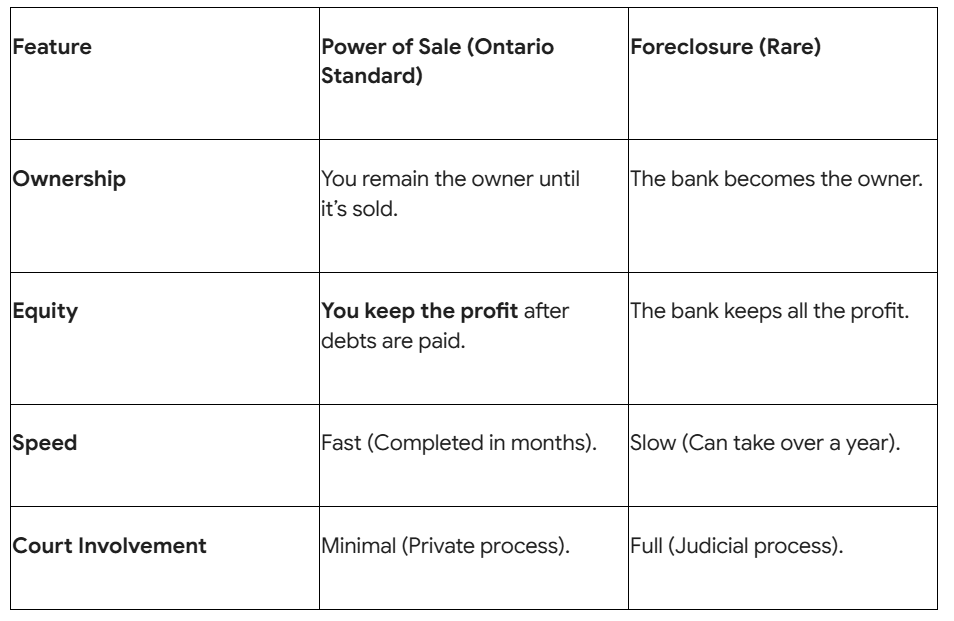
The Good News: In a Power of Sale, if your house sells for $800,000 and you only owe $500,000, the remaining $300,000 (minus fees) belongs to you.

3. The “Legal Fee” Snowball

The most dangerous part of a Power of Sale isn’t the interest, it’s the fees. In 2026, once a file is sent to the lender’s lawyer, the costs explode:

  • Lender’s Legal Fees: $2,500 – $7,000+
  • Appraisal Fees: $500 – $1,000
  • Property Inspection/Management: $1,000+
  • Realtor Commissions: 5% of the sale price.

If you owe $10,000 in arrears, by the time the house is listed, you might actually need $30,000 to stop the sale. Acting early is the only way to save your equity.

4. Can You Stop a Power of Sale?

Yes. Until the moment the lender signs a “Statement of Purchase and Sale” with a new buyer, you have the right to stop the process.

  • The “Cure”: You can pay the arrears and costs to bring the mortgage back into good standing.
  • The “Payoff”: You can pay the entire mortgage balance in full.
  • The 2026 Strategy: Most homeowners in this situation cannot get a loan from a big bank. At LendingMoney.ca, we provide Emergency Bridge Loans. We pay off the bank’s arrears and legal fees immediately, “voiding” the Power of Sale and giving you 12 months to breathe and refinance properly.

5. The Lender’s Duty of Care

In Ontario, the lender cannot simply “fire sale” your home to their cousin for $1. They have a legal duty to:

  • Get an Appraisal: They must determine the fair market value.
  • Market the Property: It must be listed on the MLS (Multiple Listing Service) to ensure the public can bid on it.
  • Act in Good Faith: If they sell it for significantly less than it’s worth, you can sue them for the difference.

Don’t Wait for the Sheriff

A Power of Sale is a legal process, but it is also a financial negotiation. If you have equity in your home, you have options. You can sell the home yourself (which is always cheaper than letting the bank do it), or you can refinance with an alternative lender like LendingMoney.ca.

Have you received a “Notice of Sale Under Mortgage”? [Upload Your Notice] for a free, confidential review. We’ll help you calculate your equity and find the “Hero Move” to save your home.

Blogs

The Head Start: How to Rebuild Your Credit During a Consumer Proposal

A common misconception in Canada is that you have to wait until you receive your “Certificate of Full Performance” to start fixing your credit score. Many people believe they are in a “financial penalty box” for the entire duration of their 5-year proposal.

The truth is much more exciting.

At LendingMoney.ca, we specialize in the “early rebuild.” While your Consumer Proposal is active and coded as an R7, you can – and should – begin layering in new, positive credit history. By the time you make your final proposal payment, you could already have 2–3 years of perfect “rehabilitated” history ready to show a mortgage lender.

Here is your 2026 playbook for rebuilding credit while still in a proposal.

1. The Clean Slate Audit

Before adding new credit, you must ensure the old “ghosts” aren’t haunting your report incorrectly.

  • Check the Coding: Ensure the debts included in your proposal are marked as “Included in Proposal” or “Settled” with an R7 rating. If a creditor is still reporting a debt as “Delinquent” or “R9” after your proposal was accepted, it’s a reporting error that is dragging your score down.
  • Dispute Errors Early: Don’t wait. Use the online dispute tools at Equifax and TransUnion to fix these clerical errors immediately.

2. Secure Your First Hero Tool: The Secured Card

Since your old credit cards were cancelled when you filed, you need a new “tradeline” to prove you can handle credit again.

  • Instant Approval Options: In 2026, cards like the Secured Neo Mastercard or the Capital One Guaranteed Mastercard are the gold standard for people in active proposals. They often require as little as a $50 deposit and don’t require a hard credit check.
  • The Strategy: Use the card for one small, recurring monthly bill (like your internet or a streaming service) and set up an auto-payment to pay it in full every month.
  • The Goal: You want the credit bureau to see 12 consecutive months of “Paid as Agreed” status while your proposal is still running.

3. Layer in a Credit Builder Loan

Lenders love “Credit Mix.” If you only have a credit card, your score will plateau. Adding a Credit Builder Loan is the perfect secondary move.

  • How it works: You make a small monthly payment (e.g., $50) into a locked savings account. The lender reports this as a “loan payment” to the bureaus. At the end of the term, you get the cash back.
  • The “Double Win”: Not only are you rebuilding your score, but you are also building an emergency fund that you can use to pay off your Consumer Proposal early (see Step 5).

4. Master the “10/30 Rule”

During a proposal, your total available credit will be low (likely just your $500 secured card). This makes it very easy to accidentally “max out” your utilization.

  • The Rule: Never let your balance exceed 30% of your limit. However, if you want “Hero” results, keep it under 10%.
  • Example: On a $500 card, keep your reported balance under $50. This tells the credit bureau’s algorithm that you have access to credit but don’t need it to survive.

5. The Accelerator Strategy: Finishing Early

The 3-year clock for a Consumer Proposal to drop off your credit report only starts after your final payment.

  • Lump-Sum Power: If you receive a tax refund, a bonus, or use the savings from your Credit Builder Loan (Step 3), you can pay off the remainder of your proposal at any time with no penalty.
  • Why this matters: If you finish a 5-year proposal in 2 years, the “R7” mark will disappear from your record 3 years sooner. This is the fastest way to get back to “A-Lender” mortgage rates.

6. Don’t Let the Small Stuff Slip

While you are hyper-focused on your proposal payments, don’t forget the bills that don’t usually show up on your credit report – until they go wrong.

  • Cell Phones & Utilities: In Ontario, a missed Rogers or Bell bill can be sent to collections, creating a brand new “R9” hit that will reset your progress.
  • Parking Tickets & Fines: These can eventually trigger “Government Collections” which look terrible to mortgage lenders. Stay current on everything.

Why Start Now?

At LendingMoney.ca, we see the difference between clients who wait and clients who rebuild. A client who starts rebuilding during their proposal is often “Mortgage Ready” the very day they get their completion certificate. A client who waits has to start that 2-year rebuilding process from scratch.

Don’t spend 5 years in a financial shadow. You’ve already taken the brave step of filing a proposal -now take the smart step of rehabilitating your future.

Ready to find the right credit-building tools for your specific situation? [Connect with a Financial Hero] at LendingMoney.ca today.

Blogs

The Lending Spectrum: B Lenders (Trust Companies) vs. Alternative Lenders

When a “Big Six” bank says no, most Canadians assume their only remaining option is a high-interest private loan. However, there is a massive middle ground occupied by B Lenders and Alternative Lenders.

While both are “alternatives” to traditional banks, they serve very different purposes. At LendingMoney.ca, we want you to understand exactly where you fit on this spectrum so you can choose the right tool for your financial recovery.

1. What is a B Lender ? (The Trust Company)

B Lenders are essentially “Bank-Lite.” They are federally or provincially regulated financial institutions, often including Trust Companies (like Home Trust or Community Trust) and specialized banks (like Equitable Bank).

  • Who they are for: The Near-Prime borrower. You have a decent job and a decent house, but maybe your credit score is 600 instead of 700, or you are self-employed and can’t prove every dollar of income.
  • The 2026 Rules: B Lenders are still heavily regulated. While they are more flexible than the Big Six, they still have strict boxes you must fit into regarding your debt-to-income ratios.
  • The Rates: They offer a “middle-ground” rate—usually 1% to 2% higher than a standard bank rate.

The Catch: They almost always require a 20% down payment because they do not offer CMHC-insured mortgages.

2. What is an Alternative Lender ? (LendingMoney.ca)

An Alternative Lender is a non-institutional provider of capital. We aren’t bound by the same rigid “stress tests” or federal “Capital Adequacy” rules that govern banks and trust companies.

  • Who we are for: The “Big Picture” borrower. You might be in a Consumer Proposal, recovering from a bankruptcy, or dealing with an “unconventional” property that an institution won’t touch.
  • The Flexibility: We don’t just look at a credit score. We look at equity, cash flow, and your plan for the future. If you have a solid Exit Strategy (a plan to get back to a bank in 1–2 years), we can provide the funding that institutions won’t
  • The Speed: Because we don’t have layers of institutional committees, we can move at lightning speed—often funding a deal in 24 to 48 hours.

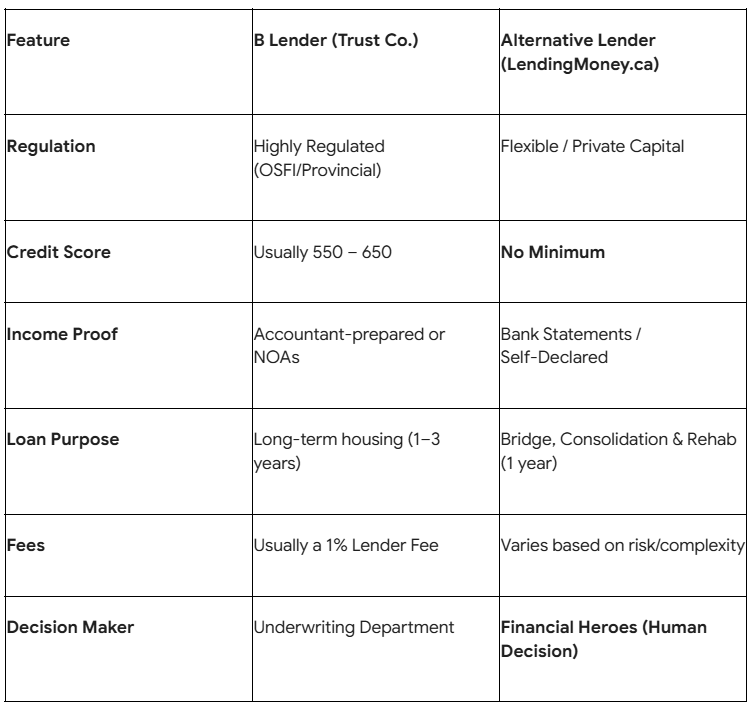
Key Differences at a Glance (2026)

3. Why the B Lender Might Still Say No

In 2026, even B Lenders have become more cautious. Because they are “Deposit-Taking” institutions, they have to answer to regulators about the “quality” of their mortgage book.

If you have active collections, an un-discharged bankruptcy, or significant CRA debt, a B Lender Trust Company will likely still decline your application. They want “bruised” credit, not “broken” credit.

4. The LendingMoney.ca Bridge Strategy

This is where we come in. We don’t compete with B Lenders; we prepare you for them.

Most of our clients use our Alternative Lending solutions as a 12-month bridge.

  1. We provide the funds to pay off the collections, settle the CRA debt, or buy out the Consumer Proposal.
  2. While you are with us, we implement your Credit Rehabilitation plan.
  3. After 12 months, your “broken” credit has become “bruised” (or better), and we “graduate” you to a B Lender or even back to an A Lender bank.

Which One Do You Need?

  • Choose a B Lender if your credit is “okay” and you just need a bit more flexibility on your income proof than the Big Six allows.
  • Choose an Alternative Lender (LendingMoney.ca) if you need speed, have a complex situation, or need a financial “reset” to clear old debts before you can qualify anywhere else.

Still not sure which “box” you fit into? [Talk to a Financial Hero] at LendingMoney.ca. We’ll analyze your situation and tell you exactly which lender is the right stepping stone for your journey.

Blogs

The 2026 Mortgage Renewal Guide: How to Beat “Payment Shock”

If you bought or refinanced your home in 2021, you likely enjoyed some of the lowest interest rates in Canadian history—some as low as 1.5% to 2%. As you approach your 2026 renewal, the landscape has changed. With the Bank of Canada holding its policy rate at 2.25% and fixed rates averaging between 4% and 5%, most homeowners are facing a monthly payment increase of 15% to 25%.

At LendingMoney.ca, we don’t want you to just “sign and send” your renewal papers. We want you to use this moment to optimize your entire financial life. Here is the 2026 guide to winning your renewal.

1. The Reality of the “2026 Payment Jump”

For a typical $500,000 mortgage, jumping from a 1.99% rate to a 4.79% rate means your monthly payment will climb by roughly $700 per month.

  • The “Auto-Renewal” Trap: Your bank will send you a letter about 21 days before your term ends. It will likely offer you their “posted rate,” which is often 0.5% higher than what you could get by shopping around. Never sign the first offer.
  • The “Stress Test” Myth: If you stay with your current lender, you do not have to re-qualify or pass the stress test. However, if you want to switch lenders to find a better rate, you may need to pass the 7.25% stress test.

2. Strategy: The 120-Day “Rate Hold”

In 2026, volatility is the only constant.

  • The Move: Start shopping four months before your renewal date. Most lenders (and all Financial Heroes at LendingMoney.ca) can lock in a rate for you for 120 days.
  • The Win: If rates go up before your renewal, you are protected at the lower locked-in rate. If rates go down, you can simply take the new, lower market rate. It’s a “no-lose” strategy.

3. Extending Amortization: The Cash-Flow Lifesaver

If the new 2026 payments are going to break your household budget, you have a powerful lever: Amortization.

  • The Pivot: If you originally had a 25-year mortgage and you are 5 years in, your remaining amortization is 20 years. At renewal, you can often “stretch” that back out to 25 or even 30 years.
  • The Result: While this increases the total interest you pay over the life of the loan, it can drop your monthly payment by $300 to $500, giving your family the breathing room you need to stay stable.

4. The “Consolidation Renewal” (Credit Rehab Move)

This is the most popular strategy at LendingMoney.ca in 2026. If you are renewing your mortgage but also carrying $30,000 in credit card debt at 22%, you are fighting a losing battle.

  • The Move: Instead of a “Straight Renewal,” do a Refinance Renewal. Roll that high-interest debt into your new mortgage.
  • The Result: Even if your mortgage rate goes up to 5%, you are still “killing” 22% debt. Your total monthly outflow for all debts will likely decrease, and your credit score will skyrocket as your utilization drops to zero.

5. New 2026 Rules for Investors (OSFI Changes)

If you are renewing a mortgage on a rental property, be prepared for new scrutiny.

  • The “Independent Qualification” Rule: As of January 2026, OSFI requires that rental properties “stand on their own” for qualification if you switch lenders.

The Catch: If your rental isn’t generating enough cash flow to cover the new, higher interest rates, you may be “trapped” with your current lender. This makes it even more important to have a clean credit profile before your renewal date.

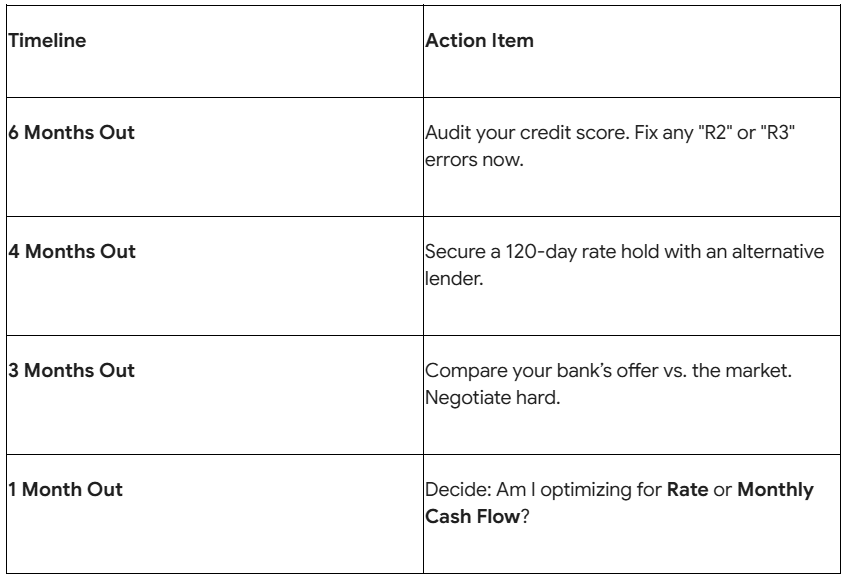
Your 2026 Renewal Checklist

Why Renew with LendingMoney.ca?

The big banks see renewal as an automated process. We see it as a financial reset. Whether you need to extend your amortization to save your budget or consolidate debt to save your credit, we are the alternative lending partnership to make it happen.

Is your renewal notice arriving soon? [Upload Your Renewal Offer] to LendingMoney.ca and let our Financial Heroes find you a better deal.

Blogs

Breaking the Streak: How to Rebuild Your Credit After Online Gambling Addiction

Recovering from an online gambling addiction is a double-sided battle. On one side is the emotional recovery—the work done through counseling and support groups. On the other side is the financial recovery—the daunting task of looking at maxed-out credit cards, payday loans, and a damaged credit score.

At LendingMoney.ca, we don’t look at where you’ve been; we look at where you are going. If you are in recovery and ready to stabilize your finances, you are making the most important bet of your life: a bet on yourself. Here is your step-by-step guide to fixing your credit and reclaiming your financial future in Canada.

1. Safety First: Install Financial "Guardrails"

Before you can fix your credit, you must ensure that your recovery is protected. The credit bureaus don’t see “gambling” on your report, but they do see the late payments and high utilization that often follow.

  • Self-Exclusion: Ensure you are registered for provincial self-exclusion programs (like iGaming Ontario or BCLC’s GameSense). This is your first line of defense.
  • Banking Blocks: Most major Canadian banks now allow you to toggle off “Gambling Transactions” within their mobile apps. Turn this on immediately.
  • The Two-Signature Rule: If you have a trusted partner or family member, consider moving your savings into an account that requires two signatures for withdrawals. This adds a “pause” button to impulsive decisions.

2. Face the Numbers (The Credit Audit)

The “fear of the mailbox” is real during recovery. However, you cannot fix what you do not measure.

  • Action Step: Download your free reports from Equifax and TransUnion.
  • Identify the Damage: Are there accounts in collections? How many payday loans are active? Payday loans are particularly damaging because they often don’t help your score when paid on time, but they ruin it if they go to collections.
  • Add a “Notice of Correction”: You can actually add a short statement to your credit file. Some people in recovery add a note asking lenders not to approve new credit applications to help prevent a relapse.

3. The Payday Loan "Pivot"

Online gambling often leads to a cycle of high-interest payday loans. These are the “kryptonite” of your credit score.

  • The Problem: Payday loans carry interest rates equivalent to 300%–500% APR. They are designed to keep you in debt.
  • The Hero Strategy: Consolidate these small, high-interest “fires” into a single, lower-interest installment loan. At LendingMoney.ca, we specialize in this “Pivot.” By moving from a payday loan to a structured installment loan, you stop the interest bleed and start reporting positive payment history to the bureaus every month.

4. Rebuild with "Micro-Victories"

Once your high-interest debt is stabilized, you need to start feeding the credit bureaus positive data.

  • The Secured Card Strategy: If your score is too low for a standard card, get a Secured Credit Card. Put a small deposit down (e.g., $200), and use it only for a fixed, recurring cost like your Netflix subscription.
  • The 30% Utilization Rule: Never let the balance on that card exceed $60. Low utilization combined with on-time payments is the fastest way to “rehabilitate” a score.

5. Address Collections Strategically

If your gambling led to accounts being sold to collection agencies, don’t panic.

  • Verify the Debt: Ensure the amount is correct.
  • Pay vs. Settle: Paying a collection in full looks better than settling for a partial amount, but both are better than leaving it active. Once a collection is “Paid,” its negative impact on your score begins to diminish over time.
  • Keep the Paperwork: Always get a “Release Letter” or “Letter of Satisfaction” once a debt is paid.

6. Focus on "Total Debt Service"

If you are aiming for a major goal—like a car or a home—lenders will look at your Debt-to-Income (DTI) ratio. Even if your credit score is still recovering, showing a steady decrease in your total debt over 6 to 12 months proves you have changed your financial behavior.

This “trended data” is what helps alternative lenders like us say “Yes” when a big bank says “No.”

Final Thoughts: You Are More Than Your Score

Recovery is a marathon. A credit score that took months to drop may take a year to climb back up, but every month of on-time payments is a victory. At LendingMoney.ca, we respect the hard work it takes to overcome addiction. We are here to provide the professional financial tools—not judgment—that you need to turn the page.

Ready to take control of your story? [Apply for a Consolidation Loan] today and let’s start your credit rehabilitation together.

Blogs

Strength in Numbers: How to Qualify for a Mortgage as a Single Parent in Canada (2026 Guide)

The dream of homeownership shouldn’t disappear just because you are a single parent. Whether you are starting over after a divorce or raising a family on your own, the path to a mortgage is often clearer than you think. While the “single income” challenge is real, Canada’s 2026 mortgage rules include several “boosters” specifically designed to help families succeed.

At LendingMoney.ca, we believe every family deserves a stable place to call home. Our “Hero” approach means we help you find the hidden income and special programs that traditional banks might overlook. Here is how to qualify for a mortgage as a single parent in 2026.

1. Unlock "Hidden" Qualifying Income

When a bank looks at your mortgage application, they calculate your Debt-to-Income (DTI) ratio. For a single parent, your salary is only one part of the equation. In 2026, lenders are more flexible than ever about what counts as “qualifying income.”

  • Canada Child Benefit (CCB): Most lenders now accept 100% of your CCB payments as qualifying income for children under the age of 15. This monthly “lifeline” can add thousands of dollars to your annual qualifying total.
  • Child Support & Spousal Support: If you have a written separation agreement or a court order, this support is considered stable income. Most lenders allow support payments to make up to 30–50% of your total qualifying income, provided you can show a history of consistent payments.
  • Boarder or Rental Income: If you are buying a home with a “mortgage helper” (a legal basement suite), you can often use 50–100% of the projected rental income to help you qualify for a larger mortgage.

2. Leverage New 2026 Government Incentives

The Canadian government has introduced several landmark measures in the Making Life More Affordable for Canadians Act (Bill C-4) that directly benefit single-parent households.

  • The First-Time Home Buyer GST Rebate: As of 2026, the GST is fully eliminated on new homes priced up to $1 million for first-time buyers. This can save you up to $50,000 on the purchase price of a new build—money that stays in your pocket for furniture or emergency savings.30-
  • Year Amortization: Single parents buying newly constructed homes can now qualify for 30-year mortgages (up from the traditional 25). This lower monthly payment makes it much easier to pass the “Stress Test” on a single income.
  • The “Second Chance” First-Time Buyer Rule: Even if you owned a home with your ex-spouse, you can qualify as a “first-time buyer” again if you have been living separate and apart for at least 90 days due to a relationship breakdown. This unlocks the Home Buyers’ Plan (HBP), allowing you to withdraw up to $60,000 tax-free from your RRSP.

3. The Power of "Home Start" and Low Down Payments

You don’t need a 20% down payment to buy a home. Through CMHC-insured mortgages, you can enter the market with as little as 5% down.

  • CMHC Home Start: This program is specifically designed to help families with a minimum credit score of 600. If your score took a dip during a separation, this program provides a realistic pathway back into homeownership without requiring a “perfect” 700+ score.
  • Flex Down Options: Some lenders allow you to use “non-traditional” sources for your down payment, such as a gift from a family member or even a personal loan, provided your credit and income are stable.

4. Tackle the "Stress Test" with Credit Rehabilitation

The biggest hurdle for single parents is the “Mortgage Stress Test,” which requires you to prove you could handle payments if interest rates were higher.

  • Consolidate Before You Apply: If you are carrying high-interest car loans or credit card debt, it eats into your “Total Debt Service” ratio. Using a LendingMoney.ca consolidation loan to pay off these small debts before applying for a mortgage can drastically increase the amount a mortgage lender will give you.
  • The “Hero” Strategy: By clearing $400/month in credit card payments through consolidation, you could potentially qualify for an additional $50,000 to $70,000 in mortgage principal.

5. Build Your "Professional Team"

Qualifying as a single parent requires a more nuanced approach than a standard application. You need experts who understand family law and alternative lending.

  • Mortgage Brokers: They have access to “B-Lenders” who are more flexible with child support and CCB income than the major banks.
  • Financial Heroes: At LendingMoney.ca, we help you bridge the gap by cleaning up your credit and consolidating debt so your mortgage application is “bank-ready.”

Final Thoughts: Your Family's New Chapter

Being a single parent takes incredible strength, and that same strength can build a financial foundation for your children. By combining government rebates, child-related tax benefits, and a smart credit rehabilitation strategy, the keys to your own front door are within reach.

Ready to see how much home you can actually afford? [Connect with a Financial Hero] at LendingMoney.ca and let’s build your path to homeownership today.

Blogs

The Road Back: How to Rebuild Your Credit After Bankruptcy in Canada

Receiving your bankruptcy discharge is a major milestone. It’s the moment the legal weight of your past debts is lifted, giving you a clean slate to build upon. However, many Canadians feel a sense of “credit paralysis” after discharge, worried that their score will never recover or that they are permanently “blacklisted” from borrowing.

At LendingMoney.ca, we see bankruptcy as a reset button, not a life sentence. While the record of your bankruptcy will stay on your credit report for 6 to 7 years, your credit rehabilitation can—and should—begin the very same day you receive your discharge.

Here is your step-by-step roadmap to rebuilding a strong, healthy credit score in Canada.

1. Audit Your Post-Discharge Credit Report

The first thing you must do is ensure your “clean slate” is actually clean. Sometimes, creditors fail to update their records, and debts that were legally discharged still appear as “active” or “delinquent.”

  • Action Step: Request your free credit reports from Equifax Canada and TransUnion Canada.
  • What to Look For: Ensure every debt included in your bankruptcy is marked as “Discharged in Bankruptcy” and shows a $0 balance. If you see errors, dispute them immediately through the bureau’s website.

2. Start Small with a Secured Credit Card

You cannot build a credit score without active credit. Since traditional unsecured cards may be out of reach initially, a Secured Credit Card is the “Hero” tool of credit rebuilding.

  • How it Works: You provide a small security deposit (typically $500) to the lender, and they give you a credit card with a limit equal to that deposit.
  • The Strategy: Use this card only for small, fixed expenses—like your monthly phone bill or one grocery trip. Pay the balance in full and on time every month.
  • Why it Matters: These lenders report your on-time payments to the credit bureaus just like a regular card, proving to the system that you can manage credit responsibly again.

3. Layer in a Credit Builder Loan

Lenders like to see a “credit mix.” Having both a credit card (revolving credit) and an installment loan (fixed payments) shows a higher level of financial discipline.

  • The Credit Builder Model: Many specialized lenders in Canada offer “Credit Builder Loans.” Unlike a traditional loan where you get the money upfront, the lender holds the loan amount in a locked savings account while you make monthly payments.
  • The Reward: Once the loan is paid off, the money is released to you. More importantly, every single one of those payments was reported to the bureaus, significantly padding your positive payment history.

4. Master the "30% Rule" (Utilization)

Even if you have a low credit limit (like $500), you should never max it out. Your Credit Utilization Ratio—how much of your available credit you use—is a huge factor in your score.

  • The Goal: Keep your balance below 30% of your limit at all times. On a $500 card, that means never owing more than $150.
  • Pro Tip: Pay your card off multiple times a month. This ensures that when the credit bureau “snaps a photo” of your account, your balance looks low and controlled.

5. Automate Everything

After bankruptcy, a single missed payment can be devastating to your recovery. Your payment history is the single most important part of your score (35%).

  • Action Step: Set up pre-authorized debits for your cell phone, utilities, and your new secured credit card.
  • The Safety Net: Treat your “Due Date” as a hard deadline. Even if you only pay the minimum (though paying in full is better), an on-time payment keeps your momentum moving forward.

6. Avoid "Credit Repair" Scams

You may see ads promising to “erase bankruptcy” or “fix credit overnight” for a high fee.

  • The Truth: No one can legally remove accurate information from your credit report. Only time and consistent, positive behavior can rebuild your score.
  • Our Approach: At LendingMoney.ca, we don’t believe in “quick fixes.” We believe in Credit Rehabilitation—providing you with the real tools (loans and advice) that actually move the needle.

Your Rebuild Timeline: What to Expect

  • 0–6 Months: Focus on getting your first secured card and auditing your report.
  • 6–12 Months: Your score should begin to stabilize. This is a good time to add a second “tradeline” (like a small installment loan).
  • 12–24 Months: With a clean post-discharge history, you may begin qualifying for competitive car loans or even store-brand unsecured credit cards.

Final Thoughts: The Journey is Worth It

Rebuilding after bankruptcy is a marathon, not a sprint. Every on-time payment is a brick in the foundation of your new financial life. By being intentional and using the right tools, you can reach a 700+ credit score much faster than you think.

Are you ready to stop looking back and start building your future? [Apply for a Credit Rebuilding Plan] with LendingMoney.ca and let’s get your journey started.