
Blogs

The Lending Spectrum: B Lenders (Trust Companies) vs. Alternative Lenders

When a “Big Six” bank says no, most Canadians assume their only remaining option is a high-interest private loan. However, there is a massive middle ground occupied by B Lenders and Alternative Lenders.

While both are “alternatives” to traditional banks, they serve very different purposes. At LendingMoney.ca, we want you to understand exactly where you fit on this spectrum so you can choose the right tool for your financial recovery.

1. What is a B Lender ? (The Trust Company)

B Lenders are essentially “Bank-Lite.” They are federally or provincially regulated financial institutions, often including Trust Companies (like Home Trust or Community Trust) and specialized banks (like Equitable Bank).

  • Who they are for: The Near-Prime borrower. You have a decent job and a decent house, but maybe your credit score is 600 instead of 700, or you are self-employed and can’t prove every dollar of income.
  • The 2026 Rules: B Lenders are still heavily regulated. While they are more flexible than the Big Six, they still have strict boxes you must fit into regarding your debt-to-income ratios.
  • The Rates: They offer a “middle-ground” rate—usually 1% to 2% higher than a standard bank rate.

The Catch: They almost always require a 20% down payment because they do not offer CMHC-insured mortgages.

2. What is an Alternative Lender ? (LendingMoney.ca)

An Alternative Lender is a non-institutional provider of capital. We aren’t bound by the same rigid “stress tests” or federal “Capital Adequacy” rules that govern banks and trust companies.

  • Who we are for: The “Big Picture” borrower. You might be in a Consumer Proposal, recovering from a bankruptcy, or dealing with an “unconventional” property that an institution won’t touch.
  • The Flexibility: We don’t just look at a credit score. We look at equity, cash flow, and your plan for the future. If you have a solid Exit Strategy (a plan to get back to a bank in 1–2 years), we can provide the funding that institutions won’t
  • The Speed: Because we don’t have layers of institutional committees, we can move at lightning speed—often funding a deal in 24 to 48 hours.

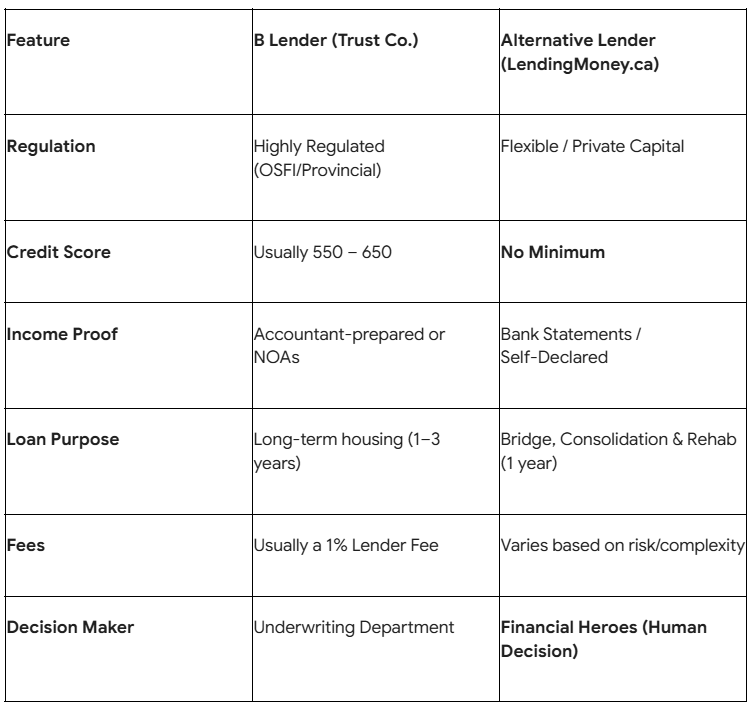
Key Differences at a Glance (2026)
3. Why the B Lender Might Still Say No

In 2026, even B Lenders have become more cautious. Because they are “Deposit-Taking” institutions, they have to answer to regulators about the “quality” of their mortgage book.

If you have active collections, an un-discharged bankruptcy, or significant CRA debt, a B Lender Trust Company will likely still decline your application. They want “bruised” credit, not “broken” credit.

4. The LendingMoney.ca Bridge Strategy

This is where we come in. We don’t compete with B Lenders; we prepare you for them.

Most of our clients use our Alternative Lending solutions as a 12-month bridge.

  1. We provide the funds to pay off the collections, settle the CRA debt, or buy out the Consumer Proposal.
  2. While you are with us, we implement your Credit Rehabilitation plan.
  3. After 12 months, your “broken” credit has become “bruised” (or better), and we “graduate” you to a B Lender or even back to an A Lender bank.

Which One Do You Need?

  • Choose a B Lender if your credit is “okay” and you just need a bit more flexibility on your income proof than the Big Six allows.
  • Choose an Alternative Lender (LendingMoney.ca) if you need speed, have a complex situation, or need a financial “reset” to clear old debts before you can qualify anywhere else.

Still not sure which “box” you fit into? [Talk to a Financial Hero] at LendingMoney.ca. We’ll analyze your situation and tell you exactly which lender is the right stepping stone for your journey.
Blogs

The 2026 Mortgage Renewal Guide: How to Beat “Payment Shock”

If you bought or refinanced your home in 2021, you likely enjoyed some of the lowest interest rates in Canadian history—some as low as 1.5% to 2%. As you approach your 2026 renewal, the landscape has changed. With the Bank of Canada holding its policy rate at 2.25% and fixed rates averaging between 4% and 5%, most homeowners are facing a monthly payment increase of 15% to 25%.

At LendingMoney.ca, we don’t want you to just “sign and send” your renewal papers. We want you to use this moment to optimize your entire financial life. Here is the 2026 guide to winning your renewal.

1. The Reality of the “2026 Payment Jump”

For a typical $500,000 mortgage, jumping from a 1.99% rate to a 4.79% rate means your monthly payment will climb by roughly $700 per month.

  • The “Auto-Renewal” Trap: Your bank will send you a letter about 21 days before your term ends. It will likely offer you their “posted rate,” which is often 0.5% higher than what you could get by shopping around. Never sign the first offer.
  • The “Stress Test” Myth: If you stay with your current lender, you do not have to re-qualify or pass the stress test. However, if you want to switch lenders to find a better rate, you may need to pass the 7.25% stress test.

2. Strategy: The 120-Day “Rate Hold”

In 2026, volatility is the only constant.

  • The Move: Start shopping four months before your renewal date. Most lenders (and all Financial Heroes at LendingMoney.ca) can lock in a rate for you for 120 days.
  • The Win: If rates go up before your renewal, you are protected at the lower locked-in rate. If rates go down, you can simply take the new, lower market rate. It’s a “no-lose” strategy.

3. Extending Amortization: The Cash-Flow Lifesaver

If the new 2026 payments are going to break your household budget, you have a powerful lever: Amortization.

  • The Pivot: If you originally had a 25-year mortgage and you are 5 years in, your remaining amortization is 20 years. At renewal, you can often “stretch” that back out to 25 or even 30 years.
  • The Result: While this increases the total interest you pay over the life of the loan, it can drop your monthly payment by $300 to $500, giving your family the breathing room you need to stay stable.

4. The “Consolidation Renewal” (Credit Rehab Move)

This is the most popular strategy at LendingMoney.ca in 2026. If you are renewing your mortgage but also carrying $30,000 in credit card debt at 22%, you are fighting a losing battle.

  • The Move: Instead of a “Straight Renewal,” do a Refinance Renewal. Roll that high-interest debt into your new mortgage.
  • The Result: Even if your mortgage rate goes up to 5%, you are still “killing” 22% debt. Your total monthly outflow for all debts will likely decrease, and your credit score will skyrocket as your utilization drops to zero.

5. New 2026 Rules for Investors (OSFI Changes)

If you are renewing a mortgage on a rental property, be prepared for new scrutiny.

  • The “Independent Qualification” Rule: As of January 2026, OSFI requires that rental properties “stand on their own” for qualification if you switch lenders.

The Catch: If your rental isn’t generating enough cash flow to cover the new, higher interest rates, you may be “trapped” with your current lender. This makes it even more important to have a clean credit profile before your renewal date.

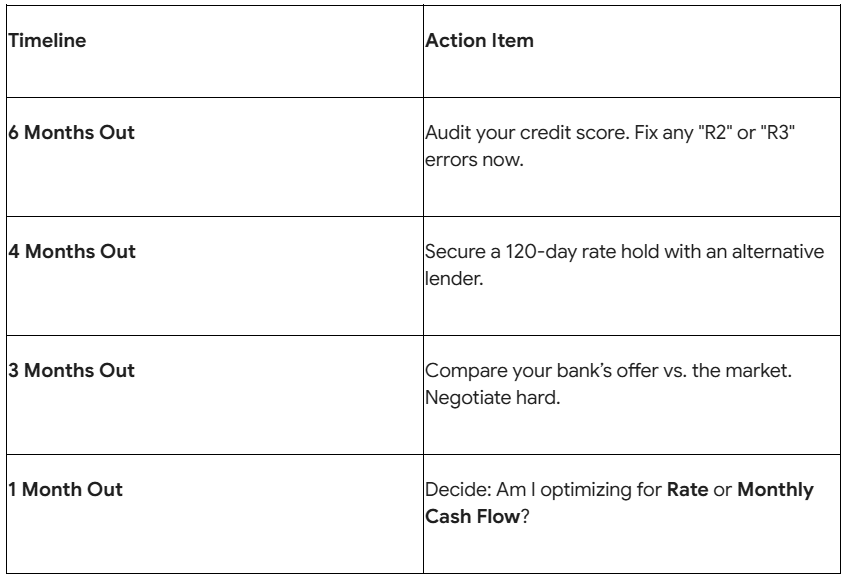
Your 2026 Renewal Checklist

Why Renew with LendingMoney.ca?

The big banks see renewal as an automated process. We see it as a financial reset. Whether you need to extend your amortization to save your budget or consolidate debt to save your credit, we are the alternative lending partnership to make it happen.

Is your renewal notice arriving soon? [Upload Your Renewal Offer] to LendingMoney.ca and let our Financial Heroes find you a better deal.